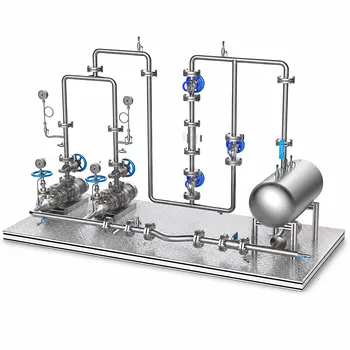
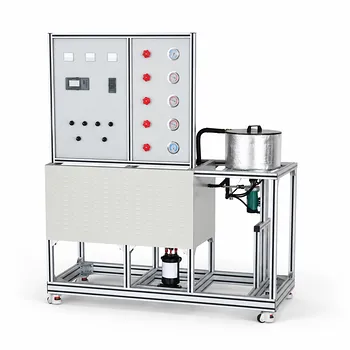
Choose sieve trays when the training objective is visible, stage-wise distillation behavior; choose ceramic packing when low pressure drop, thermal resistance, or chemical durability is more important. Stainless steel sieve trays typically provide discrete vapor–liquid contacting stages, making tray efficiency, weeping, and flooding easy to observe and measure. Ceramic packing provides continuous contacting through a packed bed, making it more suitable for studying pressure drop, liquid distribution, and packed-column separation performance.
For a chemical engineering training unit, the decision is not simply about which internals separate better. Sieve trays maximize instructional visibility and hydraulic experimentation, while ceramic packing better demonstrates low-pressure-drop operation, continuous mass transfer, and operation with aggressive or high-temperature fluids.
Start with the Training Objective
Use sieve trays to teach stage-wise mass transfer
A sieve tray column divides the separation into identifiable contacting stages. This allows trainees to relate operating data to theoretical stages, tray efficiency, reflux ratio, and feed-stage location.
The physical behavior is also comparatively easy to observe. Students can connect changes in vapor and liquid flow to tray loading, entrainment, weeping, and flooding.
Use ceramic packing to teach continuous contacting
Ceramic packing does not create discrete equilibrium stages in the same way as trays. Instead, vapor and liquid contact continuously across the packed height.
This makes a packed column useful for demonstrating pressure-drop analysis, liquid distribution, wetting, holdup, and height-based separation metrics, such as HETP or equivalent packed-bed performance measures.
Match the equipment to the laboratory curriculum
If the course emphasizes tray hydraulics and graphical stage calculations, sieve trays are usually the stronger primary choice. If it emphasizes general mass transfer, pressure drop, materials of construction, or packed-column design, ceramic packing adds important practical coverage.
The most complete training arrangement includes both configurations, either in separate columns or through interchangeable internals.
Compare the Main Design Criteria
Pressure drop
Sieve trays introduce pressure drop at every tray. The total pressure drop therefore increases with the number of trays and the operating condition of each tray.
Ceramic packing generally offers low pressure drop, particularly when the bed is properly sized and operated within its liquid and vapor loading limits. This makes it attractive for vacuum operation or processes where reboiler and condenser energy consumption must be minimized.
Pressure drop should still be measured rather than assumed. Poor liquid distribution, excessive loading, flooding, or unsuitable packing geometry can significantly increase the pressure drop of a packed bed.
Separation efficiency
Sieve trays provide a direct stage-by-stage framework for evaluating efficiency. Trainees can compare actual tray performance with ideal-stage calculations and investigate how operating conditions affect efficiency.
Ceramic packing performance depends on effective wetting, interfacial area, liquid distribution, and the height of the packed bed. It is better evaluated using height-based measures than by simply counting visible stages.
Neither internal type is universally more efficient. The result depends on vapor and liquid rates, physical properties, reflux ratio, column geometry, and the quality of the design.
Hydraulic operating range
Sieve trays have recognizable hydraulic limits. At low vapor rates, liquid can pass through the holes instead of remaining on the tray, producing weeping. At high vapor or liquid rates, entrainment and flooding can occur.
These limits are valuable teaching features because students can observe the transition from stable operation to hydraulic failure.
Packed columns have different limitations. They are sensitive to liquid maldistribution, channeling, excessive liquid holdup, loading, and flooding through the bed. These phenomena are less naturally represented as discrete stages but are highly relevant to practical column design.
Materials and chemical compatibility
Stainless steel sieve trays are suitable for many conventional laboratory mixtures and provide a robust, reusable internal structure. Their chemical compatibility must nevertheless be checked against the specific feed, products, temperature, and pressure.
Ceramic packing is particularly useful where the process involves aggressive fluids, high temperatures, or corrosion concerns. The ceramic material can tolerate conditions that may be unsuitable for some metals, but the packing must still be matched to the chemicals and mechanical requirements.
Material selection also includes seals, supports, distributors, column walls, sampling points, and ancillary equipment—not only the primary internal.
Thermal operation
Ceramic packing is attractive in applications requiring high thermal resistance. This can be relevant when a training unit is intended to represent harsh chemical-processing conditions rather than only benign laboratory separations.
Stainless steel trays offer a practical and durable solution for ordinary pilot-scale distillation. They are often easier to inspect, clean, remove, and replace during repeated student use.
Visibility and access
Sieve trays make the contacting mechanism conceptually and experimentally visible. With suitable transparent sections, sight glasses, or sampling arrangements, students can relate liquid depth and vapor bubbling to the calculated operating regime.
A packed bed is less visually transparent because the active contacting occurs throughout the packing. It therefore requires stronger instrumentation and indirect interpretation through temperature profiles, composition measurements, and pressure-drop data.
For education, this difference is significant: trays show the mechanism more directly, while packing teaches students to infer performance from distributed behavior.
Design the Training Unit Around Measurable Variables
Select the number and arrangement of trays
The tray count should reflect the separation and the intended experiment range. The primary reference identifies sieve-tray training towers configured with approximately 14 to 56 trays and operating pressures from 0.6 to 3 bar.
Tray spacing, column diameter, hole arrangement, weir height, and tray geometry must be selected together. These variables determine liquid residence, vapor–liquid contact, capacity, pressure drop, and flooding margin.
Size the packed bed and its distribution system
Ceramic packing performance depends heavily on the packed height and on how evenly liquid enters and redistributes through the bed. A poorly designed distributor can make the packing appear inefficient even when the packing material itself is suitable.
The training unit should therefore provide access to packed-bed pressure-drop measurements and, where practical, liquid-distribution observation or sampling.
Instrument both configurations consistently
A fair comparison requires comparable measurements for both internals. Useful measurements include:
- Column pressure drop
- Tray or bed temperature profile
- Feed, distillate, and bottoms compositions
- Reflux and boil-up rates
- Vapor and liquid flow rates
- Flooding or loading behavior
- Energy duties at the reboiler and condenser
Using the same feed system, analytical method, and operating procedure helps trainees distinguish the effect of the internals from unrelated equipment differences.
Include realistic control and sampling features
Training units should allow students to vary reflux, feed rate, pressure, and reboiler duty within safe limits. Sampling points should support composition measurements at relevant locations.
For trays, access to tray-by-tray or selected-stage data is particularly valuable. For packing, temperature and composition profiles across the bed help students understand that separation develops continuously rather than at discrete plates.
Understanding the Trade-offs
Sieve trays are more educationally visible but less forgiving
Sieve trays are simple, comparatively cost-effective, and well suited to teaching basic mass transfer and hydraulic limits. Their main educational advantage is that the relationship between tray condition and operating behavior is easy to explain.
Their limitation is a narrower operating range than some more complex tray types. At unsuitable vapor or liquid rates, weeping, entrainment, or flooding can quickly affect performance.
Ceramic packing reduces pressure drop but increases design dependence
Ceramic packing can provide low pressure drop and strong resistance to aggressive or high-temperature service. It is therefore valuable for demonstrating why packed columns are selected in demanding applications.
However, packed-column performance depends strongly on distributor quality, packing arrangement, wetting, and bed condition. A training unit may need more careful setup and interpretation than a sieve-tray column.
Trays simplify stage calculations; packing complicates interpretation
Tray columns naturally support stage-by-stage calculations and direct comparison with ideal equilibrium stages. This makes them effective for introductory and intermediate laboratory exercises.
Packed columns require students to connect measured concentration changes to packed height and mass-transfer performance. That is more representative of continuous contacting but can be less intuitive without careful instruction.
Interchangeable internals increase value but add complexity
A column designed to accept both sieve trays and ceramic packing can provide an unusually strong comparative learning experience. Students can examine how the same separation changes when the internal geometry changes.
The additional flexibility increases fabrication, sealing, cleaning, and maintenance requirements. Interchangeability is worthwhile only if the laboratory has the staff, instrumentation, and curriculum needed to use it.
Avoid transferring specialized data without checking scale
Cryogenic tray designs, for example, can use very small holes, low weirs, and compact tray spacing to minimize pressure drop. Those dimensions should not be adopted automatically for a conventional ambient-temperature training column.
Internal geometry must be selected for the intended fluid properties, pressure, temperature, scale, and safety requirements.
Making the Right Choice for Your Goal
The appropriate choice depends on what students must be able to observe, calculate, and compare.
- If your primary focus is stage-wise mass transfer: Select stainless steel sieve trays so trainees can study tray efficiency, reflux effects, weeping, and flooding directly.
- If your primary focus is low pressure drop: Select ceramic packing and instrument the column carefully for pressure-drop and loading measurements.
- If your primary focus is chemical or thermal resistance: Favor ceramic packing after verifying compatibility with the complete process, including supports and seals.
- If your primary focus is broad engineering education: Provide both configurations, preferably with interchangeable or parallel columns and common analytical instrumentation.
- If your primary focus is simple operation and maintenance: Sieve trays are generally easier to inspect and relate to individual stages, while packed beds require closer attention to distribution and cleaning.
- If your primary focus is realistic process comparison: Use both internals under comparable operating conditions and compare separation, pressure drop, energy duty, and hydraulic limits.
The strongest training unit does not treat trays and packing as competing technologies; it uses their differences to teach how column internals shape separation performance, hydraulics, and process design.
Summary Table:
| Design criterion | Sieve trays | Ceramic packing |
|---|---|---|
| Training focus | Stage-wise mass transfer, tray efficiency, weeping, and flooding | Continuous mass transfer, wetting, liquid distribution, and HETP |
| Pressure drop | Higher due to pressure drop across each tray | Generally lower when properly sized and distributed |
| Performance evaluation | Theoretical and actual stages, tray efficiency, reflux effects | Packed height, HETP, pressure drop, and concentration profiles |
| Hydraulic behavior | Visible weeping, entrainment, and flooding limits | Loading, channeling, maldistribution, holdup, and flooding |
| Chemical and thermal service | Durable stainless steel for many conventional mixtures | Strong resistance to aggressive fluids and high temperatures |
| Inspection and maintenance | Easier to inspect, clean, and replace | Requires careful distributor design, setup, and cleaning |
| Best choice | Courses emphasizing tray hydraulics and stage calculations | Courses emphasizing low pressure drop, materials, and packed-column design |
| Broadest learning value | Combine with packing in interchangeable or parallel configurations | Combine with trays for direct process comparison |
Build a More Effective Distillation Training Program
Equip your students, researchers, and process teams with practical experience in stage-wise and continuous mass transfer. Contact LABPARK to discuss a customized educational or vocational unit operations pilot plant.
LABPARK provides distillation training units with stainless steel sieve trays, ceramic packing, configurable internals, process instrumentation, control systems, sampling points, and analytical measurement capabilities. Our solutions help universities, research institutes, and enterprises compare tray efficiency, reflux effects, pressure drop, flooding, liquid distribution, energy duty, and separation performance under realistic operating conditions.
Tell us your target curriculum, feed system, operating range, and required measurements. LABPARK can help select the appropriate internals or design a comparative platform that supports safer instruction, stronger experimentation, and more relevant chemical engineering training.
Related Products
- Multi-Modal Distillation Unit Operations Training Pilot Plant
- Green Anhydrous Ethanol Purification Extractive Distillation Unit Operations Training Pilot Plant
- Multi-Functional Special Distillation Educational Pilot Plant
- Dual-Mode Rectification Pilot Plant for Practical Training Unit Operations
- Electrolyte Distillation Purification and Formulation Educational Pilot Plant
People Also Ask
- How can energy balance equations for condensers & reboilers be validated experimentally? Guide
- How do distillation pilot plants validate VLE data? Achieve reliable solvent separation scale-up.
- Why is the column performance diagram critical? Optimize distillation pilot plant safety & efficiency.
- How can real-time carbon number prediction improve distillation pilot plants? Optimize control.
- Why is condensate subcooling critical in pilot plants? Expert Design & Control Guide