Charge conversion, not just affinity, is the secret. In water treatment and chemical separation labs, the cation exchange column doesn’t pull chromium out by raw ionic strength—it lets chromium run straight through. By oxidizing Cr³⁺ to the anionic chromate (CrO₄²⁻) before the sample hits the resin, you flip the metal’s charge. The resin then ignores the chromate, which flows cleanly into the effluent, while the remaining metal cations—like Al³⁺, Ni²⁺, and Zn²⁺—are electrostatically bound to the column. This single charge‑swap trick turns an ordinary cation exchanger into a precision sieve for chromium.
Cation exchange resins do bind ions according to a predictable affinity series, but for a metal like chromium, relying on that series alone is often ineffective. The real leverage comes from exploiting the resin’s charge selectivity: oxidize Cr³⁺ to an anion, and the column becomes a flawless gate—releasing pure chromium while trapping every other interfering cation.
Why Simple Affinity Sorting Falls Short for Chromium
The Affinity Ladder
Cation exchange resins carry immobilized negative sites (typically sulfonic acid groups) that attract cations. The strength of attraction follows a general rule: higher charge and smaller hydrated radius mean tighter binding.
In practice, the sequence might look like Th⁴⁺ > Cr³⁺ > Ni²⁺ > Na⁺. Trivalent ions such as Cr³⁺ and Al³⁺ cluster near the top of that ladder, but they sit side‑by‑side.
The Chromium Trap
When chromium exists as Cr³⁺, its affinity overlaps heavily with other trivalent cations. Separating Cr³⁺ from Al³⁺ or Fe³⁺ by affinity alone requires extremely fine‑tuned conditions—pH, eluent concentration, and resin cross‑linking—that are rarely robust in a teaching or industrial lab.
The affinity series is useful for binary separations of widely different ions, but it fails when chemistry places your target metal in a packed crowd.
The Anionic Escape: Oxidize to Separate
Turning Chromium into an Anion
The clean breakthrough comes from a simple redox step. In alkaline or mildly acidic solution with an oxidant (such as hydrogen peroxide or persulfate), Cr³⁺ is converted to chromate (CrO₄²⁻) or, under acidic conditions, to dichromate (Cr₂O₇²⁻).
Both species carry a negative charge. The moment this conversion is complete, the chromium no longer “looks” like a cation to the resin.
Flowing Through the Cation Exchange Column
Pass the oxidized mixture through a column packed with strong‑acid cation exchange resin in the H⁺ form. Every metal cation—Al³⁺, Ni²⁺, Zn²⁺, even any unreacted Cr³⁺—is pulled onto the sulfonic acid sites and held.
The chromate anion, carrying the same negative charge as the fixed resin groups, experiences electrostatic repulsion. It slips through the column, appearing in the effluent virtually uncontaminated.
Collecting and Verifying the Chromium
The effluent now contains only chromate and any other anions originally present (like phosphate). You can directly titrate the chromate, reduce it back to Cr³⁺ for spectrophotometric analysis, or proceed to further anion‑exchange separations.
Because the other metals remain trapped on the column, the chromium fraction is already isolated—no additional precipitation or distillation is needed.
Recovering the Captured Cations (and Why It Matters)
Elution with Acid
Once the chromate has been collected, the column still holds a suite of valuable cations. Flushing with hydrochloric acid (HCl) displaces the bound metals by overwhelming the resin with H⁺ ions.
The eluate drips out carrying Al³⁺, Ni²⁺, Zn²⁺, and any other cations in a concentrated, chloride‑based solution—ready for further separation or quantification.
Sequential Precipitation and Further Analysis
With the metals now in free‑solution form, you can exploit classical wet‑chemistry steps. For example, adding succinic acid and urea allows controlled precipitation of aluminum as a basic succinate, leaving nickel and zinc behind.
This layered approach—charge‑based bulk separation first, then selective precipitation—turns a complex mixture into a series of manageable, high‑purity fractions.
Understanding the Trade-offs
Oxidation Must Be Complete
Any residual Cr³⁺ left in the sample will bind to the resin, contaminating the effluent and skewing mass balance. The oxidation step requires careful pH and oxidant control to push the reaction fully to chromate.
Resin Capacity Limits
Cation exchange resins have a fixed number of exchange sites. If the total cation load exceeds this capacity, breakthrough occurs—unbound cations start leaking into the effluent alongside the chromate. Always size the column to handle the expected metal load plus a safety margin.
pH and Redox Sensitivity
Chromate stability is pH‑dependent; in highly acidic media it exists as dichromate, which remains anionic but can oxidize the resin itself if the matrix is not robust.
Some strong‑acid resins slowly reduce Cr(VI) back to Cr(III) over time, so the separation should be performed without prolonged contact.
Not a Universal Method
This strategy works beautifully for chromium because it forms a stable, soluble anion. For metals that do not easily switch charge—like nickel or aluminum—you must fall back on gradient elution, complexing agents, or entirely different stationary phases. The chromium shortcut is a chemistry‑specific trick, not a general‑purpose protocol.
Making the Right Choice for Your Separation Goal
- If your primary focus is isolating chromium from a multi‑metal mixture: Prioritize the oxidation step. Convert Cr³⁺ to chromate, pass through a cation column, and collect the pure effluent.
- If your primary focus is understanding ion‑exchange affinity: Start with a known series—Th⁴⁺ > Cr³⁺ > Ni²⁺ > Na⁺—and perform gradient elutions. Use chromium’s oxidation only to demonstrate that charge, not just hydration energy, governs retention.
- If your primary focus is recovering all metals for further analysis: Run the column with untreated Cr³⁺ first, elute all cations, then separate them with a secondary technique like precipitation or solvent extraction.
A cation exchange column is a simple, powerful gate—but it is the operator’s chemical creativity that decides which species walks through it.
Summary Table:
| Process Step | Chemical State | Resin Interaction | Separation Outcome |
|---|---|---|---|
| 1. Oxidation | Cr³⁺ converted to CrO₄²⁻ (anion) | Repelled by negative sites | Flows into effluent (isolated) |
| 2. Cation Capture | Other metals (Al³⁺, Ni²⁺, Zn²⁺) | Electrostatically bound | Trapped on column |
| 3. Acid Elution | Trapped cations displaced by H⁺ | Flushed out using HCl | Recovered in concentrated form |
Bring Hands-On Separation Technology to Your Lab
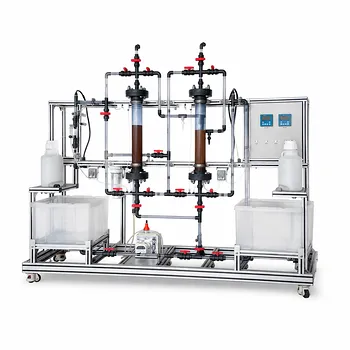
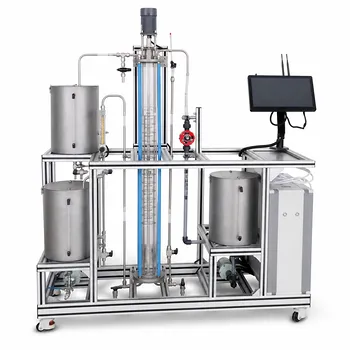
Teaching advanced separation concepts like ion exchange and charge selectivity requires robust, reliable equipment. LABPARK provides state-of-the-art Educational and Vocational Unit Operations Pilot Plants in chemical engineering, bioprocess & biotech, and environmental & water treatment. Designed specifically for universities, research institutes, and enterprises, our pilot plants bridge the gap between theoretical chemistry and practical industrial application.
Ready to upgrade your laboratory training systems or research capabilities? Contact LABPARK today to discover how our tailored pilot plant solutions can benefit your institution.
Related Products
- Ion Exchange Water Purification Educational Pilot Plant for Engineering Unit Operations
- Educational Rotary Disc Liquid-Liquid Extraction Pilot Plant
People Also Ask
- How to Prevent Ion Exchange Channeling? Expert Solutions for Pilot Plants
- What operational precautions should lab operators take for resin volume changes and air pockets? Key Guide
- How does ion exchange work in water treatment pilot plants? Cost & process guide.
- How to use ion exchange pilot plants to verify alkalinity? A hands-on guide for engineering students.
- Why does iron degrade cation resin & how to demonstrate capacity recovery? Step-by-Step Lab Guide