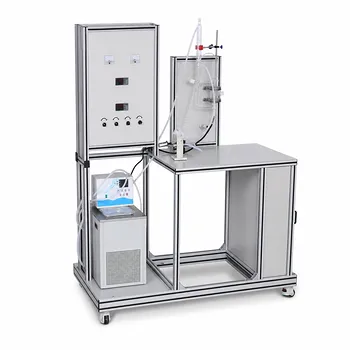
The correct startup procedure for a mass spectrometer’s vacuum system begins with the roughing pump. You must first turn on the diaphragm (roughing) pump and monitor the pressure. Only when that initial vacuum has pulled the pressure below 0.3 kPa can you safely engage the high-vacuum molecular (turbo) pump, which then takes the system down to its operating pressure below 10⁻⁶ Pa.
A mass spectrometer’s high-vacuum pump is not designed to operate at atmospheric pressure. Attempting to start it without a proper rough vacuum staggers the pump with an impossible gas load, risking destructive mechanical failure. The staged startup sequence—roughing first, then high-vacuum—is therefore not a suggestion, but a hard physical requirement that protects expensive equipment.
Why the Staged Startup Exists
The procedure is a direct reflection of how vacuum pumps are engineered. A single misstep can destroy a pump in seconds, making this sequence one of the most critical lessons in laboratory training.
The Fundamental Problem: Pumping at the Wrong Pressure
A molecular pump, such as a turbomolecular pump, works by using high-speed rotating blades to impart momentum to gas molecules and force them out of the chamber. This mechanism only functions effectively at low pressures where the mean free path is long enough. At atmospheric pressure, the gas density is far too high, creating massive aerodynamic drag and frictional heating. The motor can stall or the blades can physically collide with the housing, leading to catastrophic failure.
The Role of the Roughing Pump
The diaphragm pump, or roughing pump, is a positive-displacement pump designed to exhaust to atmosphere. It efficiently removes the bulk of the gas from the system, taking the pressure from atmospheric down to a moderate vacuum. Waiting for the pressure to fall below the critical threshold—specified here as 0.3 kPa—ensures that the molecular pump will only encounter a gas load it can handle safely.
The Gateway Pressure: 0.3 kPa
This value is not arbitrary. For many turbomolecular pumps, the maximum allowable backing or foreline pressure is several hundred Pascals. Below 0.3 kPa (300 Pa), the gas density is low enough for the pump’s rotor to spin up without risk of thermal or mechanical overload. Teaching students this specific number builds a disciplined, quantitative safety habit.
The Full Startup Sequence: A Step-by-Step Safety Protocol
In a teaching laboratory, the procedure extends beyond just the pumps. Protecting the analyzer and detector components demands an equally precise sequence of powering up electronics.
Step 1: Initiate the Roughing Pump
Turn on the diaphragm pump first. This is the only pump in the system designed to start against atmosphere. You must verify that the vacuum gauge on the foreline begins to drop.
Step 2: Wait for the Critical Threshold
Confirm the pressure falls below 0.3 kPa. This is the gate that unlocks the next stage. Operating without a gauge, or ignoring this number, is a major error. During this wait, the roughing pump is establishing the essential "backing" or "foreline" vacuum that the molecular pump will exhaust into.
Step 3: Start the High-Vacuum Pump
With the pressure below 0.3 kPa, you can safely activate the turbomolecular pump. The rotor will now accelerate cleanly, and the system pressure will plummet toward high-vacuum levels. Listen for a smooth, rising pitch as the pump spins up—unusual grinding or abrupt silence are immediate red flags.
Step 4: Enable the Sensitive Components Last
Only after the high-vacuum gauge reads below 10⁻⁶ Pa should you power the ion source, detector electronics, and any pulse power supplies. Firing filaments, applying high voltages, or activating detectors at poor vacuum risks instant burn-out, arcing, and severe contamination of the analyzer.
Understanding the Trade-offs and Common Pitfalls
While the procedure is unambiguous, it exposes a tension between speed and safety that students must learn to navigate.
The Urge to Bypass the Sequence
Students often want to rush the startup. They might start the high-vacuum pump immediately or power the source early, assuming the system will “catch up.” This is a critical mistake. The staged procedure feels slow but is the fastest path to safe operation because it avoids the days or weeks of downtime required to replace a wrecked pump.
A False Sense of Security with Automation
Many modern systems have interlocks that prevent these mistakes. However, teaching the manual procedure is essential to building a deep mental model of the machine. If a sensor fails or an interlock is bypassed for maintenance, only the operator’s understanding stands between normal operation and a five-figure repair bill.
The Shutdown Sequence: The Mirror Image
The importance of the startup sequence is reinforced by the shutdown protocol, which is its exact reverse. Power off the detector and ion source first, then stop the molecular pump and wait for its rotor to coast to a complete stop, and only then close off the roughing pump. This prevents backdiffusion of pump oil or air into the high-vacuum chamber and protects the analyzer from thermal shock or pressure spikes.
Making the Right Choice for Your Training Goal
The startup procedure is a teaching tool as much as an operational step. How you present it depends on your learning objectives.
- If your primary focus is building safe operational habits: Drill the exact numerical threshold (0.3 kPa) and the physical consequence of pump overload until it becomes automatic.
- If your primary focus is teaching why systems are designed this way: Use the sequence to explain the principles of mean free path, molecular flow, and the mechanical limits of turbomolecular pumps.
- If your primary focus is industrial pilot-plant readiness: Integrate the full startup and shutdown sequence, emphasizing the detector and source protection steps as part of a standard operating procedure for process-scale instruments.
Mastery of the startup sequence is more than a checklist—it is the first indicator that a student understands the instrument as a physical system, not a black box, and it is the foundational habit that ensures both personal safety and equipment longevity.
Summary Table:
| Step | Component / Action | Pressure Threshold | Purpose & Critical Safety Note |
|---|---|---|---|
| 1 | Initiate Roughing Pump | Starts at atmospheric pressure | Removes bulk gas; establishes backing vacuum. |
| 2 | Monitor Pressure Gate | Wait until < 0.3 kPa (300 Pa) | Critical threshold to safely engage high-vacuum pump. |
| 3 | Start High-Vacuum Pump | System falls to < 10⁻⁶ Pa | Turbomolecular pump safe spin-up without overload. |
| 4 | Power Sensitive Components | High vacuum verified | Activating filaments/detectors without arcing. |
Enhance Your Practical Training with LABPARK
Mastering correct laboratory procedures starts with hands-on experience on reliable, industry-grade equipment. LABPARK provides specialized Educational and Vocational Unit Operations Pilot Plants in chemical engineering, bioprocess & biotech, and environmental & water treatment designed specifically for universities, research institutes, and enterprises.
Equip your students and researchers with the tools they need to build safe, practical habits. Contact LABPARK today to discover our custom laboratory training solutions!
Related Products
- Binary System Vapor Liquid Equilibrium Data Determination Educational Unit Operations Pilot Plant
- Pressure Swing Adsorption Educational Unit Operations Pilot Plant
People Also Ask
- How can pilot plants assist in validating VLE models? Bridge theory and physical reality.
- Why Collect Isothermal vs. Isobaric VLE Data? Key Pilot Unit Advantages
- How Do Equations of State Predict VLE in Pilot Plants? Optimize Your Separation Design
- How do intermolecular forces and molecular kinetic energy govern gas liquefaction and vaporization? Explore VLE pilot plants
- For VLE Experiments: Fugacity vs. Activity Coefficient Method Selection Criteria