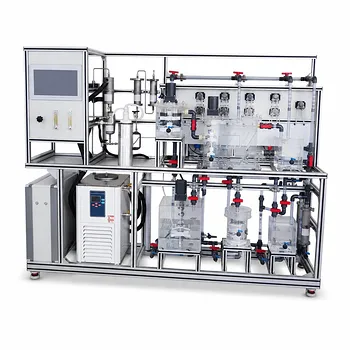
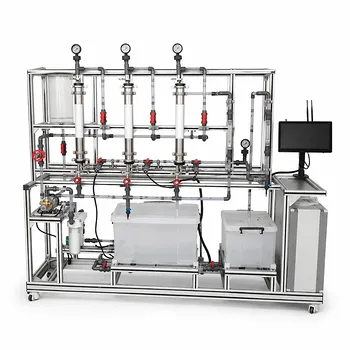
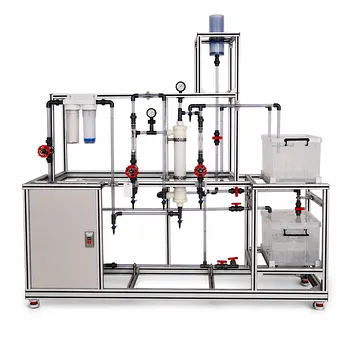
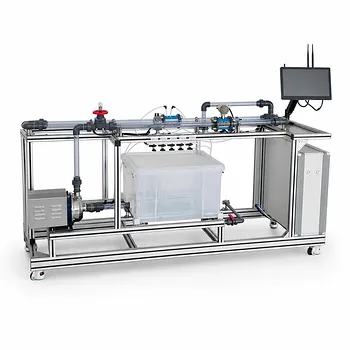
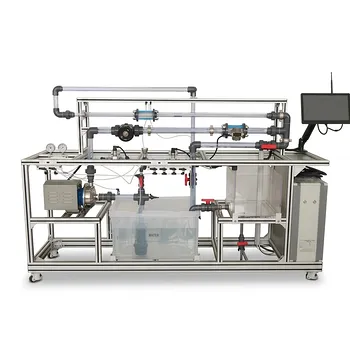
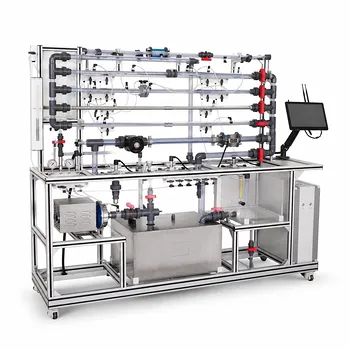
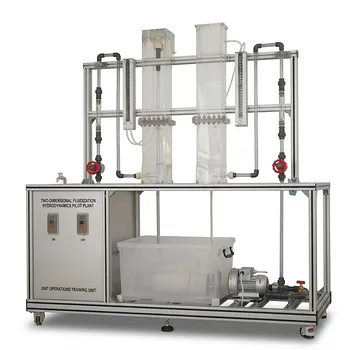
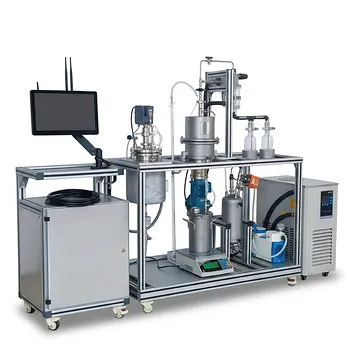
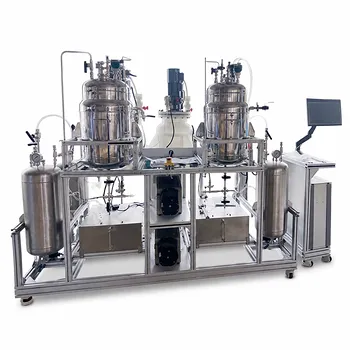
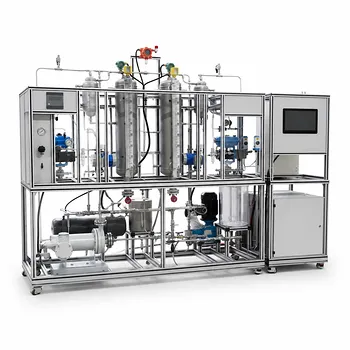
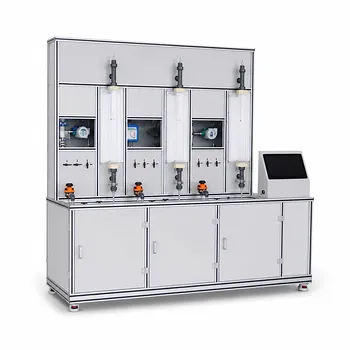
Pilot plants are the essential proving ground for treating shale gas fracturing flowback water. These scaled-down, field-deployable systems integrate multiple unit operations—coagulation-flocculation, membrane filtration, and advanced oxidation—to test and refine purification methods. By operating under real-world conditions with actual flowback fluid, they generate the performance data needed to transform hazardous wastewater into a reusable resource.
The central challenge of flowback water is its extreme and variable composition. Pilot plants solve this by allowing researchers to stress-test treatment trains in combination, not isolation. This is how we answer the crucial question: “Will this work at full scale, reliably and safely?”
Why Flowback Water Demands a Pilot-Scale Approach
Flowback water is not just dirty water. It’s a complex, high-strength industrial effluent. The environmental risk comes from its cocktail of dissolved salts, heavy metals, proprietary chemical additives, and naturally occurring radioactive materials (NORM).
The Limits of Lab-Scale Testing
Laboratory beakers cannot replicate the fouling dynamics or chemical interactions that occur inside a membrane module or a flocculation tank. Lab tests often miss the synergistic effects that can defeat a treatment stage. Pilot plants bridge this gap by processing thousands of liters of actual field water, exposing every inefficiency before capital is committed.
The Need for a Holistic Treatment Strategy
No single technology works. The high suspended solids will instantly blind a reverse osmosis membrane. The dissolved organics will foul an ultrafiltration membrane. This interdependency demands an integrated sequence. A pilot plant is the only way to optimize the orchestration of pre-treatment, separation, and polishing steps.
How Integrated Pilot Plants Unlock Solutions
A well-designed pilot plant acts as a configurable test bed. Researchers can swap components and adjust chemical doses while continuously monitoring water quality parameters.
Coagulation-Flocculation: Targeting Suspended Solids
This is the critical first defense. Pilot units allow precise tuning of coagulant type and dosing rate to destabilize fine colloidal particles and the polymeric friction reducers that create a stable sludge. Without this, downstream membranes fail immediately.
Membrane Filtration: Dissolved Contaminant Separation
Pilot testing ultrafiltration (UF) and reverse osmosis (RO) in series reveals the true, long-term decline in permeate flux. It answers practical questions: How often will we need chemical cleaning? Can we reliably achieve a brine stream concentrated enough for deep-well injection? This data is non-negotiable for economic modeling.
Advanced Oxidation: Mineralizing Recalcitrant Organics
After membranes concentrate the waste, advanced oxidation processes (like UV/H₂O₂) break down persistent organic compounds into CO₂ and water. Pilot-scale testing validates the energy consumption and reaction time needed to destroy specific biocides and scale inhibitors, transforming a toxic concentrate into a more manageable waste stream.
Process Integration and Sequencing
The true power of a pilot plant is testing the order of operations. What if oxidation is placed before RO to reduce organic fouling, but generates byproducts that damage the membrane? These trade-offs can only be discovered through an integrated, continuous-run trial that mirrors the pressure, temperature, and flow variations of a field operation.
Understanding the Trade-offs
Pilot plants illuminate reality, but they are not a silver bullet. Their value depends entirely on honest interpretation of their limitations.
The Cost of Truth
Operating a pilot plant for months in a remote field is expensive. The financial burden can tempt teams to shorten test periods, missing long-term fouling or seasonal water-quality variations.
The Non-Representative Sample Trap
A single campaign might not capture the dramatic shifts in flowback composition over a well’s lifetime—from early high-TDS production to later, diluted returns. A pilot study must be designed to account for this temporal variability, or it provides a false sense of security.
Scaling Up Is Not Linear
Achieving 90% recovery in a pilot unit does not guarantee the same at full scale. Hydraulic inefficiencies and dead zones in large tanks can skew results. Skilled engineering translation is mandatory.
Making the Right Choice for Your Goal
Your approach to pilot-scale research must align directly with your operational objective. The configuration of your pilot plant will dictate the relevance of your results.
After defining your target water quality, select a pilot strategy.
- If your primary focus is immediate environmental compliance: Deploy a simplified, robust pilot train prioritizing bulk contaminant removal. Your goal is to prove the fastest path to meeting discharge limits.
- If your primary focus is complete water recycling for arid regions: You must test a full, high-recovery RO-based pilot system to evaluate the maximum volume of reusable water against the cost of managing a minimal brine waste stream.
- If your primary focus is minimizing chemical consumption: Use a responsive, sensor-rich pilot plant to dynamically test alternative, greener coagulants and oxidants, tracking efficiency as flowback composition shifts.
- If your primary focus is long-term infrastructure design: Commit to an extended, multi-season pilot operation that captures the full lifecycle chemistry of the produced water, building an unassailable dataset for investors and regulators.
A pilot plant is not just a research tool; it is your primary risk-management instrument for turning a complex liability into a managed resource.
Summary Table:
| Treatment Stage | Core Technology | Key Pilot Function |
|---|---|---|
| Pre-treatment | Coagulation-Flocculation | Optimizes chemical dosing to remove suspended solids |
| Separation | Membrane Filtration (UF/RO) | Tests flux decline, fouling rates, and cleaning cycles |
| Polishing | Advanced Oxidation (e.g., UV/H₂O₂) | Evaluates energy needs to degrade recalcitrant organics |
Accelerate Your Environmental Research with LABPARK
Bridging the gap between laboratory research and industrial-scale wastewater treatment requires robust, reliable testing systems. LABPARK designs and manufactures high-performance Educational and Vocational Unit Operations Pilot Plants tailored for chemical engineering, bioprocess & biotech, and environmental & water treatment.
Whether you are a university developing cutting-edge filtration methods, a research institute testing advanced oxidation, or an enterprise scaling up flowback water treatment, our pilot plants deliver the precise data and real-world simulation you need.
Ready to optimize your wastewater treatment processes? Contact our expert team today to discuss your pilot plant requirements!
Related Products
- Thermal Desorption Exhaust Gas and Tail Water Treatment Educational Pilot Plant
- Multifunctional Membrane Separation Educational Pilot Plant with Ultrafiltration, Nanofiltration, Reverse Osmosis
- Multi-Functional Membrane Separation Educational Pilot Plant for Unit Operations Lab
- Natural Product Extraction Unit Operations Training Pilot Plant
- Continuous Batch Extractive Distillation Educational Pilot Plant
People Also Ask
- How do anodic & cathodic inhibitors protect heat exchangers? Optimize Your Water Treatment Pilot Plant
- What are inline fluorescence sensor risks, and how can they be managed? Key Strategies
- How is iron concentration monitored to evaluate corrosion and filtration efficiency in water treatment pilot plants?
- Lime-Soda vs. Cation Exchange Softening: How Do Effluent Characteristics Compare in Pilot Plants?
- How is P, M, and B alkalinity applied in pilot plants? Prevent Boiler Scaling & Corrosion