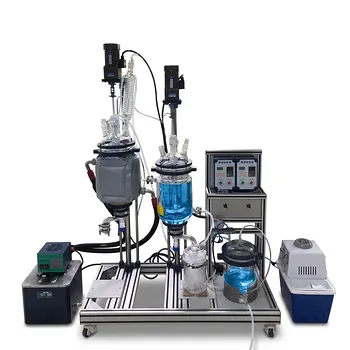
Atomic packing arrangements are the hidden scaffold that supports every crystallization analysis. In chemical engineering educational unit operations, the distinction between face-centered cubic (FCC) and hexagonal close-packed (HCP) structures helps students calculate theoretical crystal densities, forecast how solids will behave during filtration, and connect subtle shifts in cooling rates or evaporation profiles directly to the purity and morphology of the final product.
Core Takeaway: FCC and HCP share the same 74% packing efficiency and coordination number of 12—the theoretical maximum for spheres—making them the densest possible monatomic arrangements. This commonality means that from a packing perspective, their impact on crystal density and overall solid-liquid separation behavior is nearly identical. The real analytical value in a pilot plant lies in recognizing that identical efficiency can still yield distinct morphologies and growth habits, which in turn control downstream processability.
The Foundation: How Atomic Packing Defines Crystal Properties
Packing Efficiency and Theoretical Density
Both FCC and HCP fill 74% of available space, leaving only 26% void. For a pilot-plant crystallizer, this number becomes the first input for mass-balance calculations: it lets a student predict a crystal’s theoretical density from its unit cell, estimate the volume of solids in a known mass, and cross-check experimental yields against what is physically possible.
Coordination Number and Lattice Stability
Each atom touches 12 neighbors in both arrangements. This high coordination number signals a deep thermodynamic driving force toward close-packing during crystallization. When operating an educational pilot plant, this principle explains why many metallic and simple ionic compounds naturally adopt FCC or HCP lattices, and why rapidly cooled solutions that deviate from these structures often trap impurities or form less-stable polymorphs.
Density as a Diagnostic Tool
If a pilot-plant run yields a bulk crystal density significantly below the theoretical value calculated from FCC/HCP packing, it points to either occluded solvent, amorphous content, or agglomeration. These deviations become a live diagnostic: students use the theoretical density to quantify the “loss” in structural perfection and then trace it back to supersaturation, mixing intensity, or cooling rate.
Bridging Atomic Structure to Pilot Plant Operations
The Morphology Connection
FCC metals often form cubo-octahedral or cubic crystals; HCP metals frequently adopt hexagonal prisms. In chemical engineering unit operations labs, this link between atomic packing and macroscopic shape is the analytical bridge that connects lattice theory to filtration. Students learn that the underlying FCC structure of sodium chloride yields cubic crystals in pure water, but adding urea alters which faces grow fastest—producing octahedrons—without changing the fundamental FCC lattice.
Impact on Solid–Liquid Separation
Crystal shape dictates how particles pack in a filter cake. Flat, cubic FCC particles can stack with fewer void channels than irregular HCP hexagonal platelets, raising cake resistance. Educational pilot plants make this tangible: by varying the cooling profile to produce predominantly one morphology, students measure filtration pressure drop and calculate cake permeability, then directly correlate the change back to the atomic packing arrangement that seeded that shape.
Crystallization Mode and Packing Outcome
Cooling crystallization often yields denser, close-packed structures because gentle supersaturation allows atoms to arrange into FCC or HCP. Antisolvent or reactive crystallization can produce less-ordered aggregates if mixing is too rapid. The pilot plant becomes an analytical sandbox—students find that even when the thermodynamic preference is for a 74%-efficient packing, kinetic constraints can lock in a lower-packing polymorph, and the resulting filter cake behaves completely differently.
How Educational Pilot Plants Make the Invisible Visible
From Lab Curiosity to Quantitative Engineering
Laboratory glassware often produces crystals whose packing arrangement is masked by random morphology. Educational pilot plants, with their programmable temperature ramps, controlled agitation, and real-time particle-size monitoring, remove that ambiguity. Students can deliberately nucleate an FCC or HCP phase at a specific supersaturation, then watch how the chosen packing arrangement influences settling rates and filtration cycle times.
Analyzing Morphology Shifts as a Process Signature
When a pilot run produces octahedral NaCl instead of cubes, the analysis starts with atomic packing: both are FCC, so the lattice hasn’t changed. This tells the student the shift is purely kinetic—caused by selective adsorption of an additive on {111} faces. The lesson: atomic packing gives you the reference frame, and any deviation from expected external shape becomes a fingerprint of the growth environment, not a new crystal phase.
Supercooling and the Race to Close-Packing
Highly pure solutions often supercool below their saturation temperature without crystallizing, risking a sudden, uncontrolled burst of nucleation. When the system finally solidifies, it may form a disordered agglomerate rather than a well-packed FCC or HCP lattice. Cooling-curve analysis in a pilot plant reveals this danger, and students see that seeding at the right temperature is the key to allowing atoms to arrange into the desired 74%-efficient structure.
Understanding the Trade-offs and Pitfalls
Real Crystals Are Not Perfect Spheres
FCC and HCP packing efficiencies of 74% assume perfectly spherical atoms in a rigid lattice. Real organic molecules, long-chain polymers, or even small aromatics pack with much lower efficiencies, and the concept of “packing arrangement” becomes a simplified model. Students must learn to translate the sphere-packing principles into molecular crystal limits, recognizing that 74% is an ideal ceiling rarely reached outside of metallic systems.
Same Efficiency, Different Mechanical Behavior
Although FCC and HCP have identical packing efficiency, their stacking sequences (ABCABC for FCC, ABAB for HCP) give them different slip systems. In industrial crystallizers, this can mean that one packing arrangement produces crystals that fracture more easily during agitation, creating fines that blind a filter. Pilot-plant analysis must therefore pair structural identification with attrition testing, pushing beyond simple density predictions.
The Danger of Thermodynamic Over-Simplification
Using approximations that neglect heat-capacity differences between solid and liquid phases can systematically underestimate solubility, leading to earlier-than-expected precipitation. If a student relies on a simplified solubility model and then observes unexpected nucleation, they might incorrectly blame a “wrong” crystal packing arrangement, when in fact the thermodynamic baseline was flawed. The atomic packing analysis is only as strong as the solubility data feeding it.
Morphology Variability Masks Packing Identity
Because both FCC and HCP can yield multiple external crystal shapes depending on growth conditions, pilot-plant operators cannot deduce the packing arrangement from a microscope image alone. X‑ray diffraction or detailed melting‑point analysis is required. Mistaking a morphological change for a packing transformation leads to incorrect filtration predictions—a common pitfall when theory is applied without this crucial verification step.
Making the Right Choice for Your Educational Goal
- If your primary focus is understanding crystallization fundamentals: Use FCC and HCP as reference frameworks to teach how supersaturation and cooling rate drive atoms toward maximum packing density, and to calculate theoretical yields and densities against which real experiments are judged.
- If your primary focus is optimizing solid-liquid separation: Emphasize that while FCC and HCP have the same packing efficiency, the resulting crystal morphology dictates filter cake resistance. Vary growth conditions to produce different shapes and quantify the direct impact on filtration cycle time.
- If your primary focus is scale-up and process robustness: Highlight that achieving 74%-efficient packing is not enough. You must also characterize polymorphism, monitor supercooling tendencies, and use density deviations as early warning indicators of amorphous content or solvent inclusion that will break a downstream process.
- If your primary focus is bridging theory and industrial reality: Design pilot-plant exercises that deliberately introduce an additive (like urea for NaCl) to change morphology without altering the underlying FCC lattice. This teaches students that atomic packing sets the blueprint, but process chemistry paints the final picture.
Each of these goals converges on one truth: atomic packing arrangements are the invariant grammar by which a crystallizing solution writes its process story, and the educational pilot plant is the best interpreter we have.
Summary Table:
| Parameter | Face-Centered Cubic (FCC) | Hexagonal Close-Packed (HCP) | Pilot Plant Impact |
|---|---|---|---|
| Packing Efficiency | 74% (ABCABC stacking) | 74% (ABAB stacking) | Sets theoretical crystal density limits |
| Coordination Number | 12 | 12 | Indicator of thermodynamic stability |
| Typical Morphology | Cubo-octahedral / Cubic | Hexagonal prisms / Platelets | Dictates cake resistance & filtration speed |
| Slip Systems | Multiple (Ductile) | Limited (Brittle) | Affects crystal attrition during agitation |
Bring Molecular Theory to Life in Your Lab
Bridge the gap between atomic crystal structures and pilot-scale process engineering. LABPARK provides state-of-the-art Educational and Vocational Unit Operations Pilot Plants in chemical engineering, bioprocess & biotech, and environmental & water treatment for universities, research institutes, and enterprises. Our systems empower students and researchers to analyze crystallization, filtration, and thermodynamics in real-time.
Ready to elevate your engineering curriculum? Contact LABPARK today to request a custom consultation.
Related Products
- Multi Functional Membrane Crystallization Educational Unit Operations Pilot Plant
- Potassium Salt Thermal Dissolution and Crystallization Separation Educational Unit Operations Pilot Plant
- Multi-Functional Special Distillation Educational Pilot Plant
- Ethyl Acetate Synthesis Unit Operations Pilot Plant for Practical Training
- Multi-Modal Distillation Unit Operations Training Pilot Plant
People Also Ask
- Control Crystallization Pilot Plant Secondary Nucleation: 4 Key Adjustments
- Why is precise temperature control critical in crystallization pilot plants? Key to Scale-Up Success
- What key factors should be considered when configuring a crystallization unit operations pilot plant?
- How Crystal vs Amorphous Solids Guide Crystallization Pilot Plant Objectives
- What are the benefits of integrating online PAT tools like ATR-FTIR into crystallization unit operations pilot plants?