Dynamic modeling isn't a luxury—it’s the only safeguard against operational chaos. In pyrometallurgical unit operations, especially blast furnaces, adjusting a process variable like the oxygen enrichment level triggers a cascade of delayed, interconnected reactions. Without a dynamic model that simulates these time-dependent behaviors, an operator is essentially flying blind, reacting to yesterday's data and setting off a destructive cycle of overcorrection and thermal instability.
The core problem is process inertia. A change in oxygen input can take 20 minutes or more to fully manifest in furnace conditions. Dynamic modeling teaches operators to anticipate this lag, predict the true impact of their adjustments, and maintain a stable, efficient operation instead of chasing fluctuations.
The Hidden Danger of the Time Lag
Changes in a blast furnace never happen in an instant. The massive thermal mass, the countercurrent flow of gases and solids, and the complex chemical kinetics all conspire to delay the system’s response. This delay is what makes manual control so treacherous.
Why the System Doesn’t Respond Immediately
When you increase oxygen enrichment, you’re not just adding more oxidant. You’re altering the raceway flame temperature, the reduction rates of iron oxides, and the heat distribution along the entire shaft. These effects propagate at different speeds, creating a window where the furnace appears to ignore your input.
The primary reference highlights a critical fact: the system can take approximately 20 minutes or more to stabilize. During that period, a pressure or temperature reading might look wrong, tempting the operator to make further adjustments.
The Overcompensation Trap
Without a dynamic predictive model, an operator sees an undesired reading, acts, sees no immediate change, and acts again. The furnace then receives a series of compounded commands, overshooting the target. The operator then corrects in the opposite direction, again too aggressively.
This is the oscillation pitfall. The furnace’s thermal and chemical conditions don’t settle into a steady state—they pendulum between extremes. Hot metal quality suffers, fuel efficiency plummets, and the refractory lining endures unnecessary thermal shock. Dynamic modeling breaks this loop by showing the future outcome of a single, measured adjustment.
How Dynamic Models Teach Process Control
In a training environment, the goal isn’t just to run a furnace but to build an instinct for its inertia. Incorporating thermochemical models into educational pilot plants transforms a reactive student into a predictive operator.
Predicting the Full Chain Reaction
A dynamic model doesn’t just recalculate the final chemistry. It simulates the transient path: how the change in oxygen content first affects the combustion zone, then shifts the temperature profile, which in turn modifies gas composition, reduction kinetics, and eventually the burden descent and hot metal temperature.
This allows a trainee to vary fuel content, feed composition, and air flow in a risk-free setting and watch the entire timeline of the furnace’s response. The model teaches that patience is a control strategy—the best action is often a single, calculated input followed by a disciplined waiting period.
Bridging Theory and Real-Time Reaction
Thermochemical textbooks provide equilibrium constants and energy balances. They do not convey the feeling of a furnace that is 20 minutes away from revealing the full consequences of your last decision. Dynamic models bridge that gap. They give life to the time constants and dead times that define safe operating windows.
Engineers learn to ask not “What is the temperature now?” but “What is the temperature forecast in 30 minutes, given my current inputs?” That shift in mindset is what prevents the oscillation described in the primary reference.
Understanding the Trade-offs of Dynamic Modeling
While essential, relying on dynamic models comes with its own set of challenges. A model is only a representation, and overt trust in its predictions can be as dangerous as ignoring them.
Model Fidelity vs. Computational Simplicity
A model that captures every microscopic reaction and flow detail would be too slow for real-time interaction. Training systems must strike a balance, using simplified reaction kinetics and lumped parameters. This means the model’s prediction of the exact 20-minute mark may be approximate, and operators must still learn to apply a margin of safety based on real-world sensory inputs.
The Risk of “Black Box” Training
If a model is too polished, students might learn to game the simulation rather than understand the underlying physics. Effective training demands that the dynamic model exposes its internal logic—showing partial pressures, local temperatures, and degree of reduction along the way—so that the operator’s mental model aligns with the real process, not just the simulation’s output.
The Irreplaceable Value of Physical Observation
No model perfectly replicates slag foaming, burden hanging, or raceway luminosity. The pilot plant’s physical reality remains the final judge. Dynamic models are a risk-free sandbox for learning the rhythm of the process, but they must always be paired with hands-on experience that teaches the subtle signs of a furnace in distress.
Making the Right Choice for Your Training Goal
Each training objective calls for a different emphasis on dynamic modeling capability. Use this guide to align your modeling investment with your primary need.
- If your primary focus is preventing operator-induced oscillation: Choose a model that clearly visualizes the time lag and allows a side-by-side comparison of a steady, patient control strategy versus an overreactive one.
- If your primary focus is deep thermochemical education: Select a model that openly displays intermediate reaction rates and temperature profiles, letting students trace the cause-and-effect chain of an oxygen adjustment.
- If your primary focus is scaling from pilot plant to full-scale furnace: Ensure the model uses dimensionless parameters or scaling laws, so the learned timing and control rhythms translate to industrial reality.
- If your primary focus is safety and emergency response training: Implement a model that can simulate upset conditions (burden slip, channeling) in response to poor control, building the operator’s ability to recover without panic.
Mastering a blast furnace is mastering the art of waiting for the right moment. A well-implemented dynamic model teaches that art before a single ton of real hot metal is ever poured.
Summary Table:
| Key Challenge | Impact Without Modeling | Dynamic Modeling Benefit |
|---|---|---|
| Process Inertia (Time Lag) | Operator overcorrects due to delayed feedback | Predicts future states and prevents control oscillation |
| Complex Chemical Kinetics | Thermal instability and fluctuating metal quality | Simulates the transient path and heat profiles risk-free |
| Training Limitations | Trainees cannot visualize long-term consequences | Bridges theory and real-time operational intuition |
Elevate Your Process Control Training with LABPARK
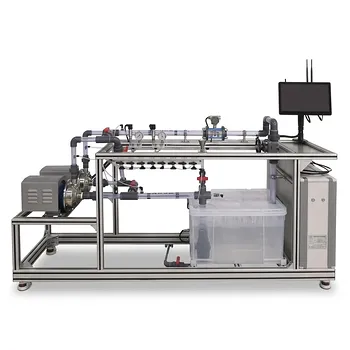
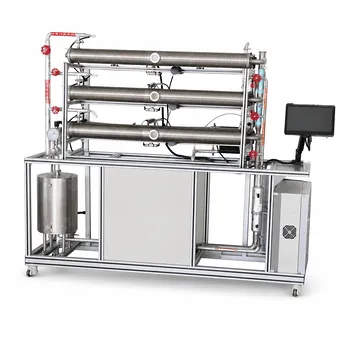
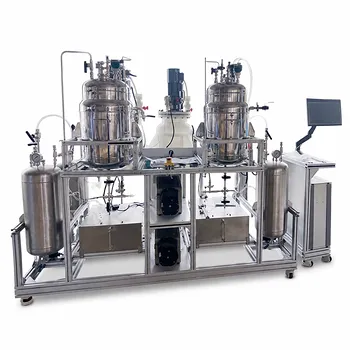
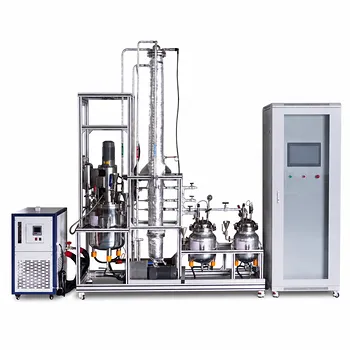
Mastering complex thermodynamic systems requires hands-on experience. LABPARK provides state-of-the-art Educational and Vocational Unit Operations Pilot Plants in chemical engineering, bioprocess & biotech, and environmental & water treatment. Designed specifically for universities, research institutes, and enterprises, our pilot plants bridge the gap between theoretical modeling and real-world execution.
Ready to enhance your training efficiency and prevent operational errors? Contact us today to customize a solution for your lab!
Related Products
- Hollow Fiber Ultrafiltration Membrane Separation Educational Pilot Plant
- Multi Pump Fluid Transport Process Piping Unit Operations Training Pilot Plant
- Natural Product Extraction Unit Operations Training Pilot Plant
- Multi-Modal Distillation Unit Operations Training Pilot Plant
- Bio-fermentation Ethanol Production Practical Training Unit Operations Pilot Plant
People Also Ask
- How do PEI, PVDF, and PSU membranes compare in pilot plants? Find the best fit.
- Pervaporation vs. Vapor Permeation: Handling Suspended Solids in Membrane Pilot Plants
- What are the advantages of membrane separation in pilot plants? Efficient Organic Vapor Recovery
- How can operators optimize operating conditions and cleaning protocols in membrane separation pilot plants to mitigate fouling?
- Isotropic vs. Anisotropic Membranes: How to Choose the Best Pilot Plant Modules