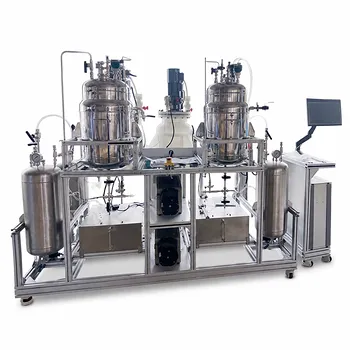
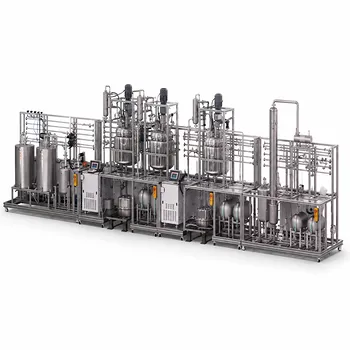
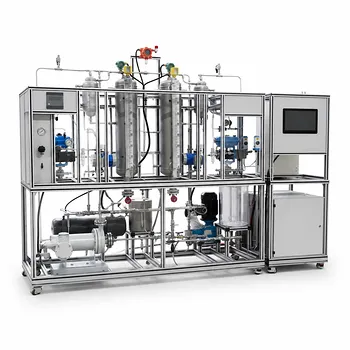
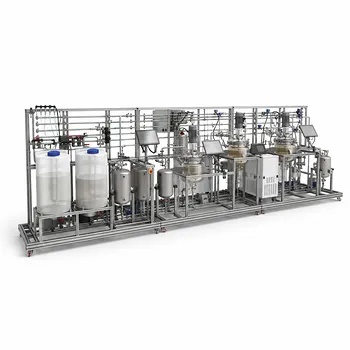
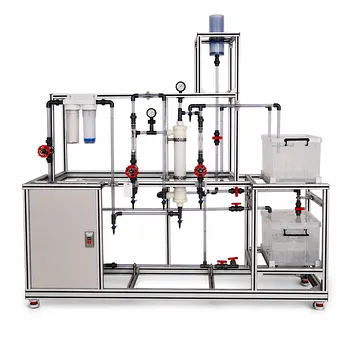
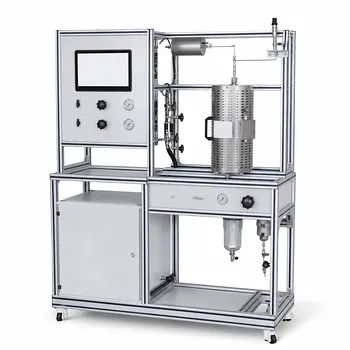
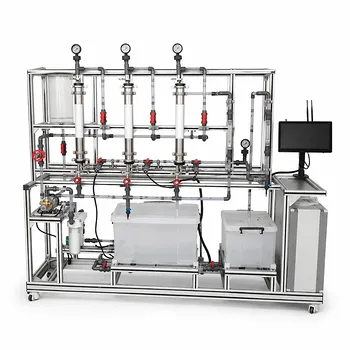
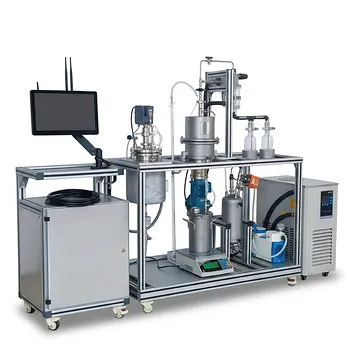
In educational pilot plants, urea synthesis is demonstrated through a continuous, high-pressure loop integrating a reactor and a stripping column. The reactor first combines ammonia and carbon dioxide to form ammonium carbamate, which then partially dehydrates into urea. The resulting liquid effluent—still rich in unconverted carbamate—flows directly into a heated stripper. There, a stripping gas (typically CO₂ or NH₃) decomposes the carbamate back into its gaseous reactants, which are recycled to the reactor inlet. This closed-loop design models modern, water-free urea processes while letting students explore equilibrium thermodynamics, mass transfer, and thermal integration at a manageable scale.
The reactor–stripper pilot plant turns a complex industrial recycle into a transparent teaching tool. It replaces cumbersome liquid recirculation with a single gas-phase loop, allowing students to isolate and analyze the driving forces of high-pressure equilibrium and the kinetics of carbamate decomposition.
How the Reactor Stage Is Demonstrated
The Two‑Step Reaction and Equilibrium
The urea synthesis is taught as two distinct equilibrium reactions.
First, ammonia and carbon dioxide react rapidly and exothermically to form ammonium carbamate.
Second, this carbamate dehydrates endothermically to produce urea and water.
The overall conversion is equilibrium‑limited; the pilot plant operates at high pressure (typically 130–200 bar) and temperature (170–190 °C) to shift the second step forward.
Students monitor temperature and pressure to see how these variables influence the equilibrium yield.
Reactor Design and Operating Conditions
The reactor is often a stirred autoclave or a plug‑flow tubular vessel that provides the necessary residence time for carbamate dehydration.
A jacket or internal coils circulate heating fluid to sustain the endothermic dehydration, while cooling may be applied after the initial exotherm.
Because the reaction mixture is corrosive (hot ammonium carbamate), the pilot unit uses stainless‑steel or glass‑lined components with appropriate safety enclosures.
Glass sight‑glasses at the reactor outlet let students visually observe the two‑phase flow—liquid urea/carbamate solution and a supercritical gas phase—illustrating real phase behavior at synthesis conditions.
Instrumentation for Process Insight
The reactor is heavily instrumented to turn empirical observation into quantitative analysis.
Temperature sensors (multiple thermocouples along the reactor length or in the jacket) capture the exotherm and the controlled heating profile.
Pressure transducers and flow meters on the ammonia and carbon dioxide feed lines enable the calculation of molar ratios and space velocity.
Online sampling ports allow withdrawal of small amounts of liquid for off‑line urea and carbamate analysis, so students can construct experimental conversion‑versus‑time curves and validate equilibrium models.
How the Stripping Stage Is Demonstrated
The Role of the Stripping Agent
Instead of using a water‑based carbamate recycle loop—common in older urea technologies—the pilot plant introduces a stripping gas, either carbon dioxide or ammonia, directly into the column.
This gas provides both the heat and the driving force for decomposition.
Students learn that feeding CO₂ as the stripping agent mimics the Stamicarbon CO₂‑stripping process, while using ammonia emulates the Snamprogetti NH₃‑stripping route.
Both variants illustrate how a lean gas stream shifts the equilibrium of carbamate decomposition back toward the gaseous reactants.
Mass Transfer and Thermal Decomposition
The stripper is typically a falling‑film column or a packed bed where the liquid reactor effluent flows downward counter‑currently to the rising hot stripping gas.
Heat is transferred directly from the gas to the liquid film, raising its temperature and supplying the enthalpy needed to break down carbamate.
At the same time, the partial pressure of NH₃ and CO₂ in the gas phase remains low, so the equilibrium decomposition of carbamate is strongly favored.
Students measure axial temperature profiles and gas‑phase compositions to quantify mass‑transfer rates and decomposition efficiency.
Integration and the Recycle Loop
The pilot plant connects the reactor and stripper in a seamless high‑pressure loop.
The carbamate‑rich liquid leaves the reactor, enters the top of the stripper, and contacts the pre‑heated stripping gas.
The resulting hot gas mixture—now enriched in NH₃ and CO₂—is routed to a high‑pressure condenser, partially liquefied, and fed back into the reactor along with fresh feeds.
This self‑contained recycle eliminates the energy‑intensive aqueous recovery section found in conventional plants, making the pilot unit compact and allowing students to concentrate on the core reactor‑stripper interaction.
Educational Insights from the Stripping Column
The stripper becomes a hands‑on module for three core principles:
- Equilibrium thermodynamics—how temperature and partial pressure affect carbamate decomposition.
- Gas‑liquid mass transfer—how stripping efficiency depends on gas‑to‑liquid ratio, packing geometry, and column height.
- Thermal integration—how the heat of stripping gas directly reduces the external heating demand of the reactor.
Transparent sections or sight‑glasses at intervals allow students to visualize film flow and bubbling patterns, reinforcing concepts like flooding, weeping, or dry zones in a real‑world context.
Understanding the Trade‑offs in a Teaching Plant
- Safety and pressure limitations: Educational units often operate at lower pressures or with smaller volumes than industrial plants, which can reduce reaction rates and conversion. Students must extrapolate results carefully.
- Simplified fluid dynamics: Glass columns and narrow tubes, while excellent for visualization, may not capture the hydrodynamic complexity of full‑scale falling‑film strippers. Wall effects and heat loss can skew mass‑transfer data.
- Chemical handling: The corrosive nature of ammonium carbamate demands stringent material selection and regular maintenance, teaching students about practical materials‑of‑construction constraints but also limiting the pilot plant’s uptime.
- Omission of downstream purification: A true urea plant requires evaporation and prilling stages that are usually not part of a synthesis‑focused pilot module. Students must be reminded that the reactor‑stripper loop only addresses the front‑end conversion.
Applying the Reactor‑Stripper Demonstration to Your Learning Goals
- If your primary focus is reaction kinetics and equilibrium: Maximize sensor density on the reactor. Run experiments that vary feed ratio, temperature, and residence time, then compare measured conversion to equilibrium calculations.
- If your primary focus is mass‑transfer and stripping efficiency: Design exercises around changing the stripping gas flow rate, inlet temperature, or column packing type. Measure liquid‑phase carbamate concentration before and after the stripper to compute mass‑transfer coefficients.
- If your primary focus is process integration and energy balance: Conduct full‑plant heat balances. Use the temperature data from reactor jacket, stripper heater, and condenser to show how the stripping gas reduces net heating demand and enables energy‑efficient recycle.
- If your primary focus is process control and dynamics: Introduce step changes in feed composition or pressure and have students tune a simple feedback loop to stabilize the reactor outlet temperature or liquid level in the stripper, linking theory to industrial control practice.
A well‑instrumented reactor‑stripper pilot plant transforms abstract urea chemistry into a tangible, data‑rich experience—empowering students to deconstruct a modern high‑pressure process into fundamental unit operations.
Summary Table:
| Stage | Key Function | Key Phenomena | Educational Focus |
|---|---|---|---|
| Reactor Stage | Combines NH₃ and CO₂ to form carbamate, then dehydrates it to urea. | Exothermic carbamate formation & endothermic dehydration. | Equilibrium yields, kinetics, and phase behavior. |
| Stripping Stage | Uses CO₂ or NH₃ gas to decompose and recycle unconverted carbamate. | Counter-current mass transfer & thermal decomposition. | Stripping efficiency, thermal integration, and recycle loops. |
Bring Industrial Chemical Synthesis to Your Lab
Looking to enhance your curriculum or research with hands-on process experience? LABPARK provides advanced Educational and Vocational Unit Operations Pilot Plants in chemical engineering, bioprocess & biotech, and environmental & water treatment. Our custom-designed systems empower universities, research institutes, and enterprises to bridge the gap between theory and industrial practice.
Contact LABPARK today to request a quote or customize your pilot plant setup!
Related Products
- Bio-fermentation Ethanol Production Practical Training Unit Operations Pilot Plant
- Green Anhydrous Ethanol Refining Practical Training Pilot Plant
- Electrolytic Hydrogen Production Educational Unit Operations Pilot Plant
- Multi-Functional Special Distillation Educational Pilot Plant
- Continuous Batch Extractive Distillation Educational Pilot Plant
People Also Ask
- Why Use PTFE & Hastelloy in Chemical Pilot Plants? Prevent Corrosion & Ensure Safety
- Why Compare Predicted and Experimental Excess Enthalpy? Key to Accurate Pilot Plant Scale-up
- Why is the chemical plant startup schedule crucial? De-risk scale-up with pilot plants.
- When to transition from PID to adaptive control in pilot plants? Key process indicators.
- Why must batch and fed-batch fermentation pilot plants be designed to accommodate changing rheological conditions?