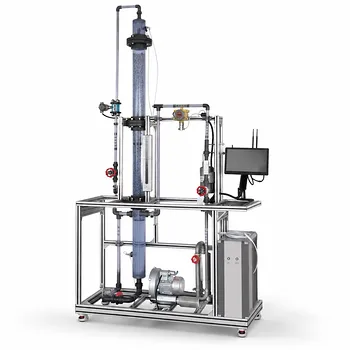
For solid materials in a unit operations lab, the decision between a fluidized bed dryer and a pneumatic flash dryer hinges on a material’s particle size, thermal sensitivity, and what you need your students to observe. A fluidized bed dryer is the benchmark for granules and crystals in the 0.5–3 mm range—it delivers uniform heat transfer, highly controllable drying, and clear visualization of fluidization principles. Choose a pneumatic flash dryer when the material consists of very fine, heat-sensitive particles that cannot fluidize properly and must be dried almost instantaneously, as it combines short-contact heat transfer with pneumatic transport.
The core trade-off is residence time versus controllability. A fluidized bed provides longer, gentler, and more uniform drying ideal for granular materials and teaching fluidization dynamics, while a flash dryer offers sub‑5‑second contact for heat-sensitive fines but sacrifices mechanical simplicity and is unsuitable for fragile or sticky solids. Align the pilot plant choice with both the material’s physical properties and the specific engineering principle you aim to demonstrate.
The Fundamental Physics of Each Dryer Type
To select the right pilot plant, you first need to understand how these dryers create the intimate gas–solid contact that drives moisture removal.
How a Fluidized Bed Dryer Works
A fluidized bed dryer suspends solid particles in a vertical stream of hot gas. The gas velocity is high enough to overcome the weight of the particles, causing them to behave like a boiling liquid.
This creates exceptionally high heat and mass transfer rates because every particle is surrounded by the drying medium. The intense mixing keeps the bed temperature highly uniform and gives you precise control over the final moisture content.
How a Pneumatic Flash Dryer Works
A pneumatic flash dryer entrains wet particles in a high-velocity, high-temperature gas stream inside a vertical duct. Drying happens during the simultaneous conveying of the solid.
The defining characteristic is residence time measured in seconds (0.5–5 s). Because the gas and solids move co-currently, the particle surface temperature rarely rises above the wet-bulb temperature of the gas, making it inherently protective for heat-sensitive materials.
Critical Material Properties That Dictate Your Choice
The primary reference is unequivocal: particle size and thermal sensitivity are the two non-negotiable sorting criteria. You must also consider mechanical fragility.
Particle Size and Geldart Classification
Fluidized beds demand a specific particle size window. They work best with free-flowing granules and crystals between 0.5 mm and 3 mm, though technically a broader range (0.03–6 mm) can be fluidized.
In Geldart’s classification, you want Group B particles (50–1000 µm, sand‑like) that bubble immediately at minimum fluidization. Group A powders (30–200 µm) can also work, but they require careful handling due to bed expansion. Fine Group C powders (<30 µm) are extremely difficult to fluidize because strong interparticle forces cause gas channeling. Pneumatic flash dryers, in contrast, excel with these very fine, hard-to-fluidize solids.
For particles too fine to fluidize stably, a flash dryer is your only option between the two.
Thermal Sensitivity and Residence Time
Material heat sensitivity determines how much thermal abuse the solid can tolerate. This directly maps to residence time.
A fluidized bed dryer keeps particles in the hot zone for minutes or longer. While the bed temperature is uniform and can be tightly controlled, the long exposure makes it less suitable for thermally labile materials unless operated at very low inlet temperatures, which reduces throughput.
A pneumatic flash dryer provides an ultra-short contact time. The particle’s core never heats up appreciably. For pharmaceuticals, fine chemicals, or easily oxidized compounds where even a small temperature excursion causes degradation, the flash dryer’s rapid surface-drying mechanism is the safer technology.
Material Fragility and Attrition Risk
If your solid is crystalline, brittle, or you need to maintain a precise particle size distribution, the mechanical stress inside the dryer becomes a deciding factor.
A fluidized bed dryer is gentle on particles. Collisions in the bubbling bed are low-energy, and there are no high-velocity impacts. In contrast, a pneumatic flash dryer subjects the material to high-velocity wall collisions and intense inter-particle friction. Fragile materials will shatter, generating fines and dust that complicate downstream collection and ruin the educational value of a well-characterized feed.
Educational Goals: What Should the Lab Demonstrate?
In a training environment, the pilot plant is a teaching tool first. You are not just drying material; you are making a physical principle visible.
When the Focus is on Fluidization and Heat Transfer Control
Select a fluidized bed dryer when the learning objectives center on:
- Visualizing minimum fluidization velocity and bed expansion.
- Measuring heat and mass transfer coefficients in a particulate bed.
- Demonstrating the impact of gas distributor design on bubbling and channeling.
- Building a classic drying curve with distinct constant-rate and falling-rate periods under tightly controlled, uniform conditions.
The fluidized bed’s glass‑wall construction makes the entire process observable, turning abstract equations into a tangible demonstration.
When the Focus is on Co-current Transport and Short-Contact Drying
Select a pneumatic flash dryer when you want students to:
- Understand the principle of simultaneous conveying and drying in a continuous unit.
- Appreciate the engineering of protecting heat‑sensitive solids through rapid, co‑current heat exchange.
- Calculate and measure very short residence times and connect them to the product’s thermal history.
- Study the effect of high gas‑solid slip velocities on drying rates.
A flash dryer pilot plant vividly demonstrates that you can dry a fine, temperature‑sensitive powder in less time than it takes to walk across the lab.
Understanding the Trade-offs and Limitations
No dryer is universally superior. Acknowledge the downsides to make a defensible selection.
Fluidized bed dryers consume more energy and require uniform, free‑flowing feed. They cannot handle pastes, slurries, or extremely fine powders without risking gas channeling. Particles larger than roughly 6–8 mm become too difficult to fluidize without excessive gas velocities. Additionally, if the material contains bound internal water, a long residence time alone may not guarantee the desired final moisture unless the drying conditions are carefully profiled.
Pneumatic flash dryers demand tall installations and high system pressure drops. The high gas velocities cause significant attrition, making them unsuitable for fragile crystals or agglomerates. Moreover, they excel only at removing surface moisture; if your material holds significant bound water within its pores, a standalone flash dryer will leave the product wet, requiring a secondary dryer (often a fluidized bed) for the internal diffusion step. This combined setup, while efficient, adds complexity that may overwhelm a basic unit operations lab.
Making the Right Choice for Your Lab
Align the equipment with both your material and the pedagogical takeaway.
- If your primary focus is demonstrating fluidization fundamentals and obtaining precise drying curves for granular materials: Choose the fluidized bed dryer. Its visual accessibility and controllability are unmatched for teaching core heat and mass transfer concepts.
- If your primary focus is processing a fine, heat-sensitive powder that cannot be fluidized and you want to illustrate continuous co-current drying: Choose the pneumatic flash dryer. It turns the challenge of drying thermally labile fines into a clear lesson on residence time engineering.
- If your material is mechanically fragile or you need to preserve particle size distribution: Avoid the flash dryer. The fluidized bed is the gentler, more forgiving option.
- If you want to demonstrate a realistic industrial two-stage drying process for a material with surface and bound moisture: Consider combining both in series, but only after students have mastered each unit individually. This moves the lab from demonstration to optimization.
The right pilot plant is the one that makes the governing principles of heat and mass transfer unmissable to your students, while reliably delivering a dry product. Choose based on the physics, and the learning will follow.
Summary Table:
| Feature | Fluidized Bed Dryer | Pneumatic Flash Dryer |
|---|---|---|
| Optimal Particle Size | 0.5–3 mm (granular/crystals) | Fine powders (<30 µm) & cohesive solids |
| Residence Time | Minutes to hours (highly controllable) | 0.5–5 seconds (instantaneous) |
| Thermal Sensitivity | Moderate (long exposure risk) | High (safeguards heat-sensitive materials) |
| Material Fragility | Gentle (low risk of attrition) | High mechanical stress & attrition risk |
| Key Learning Objective | Fluidization dynamics & drying curves | Co-current transport & flash drying physics |
Optimize Your Unit Operations Lab with LABPARK
Selecting the right equipment is key to transforming abstract engineering concepts into hands-on learning. LABPARK designs and manufactures premium Educational and Vocational Unit Operations Pilot Plants in chemical engineering, bioprocess & biotech, and environmental & water treatment for universities, research institutes, and enterprises worldwide.
Let us help you choose the ideal system to meet your curriculum and research goals. Contact LABPARK today to discuss your laboratory requirements with our technical specialists!
Related Products
- Multi-Functional Drying Educational Unit Operations Pilot Plant
- Fluidized Bed Gas Solid Catalytic Reaction Educational Pilot Plant
- Two-Dimensional Fluidization Hydrodynamics Educational Pilot Plant for Unit Operations Training
- Multi-Reactor Educational Pilot Plant for Reaction Engineering Unit Operations
- Multi Functional Catalytic Reaction and Reactor Evaluation Educational Unit Operations Pilot Plant
People Also Ask
- Vacuum vs. Atmospheric Drying: How to Choose the Right Pilot Plant Configuration for Your Lab
- How do seasonal changes affect drying pilot plant blower requirements? Key sizing tips.
- Why is dry-basis moisture content preferred over wet-basis? Simplify your drying pilot plant balances.
- How can unit operations pilot plants demonstrate simultaneous removal of light and heavy impurities? Configure a modular setup
- How do deviations in estimating latent heat impact pilot plant thermal systems? Avoid hardware mis-sizing.