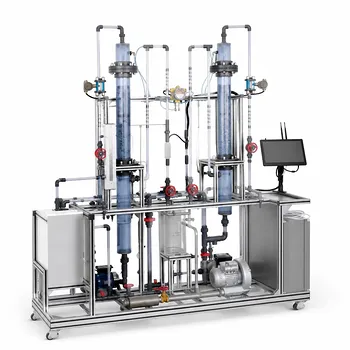
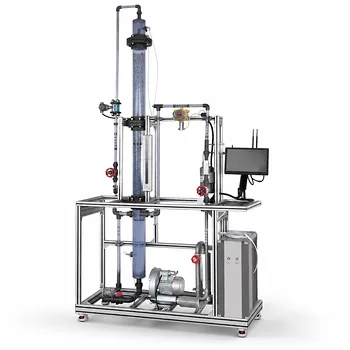
For multiphase reaction systems in chemical engineering pilot plants, the shift from traditional packed beds to microstructured column packing is transformative. This advanced design, often fabricated as uniform column arrays via deep reactive ion etching on silicon posts, directly overcomes the two critical limitations of conventional packed beds: high pressure drop and uneven fluid distribution. The result is consistently uniform flow, dramatically lower pressure losses, and a mass transfer rate that can be a hundredfold higher—all while maintaining high catalytic activity through integrated catalyst support layers.
Traditional packed-bed microreactors suffer from flow maldistribution and excessive pressure drop that undermine process intensification. Microstructured column packing solves both problems, delivering uniform flow, dramatically lower pressure drop, and a hundredfold mass transfer improvement. For pilot plants focused on advanced process training or research, this represents the definitive leap in performance.
The Hidden Bottlenecks of Traditional Packed Beds
In gas–liquid catalytic systems, conventional packed beds often fail to scale down cleanly. Two interconnected flaws dominate.
High Pressure Drop Restricts Throughput
Randomly packed granules create tortuous, unpredictable flow paths. This generates excessive resistance, raising energy demands and limiting the range of feasible operating pressures.
Maldistribution Erodes Reproducibility
Across multiple parallel channels, fluid rarely splits evenly. Some channels become starved, others flooded, causing hot spots, reduced selectivity, and irreproducible results that undermine pilot-scale data reliability.
How Microstructured Column Packing Reshapes Performance
By replacing chaotic packing with precisely ordered arrays, microstructured designs turn these bottlenecks into strengths.
Uniform Flow Distribution, Eliminating Channeling
Microstructured arrays—often featuring columns as small as 50 µm in diameter—enforce identical flow paths for every fluid element. This geometric uniformity guarantees that each parallel channel receives the same gas and liquid flow, eliminating the channeling and bypassing that plague traditional beds.
Drastically Reduced Pressure Drop
The open, aligned architecture minimizes form drag and viscous losses. Pressure drop drops to a fraction of that in random packing, enabling vacuum operation, lower energy consumption, and safer handling of volatile or heat-sensitive components.
A Hundredfold Leap in Mass Transfer
The combination of a massive, uniformly accessible interfacial area and exceptionally thin liquid films yields mass transfer coefficients up to 100 times greater. For fast gas–liquid reactions—where the reaction completes within the liquid film—the bulk liquid holdup becomes irrelevant. Microstructured packing maximizes the specific interfacial area exactly where it matters, conforming perfectly to the film model for rapid reactions.
Catalyst Integration on a Microscale
A porous post layer or alumina washcoat on the column surfaces anchors the catalyst with minimal diffusion barriers. This preserves full catalytic activity while the short diffusional path amplifies the effective reaction rate, creating an ideal platform for demonstrating process intensification in teaching and research.
Understanding the Trade-offs
No single solution fits every scenario. Objectively weighing the downsides of microstructured column packing is essential.
- Fabrication complexity and cost: Precision microfabrication techniques (DRIE, laser machining) are more expensive than simply dumping random packing. Initial capital outlay for a microstructured column is higher, though the long-term operational efficiency often offsets this.
- Sensitivity to fouling and particulates: The uniform, narrow channels that ensure excellent flow distribution can clog if the reactant stream contains solids, viscous polymers, or suspended impurities. Rigorous upstream filtration or clean feedstocks become mandatory.
- Scale-up challenges: While microstructured packings excel at pilot scale, numbering-up to commercial capacity requires careful manifold design to preserve fluid uniformity across hundreds or thousands of units.
Making the Right Choice for Your Pilot Plant
The decision hinges on what you need the pilot plant to demonstrate. Align the hardware with your educational or research objective.
- If your primary focus is demonstrating advanced process intensification: Choose microstructured column packing. The extreme mass transfer, low pressure drop, and thermal uniformity vividly illustrate the principles of intensified reaction engineering.
- If your primary focus is handling viscous, fouling, or particulate-laden feeds: Traditional random packing, despite its lower efficiency, offers greater robustness and is easier to clean, making it more practical for troubleshooting real industrial fluid mixtures.
- If your primary focus is cost-sensitive basic education on gas–liquid contact: A conventional random packed bed remains justifiable. It reliably demonstrates fundamental mass transfer and pressure drop concepts at a much lower hardware cost.
Microstructured column packing redefines what a pilot-scale multiphase reactor can achieve, turning theoretical performance ceilings into everyday operational realities for the modern chemical engineering laboratory.
Summary Table:
| Feature | Traditional Packed Beds | Microstructured Column Packing |
|---|---|---|
| Flow Distribution | Prone to channeling & maldistribution | Uniform, identical fluid flow paths |
| Pressure Drop | High resistance & energy demand | Drastically reduced, allows vacuum use |
| Mass Transfer | Standard, restricted by random geometry | Up to 100x higher mass transfer |
| Catalyst Integration | Random packing loading | Precision integrated micro-coatings (washcoat) |
| Best For | Fouling feeds & basic education | Advanced process intensification & research |
Upgrade Your Chemical Engineering Laboratory with LABPARK
Are you looking to demonstrate advanced process intensification or upgrade your research capabilities? LABPARK designs and manufactures state-of-the-art Educational and Vocational Unit Operations Pilot Plants in chemical engineering, bioprocess & biotech, and environmental & water treatment.
We help universities, research institutes, and enterprises bridge the gap between theory and industrial reality with high-performance, customizable pilot systems. Whether you need systems optimized for microstructured columns or robust traditional packed beds, our experts are ready to deliver the perfect system for your curriculum or research.
Contact us today to discuss your pilot plant requirements!
Related Products
- Absorption and Desorption Educational Unit Operations Pilot Plant
- Multimodal Absorption and Desorption Pilot Plant for Unit Operations Training
- Packed Bed Absorption Educational Unit Operations Pilot Plant
People Also Ask
- How to demonstrate physical vs chemical absorption using a pilot plant? A practical lab guide.
- Why are liquid-phase mass transfer rates in pilot plants comparable to gas-phase rates? Key Insights
- Why is interface composition critical in absorption pilot plants? Bridging Theory & Practice
- How do absorption pilot plants assist students in calculating mass transfer coefficients and sizing column parameters?
- How to Calculate HTU & NTU for Pilot Plant Packing Height: A Complete Guide