The real lesson in process simulation isn’t convergence—it’s why the solver failed.
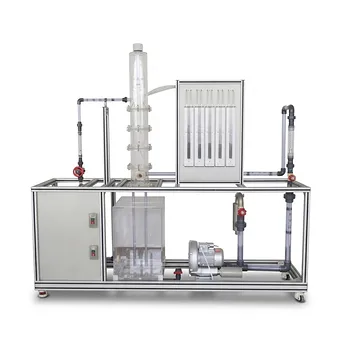
Understanding distillation column convergence issues is critical because a simulation that refuses to solve often exposes thermodynamically impossible specifications, mass balance violations, or design flaws that would cause a real column to fail. Unit operations pilot plants then bridge theory and physical reality by letting students manipulate feed location, reflux ratio, and thermal conditions and immediately observe how those choices impact separation efficiency, product purity, and stability. This hands-on confrontation turns abstract convergence warnings into concrete engineering judgment.
Core Takeaway: Simulation non‑convergence is not a software annoyance—it’s a vehicle for learning where idealized models break against actual vapor‑liquid equilibrium and hydraulic constraints. Pilot plants then transform that lesson into visceral experience, equipping future engineers to design columns that work, not just columns that converge.
Why Convergence Failures Are a Learning Goldmine
The Thermodynamic Red Flag
A divergent simulation often signals a specification that violates the Gibbs phase rule—for example, demanding 99.9% purity of a light component that simply cannot be stripped from the bottoms without an infinite number of stages. Students who only trust converged results miss the opportunity to interrogate whether their separator is even thermodynamically feasible.
Infeasible Specs as Real‑World Guardrails
When a simulation demands an unrealistic overhead purity while simultaneously limiting the reflux ratio, the solver exposes the same pinch a real column would hit. Learning to recognize these infeasible design traps—where mass transfer cannot deliver the requested separation—is far more valuable than a “green‑check” converged answer that hides flawed reasoning. It forces students to re‑examine column pressure, feed composition, and product cut points before a single dollar is spent on hardware.
Poor Initialization Mirrors Physical Startup
A common cause of convergence failure is bad initial temperature or flow estimates, exactly the kind of uncertainty a plant engineer faces during commissioning. Chasing solver diagnostics teaches the importance of providing physically plausible starting guesses—a skill that directly transfers to specifying pre‑heaters, condenser duties, and column inventory in the real world.
How Pilot Plants Turn Simulation Theory into Operational Judgment
Seeing the Consequences of Parameter Choices
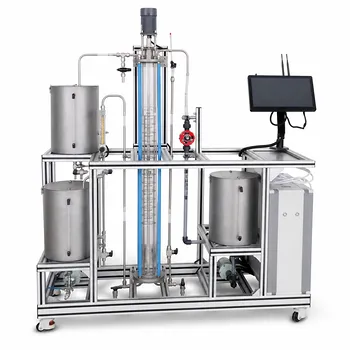
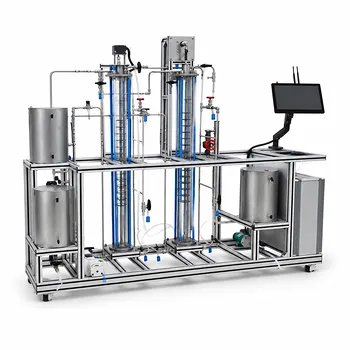
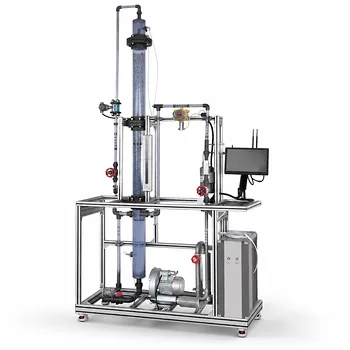
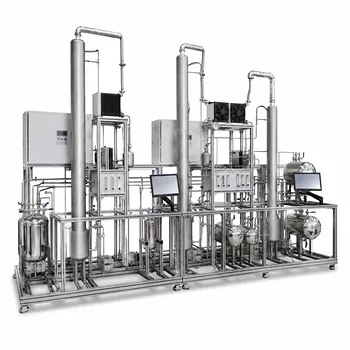
In a pilot‑scale fractional distillation column, students can physically alter the feed tray location or increase the reflux ratio and watch the top and bottom compositions change in real time. This makes abstract concepts—such as the trade‑off between purity and recovery—immediately tangible. The smell of an off‑spec product or the sight of flooding reinforces lessons no simulator can convey.
Validating Assumptions with Hard Data
Theoretical simulations often assume ideal equilibrium stages and steady‑state holdup. A pilot plant generates real temperature profiles, pressure drops, and composition data. Students can compare simulated results against those measurements and then adjust tray efficiency, Murphree vapor efficiency, or heat loss terms until the model matches reality. This iterative loop—simulate, operate, calibrate—bakes in the truth that a model is only as good as its fitted parameters.
De‑Risking Technology Transfer Before Scale‑Up
Pilot plants also teach why convergence failure can become a physical catastrophe. At larger scale, residence times balloon, exposing thermally sensitive mixtures to degradation. Pushing a simulation to converge by ignoring side reactions or using atmospheric pressure for a heat‑sensitive separation might work on the screen, but operating the same system in the pilot plant under vacuum shows exactly how product can be ruined by excessive temperature. That visceral lesson ingrains the discipline of respecting process constraints rather than gaming the solver.
The Measurable Bridge: From HETP to Real Operating Curves
Turning Theory into Empirical Constants
In a packed pilot column, students can measure the Height Equivalent to a Theoretical Plate (HETP) for different packing types and boil‑up rates. That empirical number—not a default simulator guess—becomes the essential input for sizing an industrial column. Similarly, batch and continuous pilot runs yield mass transfer coefficients and pressure drop curves that turn textbook correlations into trustworthy design tools.
Detecting Hydrodynamic and Efficiency Limits
Pilot‑plant operation exposes the physical limits that simulations rarely capture: flooding, weeping, entrainment, and uneven flow distribution. When students witness column instability at high vapor loads or see tray efficiency collapse due to foaming, they learn that a “converged” hydraulic profile without these failure boundaries is dangerously incomplete. This builds the instinct to probe simulation output for missing practical ceilings—an invaluable skill in industry.
The Limits of Pilot‑Scale Learning and Where They Can Mislead
Even the best pilot plant is a reduced‑scale proxy. Students must be aware of its inherent trade‑offs:
- Hydrodynamic dissimilarity: The liquid‑to‑vapor ratio and flow regimes in a 2‑inch column do not perfectly replicate a 10‑foot industrial tower. Wall effects, phase distribution, and heat loss differ, so efficiency data must be scaled with care.
- Limited physical sampling: Real‑time composition analysis may be less granular than a simulation’s infinite resolution. That forces students to make inferences from a few measurements, teaching them that plant decisions are always data‑starved.
- Time and resource intensity: Running a pilot column for a full factorial experiment is costly. Students quickly learn that thoughtful experimental design—guided by simulation sensitivity analysis—is what makes pilot work affordable.
- Safety and stability constraints: Explosive or acutely toxic mixtures cannot be run in a teaching lab, so pilot‑plant experience does not cover every scenario an engineer will face.
Acknowledging these limitations is itself part of the bridge: it teaches that no single tool, digital or physical, provides the whole truth.
How to Make the Most of Pilot‑Plant Education for Your Goal
Whether you are designing a curriculum, a scale‑up study, or a troubleshooting workshop, align the learning experience with the primary objective:
- If your focus is on deepening process design fundamentals: Use the pilot plant to demonstrate how reflux ratio, feed thermal condition, and tray count shift the operating line—then force a simulation to fail by asking for an impossible split, and let the students fix it together.
- If your priority is scale‑up and technology transfer: Run a defined separation in the pilot column, compare the results with an unconverged or “ideal” simulation, and iteratively calibrate the model using measured efficiency and pressure drop data. Make the mismatch the core teaching moment.
- If you want to build troubleshooting confidence: Intentionally create a flooding or weeping condition, then ask students to diagnose the cause using only pressure taps and sight glasses—simultor‑only training can never replicate this diagnostic muscle memory.
- If you are embedding reactive or specialty distillation: Use a reactive distillation pilot unit to show how simultaneous reaction and separation can make convergence difficult; demonstrate how physical operation clarifies the true “window of operation” when the solver cannot.
The engineer who has wrestled with a non‑converging simulation and smelled the distillate from a real tray is the one who will design a column that starts up cleanly, runs safely, and delivers the product the business needs.
Summary Table:
| Learning Dimension | Process Simulation (Theory) | Pilot Plant Operation (Reality) |
|---|---|---|
| Failure Mode | Mathematical non-convergence & solver diagnostics | Physical flooding, weeping, and foaming |
| Data Source | Ideal thermodynamic models & VLE assumptions | Empirical HETP, real pressure drops & efficiency data |
| System Limits | Idealized steady-state scenarios | Real-world heat losses, wall effects & safety constraints |
| Key Value | Rapid sensitivity analysis & design screening | Validation of assumptions & operational troubleshooting |
Bridge the Gap Between Theory and Practice with LABPARK
Ready to transform abstract process simulations into hands-on engineering expertise? LABPARK provides premium Educational and Vocational Unit Operations Pilot Plants in chemical engineering, bioprocess & biotech, and environmental & water treatment.
Specially designed for universities, research institutes, and enterprises, our pilot systems empower students and researchers to calibrate theoretical models with empirical data, master equipment startup, and troubleshoot real-world column hydraulics.
Contact LABPARK today to elevate your training and research capabilities!
Related Products
- Continuous Sieve-Plate Distillation Pilot Plant for Unit Operations Laboratory Education
- Multi-Functional Special Distillation Educational Pilot Plant
- Multi-Modal Distillation Unit Operations Training Pilot Plant
- Continuous Batch Extractive Distillation Educational Pilot Plant
- Dual-Mode Rectification Pilot Plant for Practical Training Unit Operations
People Also Ask
- How can real-time carbon number prediction improve distillation pilot plants? Optimize control.
- How to select the right activity coefficient model (Wilson, NRTL, UNIQUAC) for distillation pilot plants?
- Why is vacuum operation capability an essential feature for a distillation unit operations pilot plant? Unlock Efficiency
- How does catalyst water concentration affect distillation pilot plant design? Key separation train choices.
- What are the primary reflux ratio control strategies? Master Distillation Unit Operations