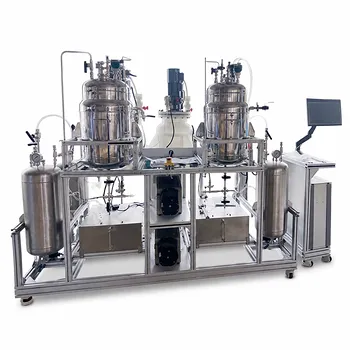
While chemical synthesis pilot plants demand rigorous control over explosive atmospheres and thermal runaways, bioprocess pilot plants trade these acute dangers for a distinct set of challenges—primarily the relentless battle against contamination and the need for significantly larger, slower, and more water-intensive operations.
This fundamental shift is not about one being "safer" in absolute terms, but about a reallocation of risk. The mild, aqueous conditions of bioprocessing inherently eliminate fire and explosion hazards common to organic solvents. However, this safety is offset by an operational burden: living cells are fragile, slow, and create a perfect environment for unwanted microorganisms, requiring a level of sterility and scale that traditional chemical reactors rarely need to consider.
The core trade-off is swapping immediate physical hazards (fire, runaway reactions) for a persistent biological one (contamination), while simultaneously accepting a slower, larger, and more wastewater-intensive process. The safety gain from benign operating conditions is directly tied to an operational penalty in throughput and facility complexity.
The Safety Profile: Swapping Runaway Reactions for Biological Containment
The safety conversation in a bioprocess pilot plant is entirely different from that in a traditional chemical synthesis unit. It’s not about managing explosions; it’s about maintaining a pure culture.
The Inherent Safety Advantage of "Green" Chemistry
Bioprocess plants operate on the principles of substitution and moderation. Most biochemical reactions occur in aqueous media at mild temperatures, close to ambient, and at near-neutral pH. This alone eliminates the two biggest threats in chemical pilot plants: the risk of thermal runaway and the fire or explosion hazard from flammable organic solvents. You simply cannot have a vapor cloud explosion from water. This inherent safety reduces the need for blast-proof walls, elaborate relief systems, and complex gas detection networks, fundamentally simplifying the physical plant's safety infrastructure.
The New Risk: Biocontamination
However, this safer chemical profile creates a unique biological vulnerability. A bioreactor full of nutrient-rich broth at a warm temperature is the ideal growth medium, not just for your engineered production organism, but for any fast-growing contaminant in the environment. A single breach in sterility can cause a batch loss far more quickly and completely than a typical chemical side reaction. The safety concern shifts to biocontainment—ensuring nothing unwanted gets in, and, if working with genetically modified organisms, nothing unwanted gets out. Your safety protocols now revolve around aseptic technique, validated sterilization cycles, and the integrity of seals and filters, which is a different discipline than managing chemical hazards.
The Operational Realities: Speed, Size, and Sterility
The mild conditions that provide the safety benefit are the same conditions that drive the operational challenges. Living cells have hard limits on productivity, and keeping a process sterile adds layers of time and equipment.
Slower Kinetics Demand Larger Reactors
Biochemical reactions are catalyzed by enzymes inside living cells. They are orders of magnitude slower than well-engineered chemical catalysts operating at high temperatures and pressures. To achieve a target production output in a given timeframe, a bioprocess pilot plant must use significantly larger reactor volumes. This isn't just a bigger tank; it means a larger physical footprint, higher capital investment for the vessel and support structures, and greater difficulty in mixing and oxygen transfer. Where a chemical pilot plant might use a 50-liter reactor, a bioprocess one for a comparable throughput could require 500 liters or more.
The Hidden Cost: High Volumes of Wastewater
Aqueous reactions are the defining feature, and this generates an immense downstream burden. For every kilogram of product, a bioprocess often produces significantly more wastewater than a chemical synthesis. This water is not clean; it contains residual nutrients, cell debris, and metabolic byproducts. Your pilot plant’s environmental and water treatment unit operations become not an afterthought, but a critical, capacity-defining step. The operational expense and complexity shift from managing volatile organic compound (VOC) air emissions to managing enormous volumes of liquid waste and ensuring compliance with biological discharge limits.
The Dominance of Sterility in Process Design
This is perhaps the most significant operational trade-off. In a chemical pilot plant, cleaning a reactor might mean a solvent rinse. In a bioprocess plant, it means sterilization. Every feed stream, from the main growth media to the antifoam, must be sterile. As the supplementary references highlight, pilot plants must manage a complex utility dance: generating plant steam, holding the entire system at high temperature for a validated "kill cycle," and then using cooling water to rapidly bring everything down to the organism's preferred temperature before inoculation. This requires auxiliary systems unseen in a chemical plant and dictates the batch-to-batch turnaround time.
Equipment Trade-offs: The Self-Aspirating Reactor Example
The trade-off is perfectly illustrated by specialized equipment like the self-aspirating bioreactor. This design uses an impeller to suck in air, eliminating the need for an expensive, energy-intensive air compressor and saving up to 30% in initial capital costs. It's a brilliant operational simplification. However, the operational penalty is immediate: the system operates under negative pressure, which dramatically increases contamination risk if any seal integrity is compromised. It also caps the maximum oxygen transfer rate, potentially slowing your biology even further, and forces a different vessel geometry (a squatter aspect ratio of ~1.6 vs. the standard 2.0), which impacts mixing and space planning. This single example encapsulates the entire field: an elegant, efficient design trades safety margin (sterility) for operational and capital cost savings.
Understanding the Trade-offs: A Holistic View
Choosing between a bioprocess and a chemical synthesis route for a pilot plant is rarely a decision based on one factor. It’s a system-level optimization.
- Safety Profile: You trade acute, immediate physical hazards (fire, explosion, toxic release) for a chronic, process-critical biological hazard (contamination, sterile breach).
- Reactor Design: You trade a compact, high-intensity vessel for a larger, slower one that demands excellent heat and mass transfer but no pressure rating for a runaway scenario.
- Workforce Skill: You trade expertise in handling dangerous chemicals and designing pressure systems for expertise in microbiology, aseptic technique, and live culture support.
- Utility Systems: You trade extensive gas handling and relief systems for an extensive steam, condensate, and wastewater treatment infrastructure.
The benefits are real—renewable feedstocks, complex molecule synthesis, high specificity—but the pilot plant that delivers these benefits is built on a foundation of biological constraint, not chemical intensity.
Making the Right Choice for Your Goal
Your decision hinges on what you need to pilot. Is the end product only accessible through biology? Or are you evaluating a "greener" route for an existing molecule? The answer guides your tolerance for these trade-offs.
- If your primary focus is producing a complex biologic that cannot be chemically synthesized: The operational burden of sterility and larger scale is a non-negotiable prerequisite. Your plant design must prioritize contamination control and wastewater capacity above all else.
- If your primary focus is replacing a high-hazard chemical synthesis with an inherently safer route: Even with larger reactors and slower rates, the elimination of runaway reaction risk and flammable solvents is often a decisive, life-cycle safety win. Your plant's capital cost should be evaluated against the potential cost of a single major chemical incident.
- If your primary focus is maximizing throughput in a limited footprint: A traditional chemical synthesis, or a highly intensified continuous bioprocess (if possible), will likely be superior. A conventional fed-batch bioprocess will strain your floor space and utility infrastructure.
- If your primary focus is evaluating energy and equipment efficiency: Explore novel reactor designs like the self-aspirating bioreactor, but do so with eyes wide open. Always run a structured hazard analysis specifically evaluating the increased contamination risk from negative pressure against the 30% capital savings.
The choice between these pilot plant philosophies is not about better or worse, but about aligning your operational tolerance with the fundamental demands of the manufacturing route you are scaling. You are trading one set of risks for another, and that trade must be a deliberate, well-engineered decision.
Summary Table:
| Feature | Bioprocess & Biotech Pilot Plants | Chemical Synthesis Pilot Plants |
|---|---|---|
| Primary Hazard | Contamination & biological containment | Thermal runaway, fire, & explosion |
| Reaction Conditions | Mild (aqueous, ambient temp, neutral pH) | Harsh (organic solvents, high temp/pressure) |
| Reactor Size & Speed | Larger volumes due to slower kinetics | Compact volumes due to faster kinetics |
| Core Utility Needs | Steam sterilization & high-volume wastewater | Relief systems & hazardous gas handling |
Scale Your Operations Safely and Efficiently with LABPARK
Navigating the complex trade-offs between chemical synthesis and bioprocessing requires the right equipment. LABPARK provides premium Educational and Vocational Unit Operations Pilot Plants in chemical engineering, bioprocess & biotech, and environmental & water treatment designed specifically for universities, research institutes, and enterprises. Let us help you equip your lab with safe, reliable, and compliant scaling solutions.
Contact our experts today to discuss your project requirements!
Related Products
- Bio-fermentation Ethanol Production Practical Training Unit Operations Pilot Plant
- Natural Product Extraction Unit Operations Training Pilot Plant
- High-Gravity Emulsification and Mass Transfer Educational Pilot Plant
- Continuous Batch Extractive Distillation Educational Pilot Plant
- Ethyl Acetate Synthesis Unit Operations Pilot Plant for Practical Training
People Also Ask
- Why Use PTFE & Hastelloy in Chemical Pilot Plants? Prevent Corrosion & Ensure Safety
- Why Compare Predicted and Experimental Excess Enthalpy? Key to Accurate Pilot Plant Scale-up
- Why is the chemical plant startup schedule crucial? De-risk scale-up with pilot plants.
- When to transition from PID to adaptive control in pilot plants? Key process indicators.
- Why must batch and fed-batch fermentation pilot plants be designed to accommodate changing rheological conditions?