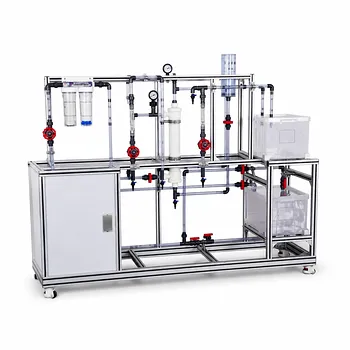
Ceramic membranes are the more durable choice for demanding pilot-plant filtration, while polymeric membranes are usually the more economical and selective option. In bioprocess and beverage processing, ceramic microfiltration can support bacterial reduction and clarification at approximately 0.2 µm, while tighter ceramic ultrafiltration, such as 0.01 µm, can remove haze-forming colloids and larger proteins. Their main advantages are thermal stability, chemical resistance, mechanical strength, and longer service life; their main disadvantages are higher cost, brittleness, and more difficult module integration.
Ceramic membranes are best when pilot testing involves repeated cleaning, elevated temperatures, long continuous runs, or chemically demanding feeds. Polymeric membranes remain attractive when low capital cost, easy replacement, flexible module design, or precise molecular selectivity matters more than maximum durability.
What the Membrane Must Accomplish
Clarification and cold sterilization are different duties
Clarification removes suspended solids, colloids, haze precursors, and—depending on membrane tightness—macromolecules such as proteins.
Cold sterilization uses filtration rather than heat to reduce or remove microorganisms from heat-sensitive fluids. A nominal 0.2 µm membrane is commonly associated with bacterial retention, but actual sterile performance depends on organism size, membrane integrity, operating conditions, and validation.
The term “cold sterilization” should therefore be treated as a validated microbial-retention process, not simply as a pore-size claim.
Ceramic pore sizes support multiple pilot objectives
A ceramic membrane around 0.2 µm is suited to microfiltration duties such as bacterial reduction, removal of suspended particles, and beverage clarification.
A tighter membrane around 0.01 µm provides ultrafiltration-level separation. It can remove fine colloidal material, haze-forming species, and relatively large proteins, including proteins above the approximate molecular-weight range identified in the reference.
Pore size alone does not fully define performance. Feed composition, transmembrane pressure, crossflow velocity, concentration polarization, fouling, and membrane integrity also determine the result.
Why Ceramic Membranes Perform Well in Pilot Plants
Higher thermal resistance
Ceramics tolerate temperatures that can exceed the operating limits of many polymeric materials. This is valuable when the pilot plant must process warm feeds, perform hot cleaning, or investigate thermal operating windows.
For bioprocessing, the distinction is important because some fluids cannot tolerate heat, even though the membrane system itself can. Ceramic construction allows the operator to evaluate robust cleaning and sterilization procedures without exposing the product to a heat treatment that could damage vitamins, amino acids, proteins, flavors, or aromas.
Greater chemical durability
Ceramic membranes generally withstand aggressive cleaning chemicals and broad pH conditions better than conventional polymeric membranes.
This supports repeated cleaning cycles using caustic, acidic, or other compatible cleaning solutions. It also reduces the risk that the membrane material itself will rapidly degrade during pilot campaigns.
Better mechanical strength
Ceramic materials are mechanically strong and dimensionally stable. They are less prone to deformation under pressure, temperature changes, or repeated operating cycles than many polymeric alternatives.
That stability is useful in pilot plants, where equipment may be operated by different users under changing conditions and where the purpose is often to explore operating limits rather than run one narrowly optimized production recipe.
Longer potential service life
Because they resist thermal and chemical damage, ceramic modules can have a substantially longer operational life than polymeric modules under harsh service. The supplementary reference identifies service lives of up to approximately 10 years in suitable applications.
That figure is not a universal guarantee. Fouling, abrasion, poor cleaning practice, mechanical shock, and unsuitable feed chemistry can shorten the life of any membrane.
Lower risk of heat-related product changes
Membrane clarification and microbial reduction avoid the high product temperatures associated with thermal sterilization. This can help preserve sensory and nutritional quality in beverages and protect heat-sensitive bioprocess materials.
The benefit is not that ceramics sterilize by heating. Rather, their durability allows the filtration system to be cleaned and operated robustly while the product itself remains under relatively mild thermal conditions.
Where Polymeric Membranes Retain an Advantage
Lower initial cost
Polymeric membranes are generally less expensive and widely available across microfiltration and ultrafiltration ranges.
This makes them practical for routine training, early feasibility studies, short campaigns, and applications where the feed and cleaning regime are not particularly aggressive.
Easier module integration
Polymeric modules are flexible and generally easier to seal and install in standard housings. Ceramic modules are more rigid, brittle, and often more demanding from a sealing and mechanical-design perspective.
For a pilot plant that changes configurations frequently, simpler installation can reduce setup time and the risk of mechanical damage.
Broad material selection
Polymeric membranes can be produced from materials such as cellulose acetate, nylon, PTFE, PVDF, and polysulfone. This gives engineers a broad menu of chemical compatibility, hydrophilicity, pore-size, and molecular-cutoff characteristics.
A polymeric membrane may therefore offer more practical options when the process requires a specific molecular separation rather than maximum resistance to cleaning or temperature.
Precise molecular selectivity
Polymeric membranes can provide highly useful and precise molecular-weight cutoffs for selected ultrafiltration applications.
That selectivity can be an advantage in bioprocess development, where the goal may be to retain a target protein, remove a contaminant, or fractionate molecules within a relatively narrow size range.
However, nominal molecular-weight cutoff is not an absolute molecular sieve. Retention depends on molecular shape, concentration, interactions with the membrane, and process conditions.
Comparing Clarification and Cold Sterilization Performance
Beverage clarification
Ceramic membranes are well suited to continuous beverage clarification when the process requires repeated operation and frequent chemical cleaning. Their stability is particularly valuable where haze, colloids, proteins, and microbial contamination must be controlled without a cooked flavor caused by thermal treatment.
Polymeric membranes can perform the same general duty at lower cost when the beverage is compatible with the selected polymer and the cleaning program is mild enough to avoid accelerated degradation.
Bioprocess fluid clarification
For bioprocess fluids, the appropriate membrane depends on whether the objective is cell removal, bacterial reduction, protein retention, protein removal, or general particulate clarification.
Ceramic membranes provide a robust platform for pilot studies involving repeated cleaning and varied process conditions. Polymeric membranes may be preferable when the separation requires a particular molecular cutoff or when the process is conducted under moderate temperature and chemical conditions.
Cold sterilization of heat-sensitive streams
A validated 0.2 µm filtration step can reduce bacterial contamination without applying a high-temperature treatment to the product. This is valuable for fluids containing heat-sensitive biological ingredients.
The system still requires appropriate integrity testing, aseptic handling, and validation against the relevant microbial challenge. Neither ceramic nor polymeric material automatically guarantees sterility merely because the nominal pore size is 0.2 µm.
Fine clarification and protein removal
A 0.01 µm ceramic membrane can provide substantially tighter clarification than a 0.2 µm microfilter. It is therefore more appropriate when the target includes fine haze precursors, colloids, or larger protein species.
The trade-off is that tighter filtration can increase hydraulic resistance and fouling sensitivity. The process may require more careful control of flux, pressure, feed pretreatment, and cleaning.
Understanding the Trade-offs
Capital cost versus operating durability
Ceramic modules typically require a higher initial investment. The supplementary reference indicates that they may cost more than ten times as much as polymeric membranes in some ultrafiltration applications.
That premium can be justified when long service life, aggressive cleaning, or high-temperature operation reduces replacement frequency and pilot-plant downtime. It is harder to justify for occasional use with benign feeds.
Chemical and thermal tolerance versus flexibility
Ceramics tolerate conditions that can damage polymeric materials, but they are less forgiving mechanically. They are brittle and can be damaged by impact, mishandling, or inappropriate pressure transients.
Polymeric modules are easier to handle and seal, but their operating envelope is usually narrower. Temperature limits, solvent compatibility, pH exposure, and cleaning chemistry must be checked for the specific polymer rather than assumed from the membrane’s nominal pore size.
Robustness versus application-specific selectivity
Ceramics offer excellent durability, but they are not automatically superior for every separation. Polymeric membranes may provide a better-defined molecular cutoff or a more suitable surface chemistry for a particular protein or solute separation.
Material selection should therefore begin with the required separation and cleaning conditions, not with durability alone.
Longer life versus fouling
Ceramics resist membrane-material degradation, but they do not eliminate fouling. Beverage proteins, colloids, cells, and other macromolecules can still accumulate on the membrane surface or within the flow channels.
A ceramic membrane may survive cleaning better than a polymeric one, yet still require sound pretreatment, crossflow management, flux control, and cleaning optimization.
Continuous operation versus system complexity
Ceramic modules are attractive for robust, continuous pilot testing because they tolerate repeated process cycles. However, their higher cost and more demanding sealing requirements can make system design and maintenance more complex.
For training plants, this creates a useful educational trade-off: ceramic modules demonstrate industrial durability, while polymeric modules make it easier to teach membrane replacement, fouling behavior, and cost-sensitive process selection.
How to Choose for a Pilot Plant
The best choice depends on the feed, the cleaning protocol, the required separation, and how often the plant will be operated.
- If your primary focus is repeated pilot campaigns and aggressive cleaning: Choose ceramic membranes because their chemical, thermal, and mechanical durability can reduce degradation and downtime.
- If your primary focus is heat-sensitive beverage or bioprocess fluids: Use membrane filtration rather than thermal treatment, selecting ceramic or polymeric material according to cleaning demands and validated microbial-retention requirements.
- If your primary focus is low capital cost and standard biological separations: Choose polymeric membranes when the feed, temperature, and cleaning chemistry remain within the polymer’s compatibility limits.
- If your primary focus is precise molecular fractionation: Evaluate polymeric membranes first because they often provide practical molecular-cutoff options, then confirm that the material can withstand the process and cleaning regime.
- If your primary focus is long-term continuous operation under demanding conditions: Favor ceramic modules, provided the budget, sealing design, handling procedures, and mechanical protections are appropriate.
- If your primary focus is pilot-plant training across multiple operating scenarios: Consider installing both technologies so users can compare cost, fouling, cleaning response, selectivity, and service durability under controlled conditions.
The most defensible selection is the membrane that meets the required separation and validated microbial-control target while surviving the complete operating and cleaning cycle.
Summary Table:
| Decision factor | Ceramic membranes | Polymeric membranes |
|---|---|---|
| Typical use | Demanding clarification, repeated cleaning, long campaigns | Routine clarification, early trials, moderate process conditions |
| Approximate filtration range | 0.2 µm for bacterial reduction and clarification; 0.01 µm for fine colloids and larger proteins | Broad microfiltration and ultrafiltration options with defined molecular cutoffs |
| Thermal and chemical resistance | High; suitable for elevated temperatures and aggressive cleaning | Material-dependent; compatibility limits must be verified |
| Mechanical durability | Strong and dimensionally stable, but brittle | Easier to handle and seal, but more prone to degradation under harsh conditions |
| Selectivity | Effective particle, colloid, and macromolecule separation | Often offers more precise molecular-weight cutoffs and surface options |
| Capital cost | Higher initial investment | Lower initial cost and easier replacement |
| Service life | Potentially longer under suitable operating conditions | Typically shorter in demanding thermal or chemical service |
| Main trade-off | Durability and long-term operation versus cost and integration complexity | Affordability and flexibility versus durability |
| Best selection criteria | Aggressive cleaning, continuous operation, elevated temperature, and long service life | Low capital cost, flexible modules, moderate conditions, or precise molecular fractionation |
Planning a pilot plant for beverage clarification, bioprocess fluid treatment, or validated cold sterilization? Contact LABPARK to discuss the right membrane technology for your process. LABPARK provides Educational and Vocational Unit Operations Pilot Plants covering chemical engineering, bioprocess and biotech, and environmental and water treatment. Our systems help universities, research institutes, and enterprises compare ceramic and polymeric membranes, evaluate 0.2 µm microbial-retention steps and tighter clarification options, study fouling and cleaning performance, and train operators under realistic conditions. We can help you select a pilot configuration that balances separation performance, cleaning durability, operating cost, safety, and long-term training or research value.
Related Products
- Multi Functional Membrane Crystallization Educational Unit Operations Pilot Plant
- Photocatalytic Membrane Separation and Degradation Unit Operations Pilot Plant
- Multifunctional Membrane Separation Educational Pilot Plant with Ultrafiltration, Nanofiltration, Reverse Osmosis
- Multi-Functional Membrane Separation Educational Pilot Plant for Unit Operations Lab
- Ultrafiltration Membrane Separation Educational Pilot Plant
People Also Ask
- Control Crystallization Pilot Plant Secondary Nucleation: 4 Key Adjustments
- Why is precise temperature control critical in crystallization pilot plants? Key to Scale-Up Success
- How Crystal vs Amorphous Solids Guide Crystallization Pilot Plant Objectives
- What key factors should be considered when configuring a crystallization unit operations pilot plant?
- What are the benefits of integrating online PAT tools like ATR-FTIR into crystallization unit operations pilot plants?