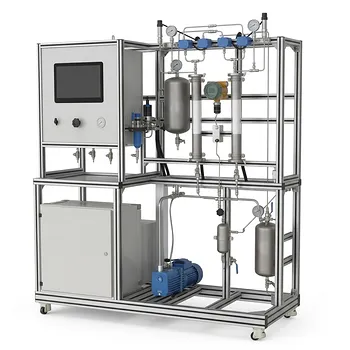
The electrostatic precipitator (ESP) in a biomass fast pyrolysis pilot plant acts as the final, high-efficiency trap for liquid bio-oil that would otherwise escape as an invisible aerosol mist. Its specific role is to coalesce and collect sub-micron droplets of partially depolymerized lignin fragments from the gas stream. It operates by applying a strong electric charge to these liquid aerosols, forcing them to migrate to grounded surfaces where they merge into a recoverable liquid film — a step that is often the difference between meeting a mass balance target and losing a significant fraction of valuable product.
While primary condensers capture the bulk of bio-oil vapors, the electrostatic precipitator targets the elusive sub-micron aerosol fraction — incompletely depolymerized lignin droplets formed during rapid quenching — that would otherwise pass straight through conventional separation equipment.
Understanding the Aerosol Challenge in Fast Pyrolysis
To see why the ESP is indispensable, you first have to recognize a hard truth about fast pyrolysis: cooling the hot vapor stream doesn’t yield a clean separation by itself.
The Condensation Gap: Vapor vs. Aerosol
Fast pyrolysis shatters biomass into a complex mixture of vaporized organic species. When this stream is rapidly quenched, lighter components condense directly to liquid, but heavy lignin-derived oligomers often bypass the phase change and form a stable, suspended mist of finely divided droplets. These aerosols carry high-molecular-weight material that the primary condensers simply cannot capture by surface condensation alone.
Why Traditional Separators Fall Short
Cyclones, mesh demisters, and filters all struggle here. The droplets are too small (often well below 1 µm) to be removed by inertial forces, and the sticky, electrically conductive nature of the bio-oil rapidly fouls physical barriers. You need a force that acts directly on each individual droplet, regardless of its size or momentum — and that’s where electrostatics takes over.
How the Electrostatic Precipitator Solves the Problem
The ESP’s core operating principle transforms an invisible aerosol into a continuous liquid stream by leveraging the droplets’ own physical properties.
The Core Operating Principle
Inside the ESP, a central high-voltage discharge electrode (often a wire or series of wires) creates a corona discharge — a localized, non-thermal plasma. Electrons and ions generated in this corona attach to the passing bio-oil droplets, imparting a net negative charge. The same strong electric field that drives the corona then accelerates these charged droplets toward the grounded outer wall or collection plates, where they adhere and coalesce. The result is a thin, flowing film of bio-oil that drains by gravity into a recovery vessel.
The Critical Role of Coalescence and Drainage
Collection alone is not enough; the droplets must merge into a bulk liquid that can be continuously removed. The ESP’s surface promotes coalescence of the fine mist into larger liquid rivulets. In pilot plants, plate or tube surfaces are often heated slightly to keep the bio-oil fluid and to prevent solidification of the heaviest tar-like components. If drainage stalls, the collected layer re-entrains as large globules or causes electrical arcing, so surface design is tightly coupled to thermal management.
Electrical Considerations
Stable corona operation typically uses a negative DC power supply in the 20–80 kV range, though actual voltage depends on electrode spacing and gas properties. Negative polarity is preferred for gases with some moisture because it yields a more stable, diffuse corona with fewer sparkovers. Maintaining clean insulators is non-negotiable, as any condensed organics can create a conductive path that short-circuits the field.
Understanding the Trade-offs
No unit operation is without its dark side, and the ESP in pyrolysis service demands careful attention to several pitfalls.
Dealing with Sticky and Conductive Bio-oil
Bio-oil is an excellent insulator when fresh, but it can become partially carbonized and conductive over time, especially near hot discharge wires. This promotes arc-over and power supply trips. Electrode fouling is relentless; you must build in cleaning cycles (steam blasts, solvent washes, or even mechanical rappers) or accept frequent shutdowns.
Risk of Fire and Explosion
The gas stream leaving pyrolysis is combustible and often contains residual oxygen, even after inerting efforts. A spark inside the ESP, while normally a nuisance, can become an ignition source if oxygen levels are not strictly controlled. Inert gas blanketing (typically with nitrogen) and continuous oxygen monitoring just upstream of the ESP are standard safety practices, not optional extras.
Energy and Maintenance Footprint
High-voltage equipment and frequent cleaning consume a meaningful amount of operator attention and capital. The precipitator’s benefit must be weighed against these ongoing costs — but for a pilot plant aiming to demonstrate high liquid yields and close the carbon balance, the trade-off almost always favors including the ESP.
Making the Right Choice for Your Pilot Plant
How you approach the ESP depends entirely on your primary goal. Use the following recommendations to guide your design and operation.
- If your aim is to maximize liquid yield: Position the ESP as the last recovery unit before the gas disposal line, operating right after the final condenser at a temperature just above the dew point of water but low enough to keep aerosols stable. Tune voltage for the highest collection efficiency without excessive sparking.
- If your priority is uptime and data continuity: Build in automatic cleaning systems and select electrode materials (such as stainless steel with a polished finish) that resist corrosion and bio-oil adhesion. Monitor the voltage–current curve in real time; a downward drift often signals fouling before you lose collection.
- If safety is your first constraint: Enforce an inert atmosphere with verified oxygen below the limiting oxygen concentration for your gas mixture. Install flame arrestors on inlet and outlet lines, and design the ESP shell to withstand a potential internal deflagration.
Mastering the ESP’s aerosol collection principle transforms what could be a hidden stream of high-value carbon into a steady, recoverable pulse of bio-oil that validates your entire process concept.
Summary Table:
| Key Aspect | Operating Detail | Role & Benefit |
|---|---|---|
| Primary Role | Captures sub-micron (< 1 µm) liquid aerosols | Recovers heavy lignin-derived oligomers, maximizing yield |
| Operating Principle | Negative DC corona discharge (20–80 kV) | Charges droplets, forcing them to migrate & coalesce on grounded walls |
| Thermal Control | Mild heating of collection surfaces | Prevents solidification and promotes continuous gravity drainage |
| Safety & Uptime | Nitrogen blanketing & O2 monitoring | Eliminates ignition/sparking risks and prevents organic fouling |
Optimize Your Pyrolysis and Chemical Processes with LABPARK
Achieving precise mass balance and maximizing liquid yields in pilot-scale operations requires robust, reliable equipment. LABPARK designs and delivers state-of-the-art Educational and Vocational Unit Operations Pilot Plants across chemical engineering, bioprocess & biotech, and environmental & water treatment.
We help universities, research institutes, and enterprises accelerate their research and training with safely engineered, high-performance systems.
Ready to elevate your lab's capabilities? Contact us today to discuss your custom project requirements!
Related Products
- Pressure Swing Adsorption Educational Unit Operations Pilot Plant
- Solid Waste Pyrolysis and Refining Educational Pilot Plant for Unit Operations
People Also Ask
- How does Pressure Swing Adsorption (PSA) technology operate? Optimize gas separation with pilot plants.
- How to demonstrate physical vs chemical absorption using a pilot plant? A practical lab guide.
- What are the key differences between PSA and TSA? Choosing the Right Adsorption Pilot Plant
- How do physical vs chemical adsorption impact pilot plant design? Key operational & regeneration strategies.
- How is moisture removal managed in an adsorption unit operations pilot plant? Dew Point Control Guide