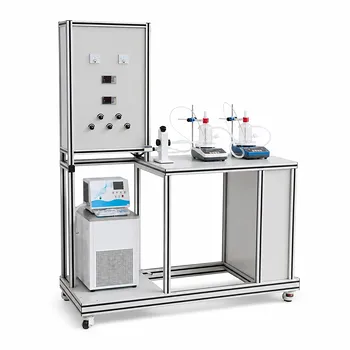
The key to stable pH control in your pilot plant starts with the right conjugate acid-base pair. Selecting a buffer system first requires matching the acid dissociation constant ($pK_a$) of a weak acid to your target pH, then preparing the mixture at a concentration and ratio that delivers robust, real-world buffer capacity. The effective window is $pH = pK_a \pm 1$, with maximum resistance to pH shift occurring when the conjugate acid and base are mixed in a 1:1 ratio and kept within a total concentration of 0.1–1.0 mol·dm⁻³.
The foundation of reliable pH control is understanding buffer chemistry: match the buffer’s $pK_a$ to your setpoint, aim for a 1:1 acid-to-base mole ratio, and balance high enough concentration for capacity against the osmotic and chemical constraints of your biological or chemical process. These principles ensure consistent reaction kinetics, cell health, and yield across scale-up runs.
Matching pKa to Your Target pH
The single most important decision is choosing a conjugate pair whose $pK_a$ sits within one pH unit of your desired operating setpoint. This defines the working range where the buffer effectively neutralizes added acid or base.
Why the ±1 Rule Governs Buffer Effectiveness
Buffer capacity is highest at the $pK_a$ and drops off sharply outside the $pH = pK_a \pm 1$ window. Within this range, the ratio of conjugate base to acid shifts from roughly 10:1 to 1:10, providing sufficient reserves of both species to absorb $H^+$ or $OH^-$ ions.
If your target is 4.76, an acetic acid–sodium acetate system (pKa 4.76) is ideal. For a pH around 9.25, an ammonia–ammonium chloride buffer (pKa 9.26) becomes the natural choice. In bioprocess settings, phosphate buffers (pKa 7.2) are often used to clamp pH near 7.0–7.4, matching microbial and mammalian cell growth conditions.
Selecting Pairs That Respect Your Process Chemistry
Beyond the number, the chemical nature of the buffer must be inert to your reactants and cells. Avoid buffers that chelate essential metals or interfere with enzymatic pathways. In bioprocesses, phosphate can sometimes precipitate with calcium or magnesium if concentrations are too high, while organic buffers like MOPS or HEPES are often chosen for cell culture because they remain non-toxic and membrane-impermeable.
Concentration: The Buffer Capacity Trade-Offs
Once you’ve selected the pair, the total concentration of the two species determines how much acid or base the system can withstand before the pH drifts outside the acceptable band.
Why Higher Concentration Equals Greater Resistance
Buffer capacity scales linearly with total concentration. Doubling the molarity of your acetic acid–acetate mixture roughly doubles the amount of metabolic acid you can neutralize. In fermentation pilot plants, where microbes constantly produce organic acids, a more concentrated buffer resists the pH drop for a longer period without needing aggressive base addition.
The Hidden Cost of Over-Concentrating Your Buffer
High buffer concentrations increase ionic strength. This can raise osmotic pressure, stressing cells and potentially inhibiting growth or product formation. In pilot plant bioreactors, exceeding 1.0 mol·dm⁻³ often triggers viability problems and wastes raw materials. The sweet spot of 0.1–1.0 mol·dm⁻³ balances buffering power with biocompatibility and cost-efficiency.
The 1:1 Acid-Base Ratio for Maximum Resilience
Your buffer’s robustness against both acid and base spikes is determined by the mole ratio of the conjugate acid to the conjugate base.
Symmetry of Protection
When [HA] = [A⁻], the system can neutralize equal amounts of strong base and strong acid with minimal pH change. This symmetrical defense is why a 1:1 ratio maximizes buffer capacity, making it the default preparation target for most pilot plant buffers.
Adjusting the Ratio to Nail Your pH Target
If your exact pH requirement is not precisely at the $pK_a$, you can fine-tune the pH by adjusting the ratio according to the Henderson-Hasselbalch equation. For instance, using 1.2:1 acetic acid to acetate will bring the pH slightly below 4.76. Always verify the final pH with a calibrated probe after preparation, as activity coefficients in real media can cause small deviations from calculated values.
Preparing and Validating Your Buffer System
Moving from theory to the plant floor requires precise preparation steps and verification methods to ensure your buffer performs as designed.
Step-by-Step Preparation in the Pilot Plant
Start by dissolving the calculated masses of the conjugate acid and its salt (or acid plus base to partially neutralize) in a volume of process water less than the final target. Stir until fully dissolved, then bring the volume up to the mark with additional water or process medium. For sensitive biological systems, pre-adjust the pH with small additions of concentrated acid or base while monitoring continuously.
Always use pH meters calibrated at the temperature of use. Buffer standard solutions must bracket your target pH for a two-point calibration. This compensates for electrode drift and temperature effects on the dissociation equilibrium.
Validating Buffer Capacity Before Trusting Your Batch
Before the run, perform a challenge test: add a known volume of a standardized acid or base to a sample of your prepared buffer and measure the pH shift. If the shift exceeds your process tolerance, you may need to increase the buffer concentration or adjust the ratio. This simple step can save entire pilot runs from pH-induced yield loss.
Understanding the Trade-offs and Common Pitfalls
Even a well-chosen buffer system can fail when practical constraints are ignored. Acknowledging the trade-offs builds a truly robust process.
Ionic Strength and Osmotic Pressure
High buffer concentrations drive up conductivity, which may interfere with online sensors or create osmotic stress. In mammalian cell culture, osmolality typically needs to stay between 260–320 mOsm/kg; buffer salts contribute significantly. If you need more capacity, consider using a buffer with a higher buffering capacity per unit of ionic strength, or combine the buffer with a controlled base feed strategy instead of increasing concentration further.
Temperature Sensitivity of pKa
$pK_a$ values are temperature-dependent. A phosphate buffer’s $pK_a$ shifts by about -0.0028 per °C. If your pilot process runs at elevated temperature (e.g., 37°C for fermentation), adjust your target ratio accordingly or choose a buffer with a low temperature coefficient, like many organic biological buffers (e.g., HEPES, Tris).
Chemical Incompatibility and Metabolic Interference
Citrate buffers chelate calcium, which can badly affect membrane integrity and enzyme activity. Acetate can be metabolized by some organisms, causing a gradual pH drift as the acid component is consumed. Always review the metabolic map of your production organism and the medium composition before locking in a buffer system.
Making the Right Choice for Your Pilot Plant Goal
Different operational priorities call for different balances in buffer design. Match your strategy to what matters most for your process.
- If your primary focus is maximum process stability against heavy acid production: Select a high total concentration (0.8–1.0 mol·dm⁻³) of a buffer with a $pK_a$ exactly at your setpoint and mix to a 1:1 ratio, but verify that your cells or catalyst can tolerate the increased osmolarity.
- If your primary focus is preserving delicate biological viability: Use a lower concentration (0.1–0.2 mol·dm⁻³) and lean on automated base addition to handle peaks in acid load, selecting a biocompatible organic buffer (e.g., MOPS, HEPES) that does not interfere with metabolism.
- If your primary focus is cost-efficiency for large pilot volumes: Choose an inexpensive inorganic buffer like phosphate or bicarbonate (where $pK_a$ aligns) at a moderate concentration, and carefully monitor ionic strength to avoid precipitation problems in downstream piping.
Your pilot plant’s pH control is only as good as the buffer system you build. By grounding your selection in the chemistry of conjugate acid-base pairs and validating it against real process conditions, you install a foundation that keeps reactions on track and your scale-up data meaningful.
Summary Table:
| Buffer System | pKa (25°C) | Working pH Range | Key Application & Constraints |
|---|---|---|---|
| Acetic Acid–Sodium Acetate | 4.76 | 3.76 – 5.76 | Acidic chemical processes; low-cost and simple. |
| Phosphate Buffer | 7.20 | 6.20 – 8.20 | Standard bioprocesses; watch for Ca/Mg precipitation. |
| Ammonia–Ammonium Chloride | 9.26 | 8.26 – 10.26 | Basic chemical systems. |
| Organic Buffers (HEPES/MOPS) | ~7.2 – 7.5 | 6.20 – 8.50 | Highly biocompatible; low temperature sensitivity. |
Scale Up with Precision: Partner with LABPARK
Maintaining strict pH control is critical to ensuring consistent reaction kinetics and cell viability during process scale-up. LABPARK delivers high-performance Educational and Vocational Unit Operations Pilot Plants designed specifically for chemical engineering, bioprocess & biotech, and environmental & water treatment applications.
Whether you are teaching process control in universities or optimizing industrial scaling in research institutes and enterprises, our pilot plants provide the precision, reliable monitoring, and durability you need to succeed.
Contact LABPARK today to discuss how our pilot plants can support your laboratory goals!
Related Products
- Quantitative Dosing and Liquid Flow Control Educational Unit Operations Pilot Plant
- Multi-Functional Special Distillation Educational Pilot Plant
- Liquid-Liquid Mass Transfer Coefficient Determination Educational Pilot Plant
- Dual-Mode Rectification Pilot Plant for Practical Training Unit Operations
- Natural Product Extraction Unit Operations Training Pilot Plant
People Also Ask
- How do educational unit operations pilot plants bridge theory and industrial process development? Hands-On Learning
- How do educational unit operations pilot plants bridge theory and design? Bridge the Engineering Gap
- How do educational unit operations pilot plants address safety and waste management when scaling up?
- How do unit operation requirements differ between traditional chemical processes and bioprocesses? Build Better Pilot Plant Curricula
- Why Custom Pilot Plants Beat Used Equipment in Vocational Labs: Achieve Safe, Effective Learning