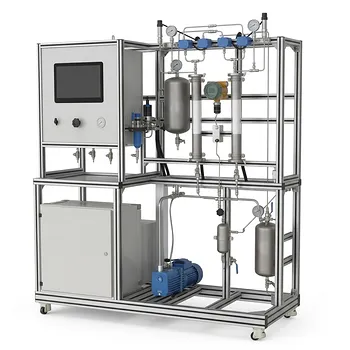
The immediate classification depends entirely on a particle's mean size and density, which dictates its fluidization behavior. For a laboratory engineer operating a gas-fluidized bed pilot plant, solid particles are definitively sorted into four Geldart groups. Group A materials, like fine catalysts, expand significantly before bubbling. Group B materials, resembling sand, start bubbling exactly at the minimum fluidization velocity. Group C fines are cohesive and notoriously difficult to fluidize, while Group D large, dense particles are prone to unstable slugging. This classification is your primary map for predicting and achieving stable, representative pilot-scale operation.
Mastering particle classification is not merely a selection step; it is the fundamental control strategy for ensuring stable fluidization and obtaining meaningful data from your pilot plant. A chosen particle's group determines your reactor's hydrodynamic "personality"—from gentle, predictable expansion to violent, chaotic slugging—and your success hinges on matching that personality to your research or educational objective.
Deconstructing the Geldart Classification for Pilot Plant Operation
The classification system is your diagnostic tool. It translates basic, measurable physical properties into a predictable fluidization regime. This allows you to proactively configure your pilot plant and troubleshoot common problems like channeling, slugging, and excessive elutriation.
Group A: The "Aeratable" Materials
Group A particles are the ideal candidates for smooth, controllable fluidization studies. They are the benchmark of stability in fluid catalytic cracking (FCC) units and other catalytic processes.
- Characteristics: These particles have a small mean size (typically 30–200 µm) and low particle density (less than ~1.4 g/cm³).
- Fluidization Behavior: They exhibit a critical advantage: a region of non-bubbling, stable expansion known as homogeneous fluidization between the minimum fluidization velocity (( U_{mf} )) and the minimum bubbling velocity (( U_{mb} )). Bubbles, when they do form, are small and well-distributed, leading to excellent gas-solid contact. When the gas supply is shut off, the bed collapses slowly, indicating good gas hold-up.
- Pilot Plant Application: Select Group A powder when your primary goal involves studying catalytic reaction kinetics, where excellent mass transfer and predictable gas-phase backmixing are paramount.
Group B: The "Sand-like" Benchmark
This group is the most predictable and well-behaved, making it the standard workhorse for fundamental fluidization studies and many industrial applications that don't require extreme expansion.
- Characteristics: These particles are sand-like in nature, with a size range of 50–1000 µm and a density from roughly 1.4 to 4.0 g/cm³.
- Fluidization Behavior: Bubbling begins immediately at (( U_{mf} )). The transition from a packed bed to a bubbling fluidized bed is sharp and unmistakable. This makes the onset of fluidization easy to identify experimentally.
- Pilot Plant Application: This group is the primary choice for education and fundamental hydrodynamic research. Its sharp transition makes it perfect for empirically verifying the Broadhurst and Becker correlation for ( U_{mf} ), a classic pedagogical exercise where students compare pressure-drop measurements against theoretical predictions.
Group C: The "Cohesive" Challenge
Group C materials present a significant operational challenge and are a primary source of pilot plant failure if not managed correctly. They are not typically selected for general studies.
- Characteristics: These are very fine particles, usually less than 30 µm, with strong interparticle forces (van der Waals, electrostatic) that dominate over the hydrodynamic forces of the fluidizing gas.
- Fluidization Behavior: They resist normal fluidization. Instead of fluidizing, gas forms persistent vertical channels through a non-moving bed (channeling), or the entire bed lifts as a solid plug. This results in zero mixing and unusable data.
- Pilot Plant Application: Avoid selecting Group C powders for standard pilot plant demonstrations unless the express purpose of the experiment is to study fluidization aids, vibration techniques, or the agglomeration process itself.
Group D: The "Spoutable" Giants
This group operates at the extreme end of the particle spectrum and creates violent fluidization environments. They are suitable only for specific, heavy-duty processes.
- Characteristics: These are large (>400 µm) and/or very dense particles.
- Fluidization Behavior: Fluidization is dominated by large, slow-moving bubbles, or "slugs," that can span the entire diameter of a small pilot plant column. Bubbles rise more slowly than the interstitial gas, causing the gas to bypass the solids entirely. This severely degrades gas-solid contact.
- Pilot Plant Application: These particles are prone to spouting and slugging. Select them only if you are modeling large-particle processes like coal gasification or specific drying operations, and always ensure your column diameter is sufficiently large to mitigate slugging.
Understanding the Trade-offs in Particle Selection
The choice of a particle group is a direct trade-off between reactivity and operability. Your selection must balance the critical parameters explored in the deep needs of your experiments.
The Kinetic Advantage vs. Separation Burden
There is an inherent physical conflict at the heart of fluidized bed design: increasing reaction surface area directly increases the risk of particle loss.
- The Benefit of Going Fine: A smaller particle size dramatically increases the effective gas-solid contact area, which enhances mass and heat transfer rates. This is the kinetic advantage that fluidized beds are built for, especially for highly exothermic reactions where thermal runaway in a fixed bed is a constant risk.
- The Cost of Being Too Fine: If particles are too fine (encroaching on Group C behavior or the lower end of Group A), you increase dust carryover and elutriation. The entrained fines become a significant downstream problem, requiring high-efficiency cyclones or filters that introduce new pressure-drop requirements.
- The Operational Sweet Spot: Your pilot plant instrumentation must be configured to handle this trade-off. For example, if you choose a Group A powder with a wide size distribution, you must use its elutriation apparatus to collect fines over time. By applying the Wen and Hashinger correlation, you can calculate a specific elutriation constant (( E^*_s )) and determine the average solids residence time, a critical parameter for verifying residence-time distribution models (( E(t) )) and predicting actual conversion.
Thermal Uniformity vs. Mechanical Complexity
Your choice of particle also dictates the reactor's thermal behavior, a key factor when selecting between fixed and fluidized systems for educational comparisons.
- Fluidized Bed Uniformity: By selecting a properly fluidizable Group A or B particle, you enable the bed's most celebrated trait: intense solid-fluid mixing that creates highly uniform bed temperatures and exceptionally high heat transfer coefficients. This is the core argument for choosing a fluidized bed over a fixed bed for highly exothermic reactions like acrylonitrile synthesis.
- Fixed Bed Limitations: In contrast, a fixed-bed reactor with the same particle would risk localized overheating (hot spots). A pilot plant offering both configurations allows direct, hands-on comparison of this effect, demonstrating why the same catalyst in a fluidized state can prevent thermal runaway and catalyst damage.
Making the Right Choice for Your Goal
The "right" solid particle is defined entirely by the specific goal of your pilot plant experiment. Your aim is to match the material's fluidization group to the educational or research objective.
- If your primary focus is demonstrating stable, catalytic fluidization and studying reaction kinetics: Start your selection with a Group A powder, such as a fresh FCC catalyst, to achieve homogeneous expansion and optimal gas-solid contact.
- If your primary focus is fundamental hydrodynamics education and empirical verification of ( U_{mf} ): Use a narrow-size-cut Group B silica sand. Its immediate bubbling at ( U_{mf} ) provides a clear, unmistakable data point for students comparing sensors to theory.
- If your primary focus is investigating fluidization difficulties and advanced particle handling: Deliberately test a Group C powder, but do so explicitly to study the effects of mechanical vibration, acoustic energy, or additive mixing on overcoming channeling.
- If your primary focus is scaling up for heavy-duty processes prone to slugging: Operate with Group D particles in a large-diameter column to study spouting phenomena, gas bypassing, and the unique heat transfer characteristics of large particle systems.
You are solving a matching problem, where the powder's physics dictate the experiment's success. By understanding the behavioral contract of each Geldart group, you can transform a simple powder selection into a powerful experimental control variable.
Summary Table:
| Geldart Group | Size Range (µm) | Key Behavior | Primary Pilot Plant Application |
|---|---|---|---|
| Group A (Aeratable) | 30 – 200 | Expands before bubbling | Catalytic reaction kinetics |
| Group B (Sand-like) | 50 – 1000 | Bubbles immediately at $U_{mf}$ | Hydrodynamic education & calibration |
| Group C (Cohesive) | < 30 | Channels & plugs; resists fluidization | Studying fluidization aids & agglomeration |
| Group D (Spoutable) | > 400 | Large, slow bubbles; prone to slugging | Modeling large-particle/drying processes |
Elevate Your Engineering Lab with LABPARK
Are you looking to bridge the gap between theory and practice? LABPARK provides high-quality Educational and Vocational Unit Operations Pilot Plants in chemical engineering, bioprocess & biotech, and environmental & water treatment. Tailored for universities, research institutes, and enterprises, our advanced systems—including gas-fluidized beds—ensure precise, repeatable, and safe experimental outcomes.
Ready to upgrade your laboratory capabilities? Contact LABPARK today to discover the ideal pilot plant solution for your institution!
Related Products
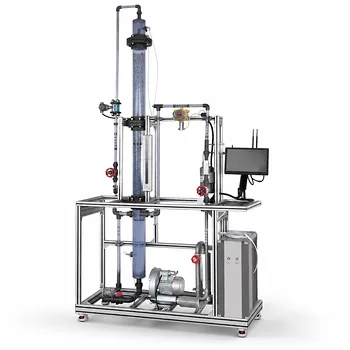
- Fluidized Bed Gas Solid Catalytic Reaction Educational Pilot Plant
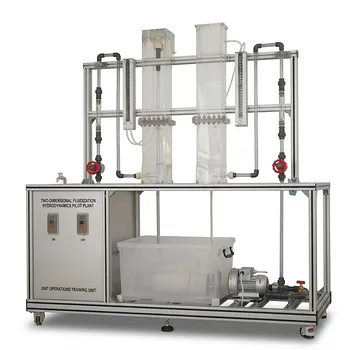
- Two-Dimensional Fluidization Hydrodynamics Educational Pilot Plant for Unit Operations Training
- Educational Unit Operations Pilot Plant for Intraparticle Diffusion Effective Factor Measurement
- Fixed Bed Gas Solid Catalytic Reaction Educational Pilot Plant
- Micro-Scale Gas-Solid Catalytic Reaction Educational Pilot Plant
People Also Ask
- Why is the bed height-to-diameter ratio (L/dt) critical? Fluidized bed pilot plant selection guide.
- How is the minimum fluidization velocity (U_mf) determined and utilized? A Unit Operations Guide
- How does the Mears criterion evaluate transport resistance? Key Guide to Intrinsic Kinetics
- How do reactor pilot plants safely study gas-solid reactions? Master kinetics with thermal & flow control.
- How do pilot plants demonstrate fluidized-bed reactor advantages over fixed-bed? Find Out Now