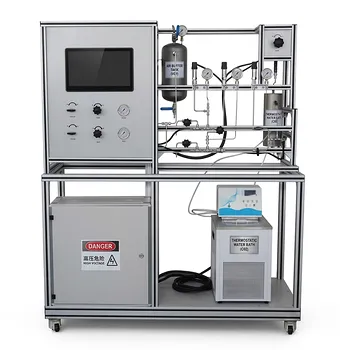
For a fluid transport experiment in a pilot plant, your choice is binary at the highest level: centrifugal pumps for standard conditions, and positive displacement pumps when viscosity, low flow, or high head push you off the curve. If you are moving a low-viscosity fluid at moderate flow rates (roughly 0.25–103 m³/h) against a head of 10–50 meters, a centrifugal pump is the default, trouble-free option. The moment your fluid becomes highly viscous, or you need a tiny, precisely metered flow against a tall column of pressure, you switch to a positive displacement machine—a gear, diaphragm, or reciprocating pump.
A pilot plant’s goal is to teach scaling principles, not to mask them. The core rule is simple: centrifugals reward high-speed, thin-fluid transport with simplicity; positive displacement pumps tame thick, stubborn fluids with brute mechanical force and precise volumetric control. The true skill lies in knowing where the boundary moves when viscosity silently robs a centrifugal pump of its head, flow, and efficiency.
The Decision Framework: Matching Pump to Performance Duty
Pump selection is a three-axis problem. Flow rate, head, and viscosity define distinct operating regions, and each pump class thrives in a specific corner of that map.
Where Centrifugal Pumps Dominate
Centrifugal pumps are the workhorses of pilot-plant fluid transport. Their performance sweet spot sits squarely in the 0.25 to 103 m³/h range, generating heads from 10 to 50 meters.
These machines achieve that by accelerating a fluid with an impeller and converting velocity into pressure. The result is a steady, non-pulsating flow that is gentle on instrumentation and easy to control. For any experiment involving clean water, dilute aqueous solutions, or solvents with a viscosity close to water, this is your first choice. Maintenance is minimal, and the pump curve—flow versus head—is predictable.
When Positive Displacement Pumps Become Mandatory
The need for a positive displacement (PD) pump snaps into focus in two clear scenarios: low-flow, high-head requirements, or highly viscous fluids.
A PD pump traps a fixed volume of fluid and forces it through the discharge. Because it does not rely on fluid momentum, it can generate immense pressure and handle viscosities that would stall a centrifugal impeller. For pilot-plant experiments, these two subtypes cover most needs:
- Gear pumps are purpose-built for viscous oils, polymers, and similar syrupy liquids. They can push against heads up to 200 meters, and their self-priming nature makes them forgiving of suction-side irregularities.
- Diaphragm pumps, operating in the 0.05 to 50 m³/h band, solve a different problem. They offer zero-leakage containment for corrosive, toxic, or sterile fluids, and their stroke-adjustable mechanism makes them ideal metering devices when you need precise volumetric dosing.
The Hidden Shift: How Viscosity Rewrites the Rules
The most common trap in pilot-plant pump selection is assuming the centrifugal pump curve measured with water still holds as the fluid gets thicker. It does not.
When the kinematic viscosity exceeds 20 cSt (a typical oil or glycerol solution), internal friction inside the centrifugal pump rises sharply. The impeller churns, recirculation increases, and the discharge flow actually drops. The pump’s head, flow, and efficiency all degrade, while the required shaft power climbs. If you ignore this, your pump will under-deliver and over-heat.
The correction is empirical. Using standard correction charts, engineers derive three coefficients: (C_Q) for flow, (C_H) for head, and (C_\eta) for efficiency. By multiplying the water-based performance parameters by these coefficients ((Q' = C_Q Q), (H' = C_H H), (\eta' = C_\eta \eta)), you can plot a realistic performance curve for the viscous fluid. This exercise is exactly what a pilot plant should teach—that pump selection is not a one-curve-fits-all problem.
Beyond Flow and Viscosity: Fluid Chemistry Decides Construction
Selecting the pump type only gets you halfway. The pump’s wetted materials and sealing technology must survive the fluid’s chemical aggression, temperature, and solids content.
- For clean, water-like fluids, a standard single-stage centrifugal is sufficient. Multi-stage machines step in when head demands climb, while double-suction impellers handle high flow rates without excessive bearing loads.
- For corrosive acids and bases, corrosion-resistant pumps (often designated F-type) with specialized mechanical seals are mandatory. A standard cast-iron casing would dissolve and contaminate the experiment.
- For high-temperature oils (above 200°C), Y-type oil pumps with cooling jackets protect bearings and seals from thermal damage.
- For slurries or particle-laden streams, P-type impurity pumps use open or semi-open impellers to resist clogging and abrasion.
- For lethal or volatile fluids, magnetic drive pumps eliminate the mechanical seal altogether, using a magnetic coupling to drive the impeller through a solid containment shell, achieving zero leakage.
Understanding the Trade-offs
No pump type is perfect. Recognizing the drawbacks of each choice is what separates a textbook selection from a successful pilot-plant experiment.
- Centrifugal pumps fail with viscosity. The drop in head and efficiency is steep once the 20 cSt threshold is crossed. They also cannot self-prime reliably and are poor metering devices compared to PD alternatives.
- Positive displacement pumps create pulsating flow. Reciprocating and diaphragm pumps, in particular, deliver a sinusoidal flow profile that can confuse sensitive flowmeters, cause pipe vibration, and require pulsation dampeners. Rotary gear pumps produce a gentler but still slightly periodic flow.
- PD pumps are less tolerant of solids. Gear pumps, for instance, can be damaged by hard particles that abrade the meshing elements. Diaphragms can be fatigued or punctured.
- Maintenance shifts from simple to critical. A centrifugal pump typically needs only seal and bearing attention. A gear pump has precise clearances that must be maintained, and a diaphragm pump has a finite-life flexible member that will eventually require replacement.
Making the Right Choice for Your Pilot-Plant Experiment
Selection becomes methodical when you map the fluid’s properties to the operational guardrails of each pump class. Use this decision logic for your next fluid transport experiment.
After a brief introductory sentence, the specific choice depends on which variable is dominant in your teaching or research objective:
- If your primary focus is demonstrating standard process fluid behavior: Begin with a centrifugal pump. Its steady flow and wide operating window make it the clearest tool for teaching pump curves, system curve matching, and the fundamentals of head versus flow.
- If your primary focus is viscous fluid transport or high-pressure, low-flow metering: Choose a gear pump (for high viscosity and head up to 200 m) or a diaphragm pump (for corrosive or precise metering duties). This forces students to grapple with positive displacement principles and pulsation.
- If your primary focus is the impact of fluid properties on pump performance: Design an experiment that runs the same centrifugal pump with water and then with a high-viscosity oil (over 20 cSt). The observed drop in head and flow, corrected by the (C_Q), (C_H), (C_\eta) factors, turns an abstract chart into a visceral lesson.
- If your primary focus is material compatibility and safety: Select a sealless magnetic-drive centrifugal for a volatile or toxic organic, or a diaphragm pump for a corrosive acid. This brings mechanical design and process safety to the forefront.
The pump is never just an on/off switch. In a pilot plant, it is the primary actor that reveals how flow, pressure, and fluid identity interact. Choose the pump that makes that interaction impossible to ignore.
Summary Table:
| Pump Type | Flow Rate | Head Range | Viscosity Limit | Best Use Case |
|---|---|---|---|---|
| Centrifugal | 0.25–10³ m³/h | 10–50 m | < 20 cSt | Clean, low-viscosity fluids (water, solvents) |
| Gear (PD) | Low flow | Up to 200 m | > 20 cSt | Viscous oils, polymers, and syrups |
| Diaphragm (PD) | 0.05–50 m³/h | High | High | Corrosive, toxic, or precise volumetric dosing |
Optimize Your Unit Operations Lab with LABPARK
Equipping your laboratory requires precise, reliable, and scalable equipment. LABPARK provides high-quality Educational and Vocational Unit Operations Pilot Plants in chemical engineering, bioprocess & biotech, and environmental & water treatment.
Designed specifically for universities, research institutes, and enterprises, our pilot plants can be customized with the exact pumping systems and instrumentation your curriculum or research demands. Contact LABPARK today to discuss your setup and receive a tailored technical solution!
Related Products
- Two Phase Flow Pattern Velocity Resistance Measurement Educational Pilot Plant
- Centrifugal Pump Performance and Orifice Flowmeter Calibration Educational Pilot Plant
- Multi Pump Fluid Transport Process Piping Unit Operations Training Pilot Plant
- Chemical Pipeline Assembly and Fluid Transport Practical Training Unit Operations Pilot Plant
- Centrifugal Pump Performance Determination Educational Unit Operations Pilot Plant
People Also Ask
- How to update chemometric calibration models in pilot plants? Best practices for process engineers.
- Why is Peng-Robinson preferred over SRK? Enhance thermodynamic modeling in educational pilot plants.
- Why is continuous measurement preferred over manual sampling in pilot plants? Get real-time kinetic insights.
- How does gas velocity affect static elevation pressure drop? Master the Flanigan Method
- What limits the homogeneous flow liquid ratio in pilot plants, and how is it addressed?