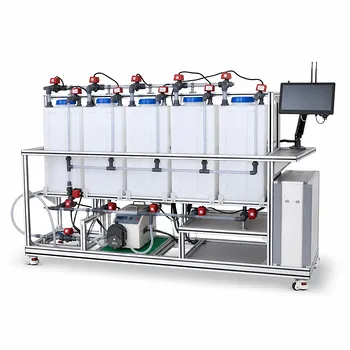
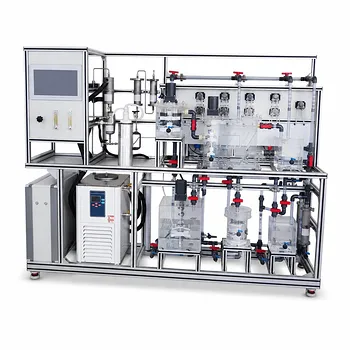
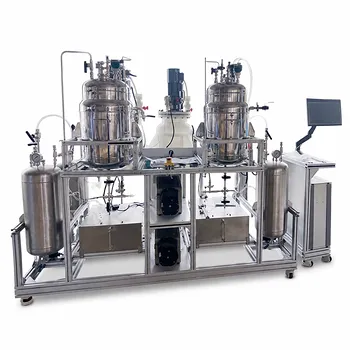
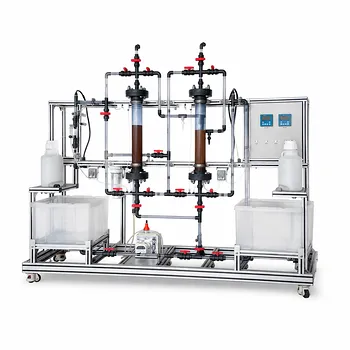
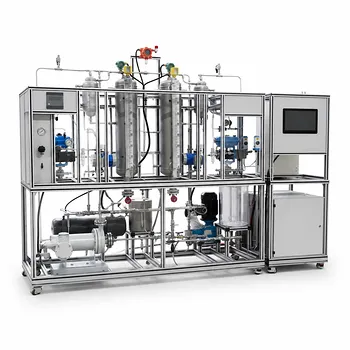
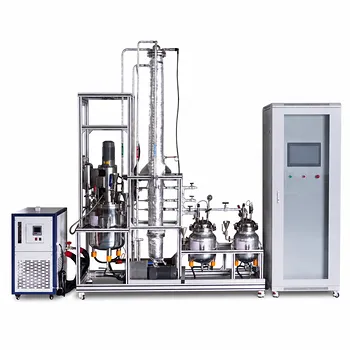
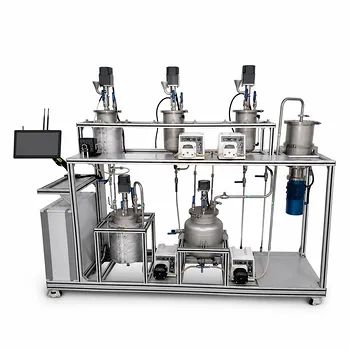
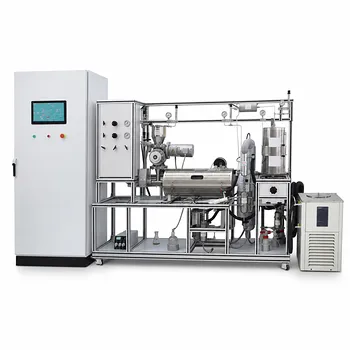
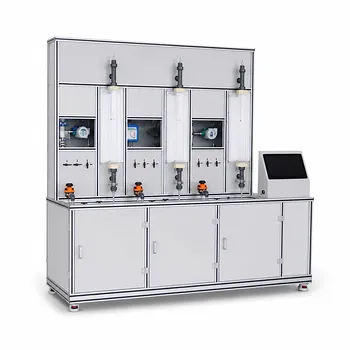
The primary factor in selecting educational separation units is the phase of the target contaminant, not just the phase of the water itself. For a liquid-continuous stream like wastewater, you have a critical fork in the road: is the pollutant a dissolved substance, or is it a suspended solid? Dissolved ions and molecules call for mass-transfer technologies like membrane separation, ion exchange, and adsorption. Suspended, undissolved solids require physical, often gravity-based, separation like sedimentation and filtration. The entire purpose of an educational pilot plant is to make this fundamental distinction tangible, allowing students to see how solubility and particle size dictate technology choice.
The core of educational pilot plant design is matching the phase of the pollutant to the separation principle. Dissolved solids are separated by manipulating chemical potential across a barrier or using a selective solid agent, while suspended solids are separated by exploiting density and size. A well-designed plant lets users measure the stark difference in energy use and mechanism between forcing water through a reverse osmosis membrane and simply letting gravity settle sludge in a sedimentation tank.
The Core Decision: Dissolved vs. Suspended Contaminants
The first and most impactful decision in configuring an educational pilot plant flows directly from the phase of the primary contaminant relative to the water. This isn’t about removing water from the contaminant; it’s about what state the contaminant is in.
Addressing Suspended Solids: The Realm of Physical Separation
When contaminants exist as discrete particles within the liquid, they are in a distinct solid phase. Separation here relies on physical principles, primarily differences in density and size.
Sedimentation is the classic example. It uses gravity to settle denser particles, effectively creating a physical separation between the clarified water and the sludge. An educational plant makes this visible. Students can alter weir heights, vary flow rates, and directly observe the impact on the solid-liquid interface, learning about overflow rates and the concept of particle terminal velocity in real time.
Filtration and hydrocyclones extend this principle. Filtration uses a physical barrier (a screen or deep bed) to trap solids based on size exclusion. A hydrocyclone, conversely, uses centrifugal force to accelerate the density-driven separation, creating a high-shear, compact system. Incorporating these units into a pilot plant visually demonstrates the trade-off between simple gravity systems (low energy, large footprint) and centrifugal systems (higher energy, tiny footprint).
Targeting Dissolved Solids: The Realm of Mass Transfer
When a contaminant, such as salt or heavy metal ions, is completely dissolved, it exists in a single liquid phase. No amount of simple settling or coarse filtration will remove it. You must employ a mass-transfer operation, often involving a solid phase or a selective membrane to "catch" the dissolved species.
Membrane separation, namely reverse osmosis (RO) and nanofiltration (NF), uses a non-porous or semi-porous barrier. The driving force is pressure, applied to overcome the natural osmotic pressure and literally push water molecules through the membrane while rejecting dissolved salts. An educational plant here isn't just a filter; it's a system for demonstrating Fick's law and solution-diffusion models under pressure.
Ion exchange uses a solid resin phase. Dissolved ions like calcium (Ca²⁺) or copper (Cu²⁺) are chemically exchanged for harmless ions like sodium (Na⁺) or hydrogen (H⁺) attached to the resin. A pilot plant column allows students to run breakthrough curves, seeing firsthand the point where the resin's capacity is exhausted and dissolved contaminants begin to "leak" through—a core design lesson in mass transfer zones.
Adsorption uses porous solids like activated carbon. Dissolved organic pollutants physically adhere to the vast internal surface area of the carbon. In an educational setup, running a dye or specific organic pollutant through an adsorption column makes the concepts of isotherms (Freundlich, Langmuir) concrete. Students directly measure how the rate of color removal changes over time, linking pore diffusion theory to a practical, measurable outcome.
Deeper Principles: Driving Forces and System Integration
Once the basic phase logic is mastered, an advanced educational pilot plant must illuminate the "why" behind each technology's efficiency and selectivity. This moves the conversation from "what works" to "how well it works and at what cost."
Dissecting Membrane Operations by Driving Force
The term "membrane separation" is too broad. A sophisticated training plant classifies membrane units by their primary driving force, as this dictates their application and energy consumption.
- Pressure-Driven Processes (RO, NF, UF, MF): These are the workhorses for water treatment. The educational value comes from comparing their pore sizes and operating pressures. Students can learn why an RO system (rejecting ions, high pressure) uses dramatically more energy than a UF system (rejecting viruses, low pressure) by running both in parallel and measuring their respective kilowatt-hours per cubic meter of clean water produced.
- Electrical Potential-Driven Processes (Electrodialysis): Here, the driving force is an electrical field, not hydraulic pressure. Electrodialysis uses ion-exchange membranes to selectively move ions out of the water, ideal for brackish water desalination. Placing an electrodialysis unit next to an RO unit in a pilot plant creates a powerful learning moment: comparing a process that pulls water through a membrane (RO) with one that pulls ions through a membrane (ED).
- Concentration/Temperature-Driven Processes (Membrane Distillation): These bridge thermal and membrane processes. Using a temperature difference to create a vapor pressure gradient, water evaporates and passes through a hydrophobic porous membrane. This system teaches how low-grade waste heat could theoretically be used for treatment, contrasting sharply with the electrical demands of high-pressure pumps.
Understanding Module Configuration and Scalability
The physical packaging of the technology—the module—is a critical educational variable that affects cleaning, fouling, and plant complexity.
Plate-and-frame modules are excellent teaching tools. Their low packing density means they are bulky, but they can be easily disassembled. This visual access makes them perfect for demonstrating basic filtration mechanics and the physical reality of "rejected" solids forming a cake layer. They handle high-fouling streams better for a classroom setting. In contrast, spiral-wound modules represent an industrial reality, balancing compactness with performance. Hollow fiber modules are the extreme, packing immense amounts of surface area into a tiny volume, but the practical lesson they teach is unforgiving: the absolute necessity of pre-filtration, as cleaning a fouled hollow fiber is nearly impossible.
Understanding the Trade-offs
Objectivity in engineering means openly acknowledging that no single unit solves every problem. An educational plant must highlight these conflicting priorities.
- Energy vs. Selectivity: Sedimentation has near-zero energy input but offers zero removal of dissolved molecules. Reverse osmosis offers near-total removal of dissolved salts but carries a high energy penalty. Ion exchange doesn't require the continuous high-pressure of RO, but its sorbent eventually exhausts, requiring a batch regeneration step with chemicals like acid or brine. The plant must teach that higher purity almost always demands higher complexity and a higher energy or chemical footprint.
- Capital vs. Operational Cost: An adsorption column with activated carbon has a lower upfront cost than an RO skid. However, the carbon will become saturated and needs replacement or expensive thermal regeneration, creating an ongoing operational cost. A pilot plant where students calculate and compare these lifecycle costs—RO membrane replacement vs. carbon media rebuy—provides crucial techno-economic evaluation skills.
- Scalability Pitfalls: A process that works perfectly in a lab-scale pilot plant can fail spectacularly when scaled. Adsorption columns are notorious for channeling at a larger scale, while membrane systems face disproportionate hydraulic pressure losses. The pilot plant's highest purpose is to provide a safe, small-scale environment to study these non-idealities—the practical challenges of uneven flow distribution, dead zones, and membrane fouling that textbooks often ignore.
Making the Right Choice for Your Educational Goal
Your selection of pilot plant unit operations must be driven not by a desire to collect every technology, but by the specific mass-transfer principles and industrial contexts you need to illuminate. Choose based on your primary teaching objective.
- If your primary focus is fundamental phase separation: Start with a complete liquid-solid separation loop. Combine a mixing tank for creating a suspended solids slurry, a clear-view sedimentation tank to demonstrate gravitational settling, and a small-scale hydrocyclone to show how centrifugal force accelerates that same separation. This physically illustrates the difference between density-based and force-based separation.
- If your primary focus is advanced water chemistry and dissolved pollutants: Design a multi-column system with ion exchange and adsorption units. This setup directly teaches mass transfer zones and breakthrough curves. Include the necessary chemical dosing pumps for regeneration studies, allowing students to measure the economic and environmental cost of chemical recovery for resins and carbons.
- If your primary focus is membrane technology's driving forces: Construct a modular membrane bench that lets you sequentially swap in plate-and-frame UF, spiral-wound RO, and an electrodialysis stack. The core lesson is comparing energy per-unit permeate by having meters on each dedicated pump and power supply, making the energy-selectivity trade-off a measurable fact, not a theoretical abstraction.
An intelligently selected educational pilot plant is itself a lesson, physically proving that the most effective separation strategy is the one that elegantly matches the separation energy to the phase of the pollutant.
Summary Table:
| Contaminant Phase | Separation Technology | Driving Force / Mechanism | Key Educational Value |
|---|---|---|---|
| Suspended Solids | Sedimentation & Hydrocyclones | Gravity / Centrifugal force | Demonstrates physical settling, velocity, and footprint trade-offs. |
| Dissolved Solids | Membrane Separation (RO/NF/UF) | Hydraulic pressure gradient | Teaches osmotic pressure, Fick's law, and energy consumption. |
| Dissolved Solids | Ion Exchange & Adsorption | Chemical potential / Sorption | Illustrates mass transfer zones, breakthrough curves, and isotherms. |
Bring Industrial-Scale Learning to Your Laboratory
Are you looking to equip your students or researchers with hands-on, practical engineering skills? LABPARK provides state-of-the-art Educational and Vocational Unit Operations Pilot Plants in chemical engineering, bioprocess & biotech, and environmental & water treatment.
Designed specifically for universities, research institutes, and enterprises, our modular plants allow users to explore real-world mass-transfer principles, energy-selectivity trade-offs, and scalability challenges in a safe, controlled environment.
Ready to elevate your training curriculum? Contact LABPARK today to discuss your specific technical requirements and receive a customized solution!
Related Products
- Electrochemical Water Treatment Educational Unit Operations Pilot Plant
- Thermal Desorption Exhaust Gas and Tail Water Treatment Educational Pilot Plant
- Water Electrolysis Hydrogen Production and Storage Educational Pilot Plant
- Ion Exchange Water Purification Educational Pilot Plant for Engineering Unit Operations
- Alkaline Membrane Water Electrolysis Educational Pilot Plant Unit Operations Training System
People Also Ask
- What design features do educational electrochemical pilot plants utilize to manage gas liberation and water loss?
- How can unit operations pilot plants show lead-acid concentration vs state of charge? Real-time monitoring guide.
- How do educational electrochemical pilot plants scale up electrolysis? Master industrial engineering.
- How to Estimate Sulfate in Water Treatment Pilot Plant Deposits: Gravimetric Guide
- How can foaming be managed during steam generation experiments in water treatment unit operations pilot plants? Tips