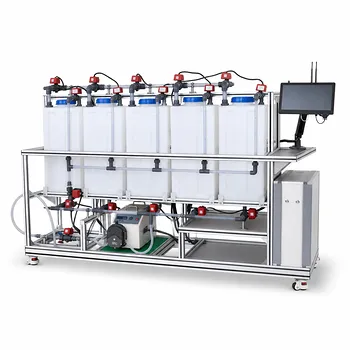
Acid-base neutralization in environmental water treatment pilot plants is the controlled, scaled-up union of hydrogen and hydroxide ions to form water—managed through automated dosing and real-time pH feedback.
In a typical pilot plant, acidic wastewater receives alkaline agents like lime or sodium hydroxide, while alkaline streams are treated with acidic reagents or carbon dioxide. Continuous pH sensors and control loops drive the process toward a target pH band (usually 6–9), giving researchers the power to examine reaction kinetics, fine-tune dosing schemes, and evaluate mass transfer efficiency in real reactors.
The leap from textbook neutralization to pilot-plant operation is not just about adding chemicals—it’s about mastering the dynamics of feedback control, reagent selection, and the subtle equilibrium quirks that can cause pH overshoot, sensor drift, or unintended byproduct formation.
The Chemistry That Powers Wastewater Neutralization
Strong Acid–Strong Base: The Sensitive Sweet Spot
When a strong acid like HCl meets a strong base like NaOH, the reaction goes virtually to completion.
Its equilibrium constant (K = 1.0×10¹⁴) is enormous, and the equivalence point sits precisely at pH 7.
However, the steep pH curve near that point makes control extremely sensitive—a tiny overdose can swing the pH by several units, easily triggering process oscillations in the pilot plant.
Weak Acids and Bases: Why “Neutral” Isn’t Always pH 7
Neutralizing acetic acid (HAc) with NaOH yields an equivalence point that is slightly alkaline because the conjugate base acetate remains in solution.
Conversely, neutralizing ammonia with HCl leaves the solution slightly acidic due to the ammonium ion.
Even though the equilibrium constants are still large (e.g., K = 1.75×10⁹ for HAc–NaOH), ignoring this shift leads to miscalibrated sensors and inaccurate dosing calculations.
Engineering the Neutralization Process in a Pilot Plant
Real-Time pH Monitoring and Feedback Control
Pilot plants rely on automated dosing control loops that read real-time pH sensors and adjust reagent delivery in milliseconds.
Students and operators study how sensor lag and controller tuning affect stability, often observing the classic oscillation that occurs when integral gain is too aggressive.
This hands-on work translates directly to designing robust industrial treatment systems.
Dosing Strategies and Reagent Selection
Neutralizing agents are chosen not just for cost, but for what they leave behind.
Lime (CaO) precipitates sulfate as gypsum (CaSO₄), lowering total dissolved solids and sometimes yielding a salable byproduct.
Ammonia (NH₃) can produce ammonium sulfate, a commercial fertilizer—turning a waste treatment step into a resource recovery opportunity.
Conversely, introducing CO₂ into alkaline wastewater avoids solid residues and offers a cleaner, gas-based neutralization route.
Two-Stage Treatment for Complex Effluents
Industrial esterification (e.g., DOP or ethyl acetate production) generates a cocktail of organic acids, alcohols, and catalyst residues.
Pilot plants model the full cleanup: an initial neutralization tank (using sodium carbonate to reach pH 6–9) followed by a wastewater stripping column that volatilizes and recovers residual organics like ethanol.
This dual-stage approach lets teams optimize chemical dosing while simultaneously measuring VOC recovery and mass transfer coefficients.
Navigating the Trade-offs and Pitfalls
The Danger of pH Overshoot
Because the pH curve near the equivalence point is steep, a small excess of reagent can cause damaging pH overshoot.
Pilot-plant exercises teach operators to set conservative dosing rates, employ cascade control, and use proportional-integral-derivative (PID) loops with carefully tuned parameters to avoid this costly mistake.
Sensor Calibration and Indicator Validation
No sensor is foolproof—drift, fouling, and electrical noise can corrupt readings.
Manual titrations with the right acid-base indicator (e.g., phenolphthalein for strong base titrations, methyl orange for strong acid) serve as validation checks.
The indicator’s transition range must overlap the pH jump of the reaction; otherwise, visual endpoints mislead and dosing calculations go astray.
Byproduct Management and Safety Boundaries
Non-toxic inorganic wastewater can be discharged once its pH falls within 6–10, but streams carrying heavy metals or solvents must be segregated.
Pilot plants reinforce strict waste handling: hazardous effluents are collected in dedicated containers filled to no more than 75% capacity to prevent spills.
Precipitation byproducts like gypsum can scale reactor walls, so students also learn to anticipate maintenance cycles and solids handling.
Making the Right Choice for Your Pilot Plant Goal
- If your primary focus is operator training and control system design: Start with strong acid–strong base systems to expose the fragility of pH control near neutrality and practice authoritative PID tuning.
- If your primary focus is industrial process simulation: Select reagents that mirror real-world trade-offs—lime for byproduct precipitation or ammonia for fertilizer recovery—and integrate downstream unit operations like stripping columns.
- If your primary focus is academic demonstration of equilibrium chemistry: Use weak acid/base neutralizations to showcase why the equivalence point deviates from pH 7, cementing the theory behind indicator and sensor calibration.
By bridging chemical principles with dynamic process control, environmental water treatment pilot plants transform acid-base neutralization from a simple titration curve into a robust toolkit for designing cleaner, safer, and more cost-effective wastewater systems.
Summary Table:
| System Type / Reagent | Key Chemical Characteristic | Operational Focus in Pilot Plants |
|---|---|---|
| Strong Acid–Strong Base | Enormous equilibrium constant ($K=10^{14}$); equivalence at pH 7. | Highly sensitive control; prone to pH overshoot and oscillations. |
| Weak Acid/Base Systems | Equivalence point deviates from pH 7 due to conjugate species. | Complex sensor calibration; critical for academic equilibrium studies. |
| Alternative Reagents (Lime, CO2) | Produces precipitates (Gypsum) or avoids solid residue (gas-based). | Byproduct management; study of scaling, fouling, and solids handling. |
Bring Industrial-Scale Water Treatment Into Your Lab
Accelerate your research, training, and process optimization with state-of-the-art equipment. LABPARK provides premium Educational and Vocational Unit Operations Pilot Plants in chemical engineering, bioprocess & biotech, and environmental & water treatment for universities, research institutes, and enterprises.
Our pilot plants empower you to:
- Master Process Dynamics: Practice PID loop tuning, manage sensor lag, and prevent pH overshoot.
- Simulate Real-World Scenarios: Test alternative reagents like lime or ammonia, and study byproduct recovery.
- Enhance Practical Training: Offer students and operators hands-on experience with industrial-grade dosing systems.
Contact LABPARK today to discuss how our pilot plants can meet your educational and research objectives!
Related Products
- Electrochemical Water Treatment Educational Unit Operations Pilot Plant
- Thermal Desorption Exhaust Gas and Tail Water Treatment Educational Pilot Plant
- Ion Exchange Water Purification Educational Pilot Plant for Engineering Unit Operations
- Water Electrolysis Hydrogen Production and Storage Educational Pilot Plant
- Continuous Batch Extractive Distillation Educational Pilot Plant
People Also Ask
- What design features do educational electrochemical pilot plants utilize to manage gas liberation and water loss?
- How can unit operations pilot plants show lead-acid concentration vs state of charge? Real-time monitoring guide.
- How do educational electrochemical pilot plants scale up electrolysis? Master industrial engineering.
- How to Estimate Sulfate in Water Treatment Pilot Plant Deposits: Gravimetric Guide
- How can foaming be managed during steam generation experiments in water treatment unit operations pilot plants? Tips