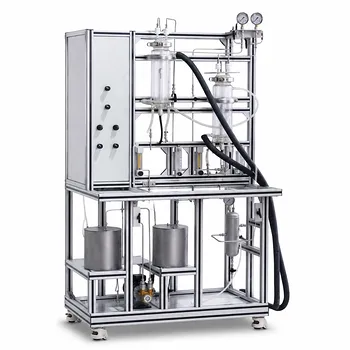
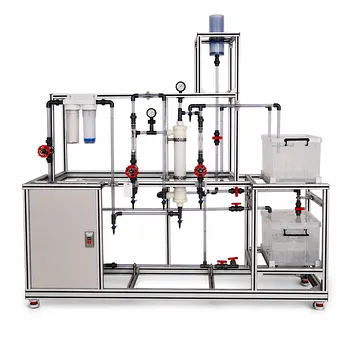
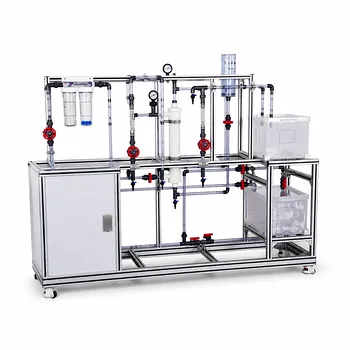
The core of continuous enzymatic bioprocessing with enzyme recovery is a closed-loop system that physically separates the catalyst from the product stream in real time. A membrane filtration loop is coupled directly to the bioreactor: the reaction fluid is continuously pumped through a cross-flow membrane module, where smaller product molecules permeate out for downstream collection while the larger enzyme molecules are retained and recycled back into the vessel. This integration transforms what would be a batch process into a steady-state operation, slashing enzyme consumption and preserving catalyst activity.
The fundamental challenge isn’t just running a reaction—it’s solving the costly paradox of losing a soluble, high-value catalyst every time you harvest product. Integrating membrane separation with enzymatic bioreactors locks the enzyme inside the process loop, enabling continuous removal of product while simultaneously recovering and reusing the enzyme. This marriage of reaction and separation is what makes pilot-scale enzyme-driven syntheses economically viable and educationally powerful.
Why Simple Batch Processing Falls Short for Soluble Enzymes
Enzymatic bioprocesses often use soluble catalysts because they offer excellent mass transfer and high activity. But that solubility creates a recovery nightmare: at the end of a batch, the enzyme is lost with the product stream or poisoned by accumulated inhibitory products.
The economic bottleneck of catalyst loss
High-purity enzymes are expensive, sometimes accounting for the majority of a process’s operating cost. Throwing them away after a single use is simply not acceptable for pilot or production scale. The deep need is for a system that keeps the catalyst working for hundreds of cycles while still allowing continuous, automated product harvesting.
Product inhibition as a hidden brake
Many enzymatic reactions are product-inhibited—as the target molecule builds up, the reaction slows or stops. A standard batch reactor can’t address this. Integrating a membrane allows you to continuously strip away the inhibitory product, maintaining a low concentration in the reactor and driving the reaction forward at maximum velocity. This is a key reason why the combination is so much more efficient than separate reaction and separation steps.
The Recycle-Loop Architecture at the Heart of Integration
The most common integration pattern is the catalyst retention (mobile phase) configuration, and it’s the one most pilot plants train on first.
How the physical circuit works
The bioreactor is connected to a cross-flow (tangential flow) membrane unit. A pump pushes the reaction mixture from the reactor across the membrane surface, parallel to its face. Because the flow is tangential, it constantly sweeps the membrane clean, reducing fouling compared to dead-end filtration. The membrane’s molecular weight cut-off (MWCO) is chosen to be smaller than the enzyme but larger than the product.
Small product molecules (plus water, salts, and any unreacted low-MW substrates) pass through the membrane as permeate and are continuously drawn off. Retained enzyme and any colloidal material stay in the retentate stream, which flows directly back into the bioreactor. Fresh substrate is fed into the reactor to replace what was converted, creating a true continuous operation.
Why cross-flow filtration is the default choice
Cross-flow (tangential) filtration is used over dead-end filtration because it minimizes the build-up of a cake layer. The sweeping action keeps the membrane surface relatively clean for longer periods, which is critical when dealing with biological macromolecules that are prone to gel formation and adhesion. In pilot-plant training, one of the first things users learn is how cross-flow velocity and transmembrane pressure affect this delicate balance.
Mapping the Three Core Configurations
Supplementary research and pilot-plant design reveal three main ways to embed a membrane unit with an enzymatic bioreactor. Understanding these allows you to match the integration strategy to your specific process goal.
1. Catalyst retention (mobile phase) – the workhorse
This is the configuration already described: the membrane is an external loop that physically retains a dissolved enzyme or suspended yeast cells inside the reaction fluid. Only low-MW products pass. It’s the go-to strategy whenever the enzyme is soluble and its molecular weight is significantly larger than the product. Ultrafiltration (UF) membranes with MWCOs in the range of 10–100 kDa are typical for retaining enzymes while letting through sugars, organic acids, or antibiotics.
The pilot-plant value here is enormous. Users learn to characterize enzyme retention efficiency, optimize permeate flux, and diagnose the onset of concentration polarization and fouling—all under conditions that mimic industrial realities.
2. Selective product removal – driving equilibrium
Here, the catalyst is held in a fixed or fluidized bed inside the reactor, physically apart from the membrane. The membrane’s job is narrower: it continuously extracts a specific product component from the reaction mixture. This is used when the enzyme is immobilized or when you want to shift a thermodynamically limited equilibrium. By removing the product as it forms, you keep the reactor in a state where the forward reaction is overwhelmingly favored, leading to higher per-pass yields and less byproduct formation.
In pilot plants, this configuration demonstrates how integration can replace costly separation columns or distillations later in the process, while also serving as a model for process intensification.
3. Catalytically active membranes – the ultimate intensification
The membrane itself becomes the reactor. Enzymes are immobilized directly inside the membrane’s pores or on its surface. As the feed solution passes through, reaction and separation occur in the same physical step. This is less common in large-scale pilot plants due to challenges in controlling enzyme loading and mass transfer, but it’s an excellent teaching tool for advanced process intensification concepts and for R&D labs exploring the miniaturization of bio-catalytic systems.
Understanding the Trade-offs
Integration is powerful, but it’s not a magic wand. The same physics that enables enzyme retention also creates the most persistent operational headache: membrane fouling.
Fouling and flux decline
Proteins, cells, and other biomolecules can adsorb to the membrane surface or block pores. This reduces the permeate flux and, consequently, the rate at which product can be removed. Over time, the back-pressure builds, and cleaning cycles become necessary. In a pilot plant, users quickly learn that the true cost of the process isn’t just the membrane module—it’s managing the flux decline curve and the downtime for chemical cleaning.
Concentration polarization
Right at the membrane surface, a high concentration of retained enzyme and other macromolecules builds up, even with tangential flow. This gel-like layer can change the effective MWCO of the membrane and even denature sensitive enzymes due to local pH or shear effects. Pilot training focuses on adjusting cross-flow velocity and transmembrane pressure to push the polarization layer away without damaging the enzyme.
Catalyst deactivation isn’t eliminated
Membrane reactors retain the enzyme, but they don’t make it immortal. Shear forces in the pump and across the membrane surface can mechanically denature enzymes over time. The integrated system is still subject to thermal or chemical deactivation; it just makes the most of the enzyme’s active lifetime. Understanding this trade-off—retention vs. shear stress—is a key learning outcome in any bioprocess pilot plant.
Making the Right Choice for Your Pilot-Scale Goal
The integration method you choose should be driven by the specific problem you’re solving, not by the appeal of a single technology. Use this decision framework to guide your pilot-plant design or training module.
- If your primary focus is enzyme cost reduction and continuous operation: Implement a cross-flow UF membrane loop for mobile-phase catalyst retention. This directly recycles the soluble enzyme and decouples product harvesting from catalyst life.
- If your primary focus is overcoming product inhibition and pushing equilibrium: Opt for selective product removal with an immobilized enzyme bed and a membrane tuned to extract only the target product. This maximizes yield per pass and reduces downstream separation load.
- If your primary focus is demonstrating the ultimate in process intensification: Explore catalytically active membrane modules. Reserve this for advanced R&D pilots where the goal is to merge reaction and separation into a single unit operation, acknowledging the added complexity of enzyme immobilization and mass transfer design.
The membrane-bioreactor loop is not just a piece of equipment—it’s the strategic bridge that turns a simple enzymatic reaction into a viable, continuous manufacturing process. Master its integration, and you solve the deep needs of catalyst economics, product purity, and scalable process intensification all at once.
Summary Table:
| Integration Configuration | Primary Goal | Membrane Function |
|---|---|---|
| Catalyst Retention | Enzyme cost reduction & continuous operation | Retains soluble enzymes in loop; product permeates out |
| Selective Product Removal | Shifting equilibrium & avoiding inhibition | Removes target product continuously from immobilized enzyme bed |
| Catalytically Active Membranes | Process intensification | Enzymes immobilized in membrane; reaction & separation occur together |
Bring advanced bioprocess engineering to life in your facility. LABPARK provides state-of-the-art Educational and Vocational Unit Operations Pilot Plants in chemical engineering, bioprocess & biotech, and environmental & water treatment. Designed specifically for universities, research institutes, and enterprises, our systems offer hands-on training in continuous membrane separation, enzyme recovery, and bioreactor integration.
Ready to elevate your training and research capabilities? Contact LABPARK today to customize your pilot plant system!
Related Products
- Photocatalytic Membrane Separation and Degradation Unit Operations Pilot Plant
- Multi-Functional Membrane Separation Educational Pilot Plant for Unit Operations Lab
- Multifunctional Membrane Separation Educational Pilot Plant with Ultrafiltration, Nanofiltration, Reverse Osmosis
- Ultrafiltration Membrane Separation Educational Pilot Plant
- Hollow Fiber Ultrafiltration Membrane Separation Educational Pilot Plant
People Also Ask
- What are the key differences in membrane configurations? Choose the Right Unit Operations Pilot Plant
- How Do Pervaporation, Vapor, and Gas Permeation Differ in Pilot Plants? Key Comparison
- What are the structural & performance trade-offs of flat-sheet, spiral-wound, & hollow-fiber membrane modules?
- How do PEI, PVDF, and PSU membranes compare in pilot plants? Find the best fit.
- Pervaporation vs. Vapor Permeation: Handling Suspended Solids in Membrane Pilot Plants