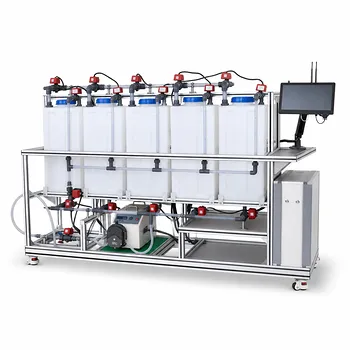
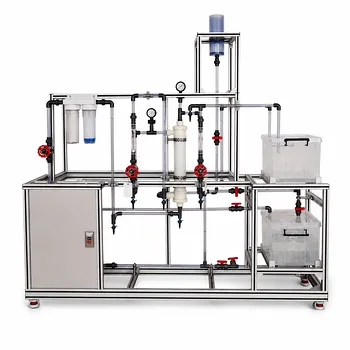
Understanding ion transference numbers is the key to turning an educational electrodialysis (ED) pilot plant into a powerful, quantitative teaching tool. This foundational concept defines the fraction of current carried by each ion, directly dictating membrane selectivity and separation efficiency. By grasping this, you can select a plant that enables rigorous measurement, not just demonstration, and you can operate it to teach how voltage, flow, and ionic properties drive real-world desalination and resource recovery.
Without a firm grasp of transference numbers, an ED pilot plant is merely a black box that desalinates water. With it, the same equipment becomes a transparent model of electrochemical engineering, revealing how ion size, charge, and membrane chemistry determine separation feasibility. This knowledge bridges the gap between Hittorf-method theory and industrial process control, preparing students for the complexities of environmental and bioprocess unit operations.
From Theory to Practice: What Ion Transference Numbers Reveal
In educational settings, the primary value of a pilot plant is not its throughput but its ability to make invisible processes visible. Ion transference numbers provide the conceptual lens for that visibility.
Defining the Core Metric
The ion transference number ($t_i$) is the fraction of total electric current carried by a specific ion species during migration. It is not a fixed material constant; it depends on the ion’s mobility, concentration, and the surrounding electrolyte environment. In an ED unit, this property directly controls which ions cross the membrane and at what rate.
Bridging the Hittorf Method and Industrial Scale
Classic physical chemistry labs measure transference numbers via the Hittorf method—a precise but slow bench-scale experiment. An educational pilot plant elevates that lesson. Students can now manipulate flow rates and current densities in a continuous system, then calculate current efficiency ($\eta_i$) in real time. This bridges the gap between ideal, static transport cells and dynamic, multi-compartment industrial separators.
Why Selectivity Matters for Plant Selection
A membrane’s “perfect” selectivity is a function of the transference number for the target ion. If an anion-exchange membrane has a transference number of 0.98 for chloride ions, 2% of the current is still carried by competing cations—a direct measure of leakage. When selecting a pilot plant, you must ensure it has the instrumentation to quantify this leakage. A system that only reports outlet conductivity cannot teach selectivity; one with in-line ion monitoring or the ability to sample individual compartments can.
How Transference Principles Guide Plant Operation
Once you have selected a plant capable of quantitative study, operating it according to transference-based principles transforms routine desalination into a lesson in system optimization and troubleshooting.
Setting Parameters with Precision
Operation is not about simply turning up the voltage. Understanding limiting current density—the point where ion transport at membrane surfaces becomes mass-transfer limited—is critical. When current exceeds this threshold, a phenomenon called water splitting occurs, wasting energy and changing the pH locally. Teaching operators to identify this limit by observing a sudden drop in current efficiency (derived from transport principles) builds valuable instinct for industrial-scale process safety.
Measuring Performance: Current Efficiency vs. Transport Number
It is vital to distinguish between the pure transport number ($t_i$, measured under suppressed diffusion) and the practical current efficiency ($\eta_i$). In a running pilot plant, concentration gradients inevitably drive osmotic transport and back-diffusion, so $\eta_i$ is always less than $t_i$. A well-designed educational exercise compares these two values across different flow rates. This teaches future engineers that real-world separation performance is a composite of electrical migration and unwanted mass transfer—a lesson no textbook can deliver as powerfully.
Diagnosing Issues Through Transport Data
A gradual decay in current efficiency, without a change in operating voltage, often signals membrane fouling or scaling. Because the transference number approach links electrical measurements to mass transport, students learn to infer physical membrane conditions from electrical signals. For example, when scaling blocks ion pathways, the effective transference number decreases, and the cell resistance climbs. Monitoring these trends turns troubleshooting into a structured, scientific inquiry rather than guesswork.
Selecting the Right Pilot Plant for Educational Depth
Not all ED pilot plants are created equal. Your choice should be directly informed by the deep need to teach transference-driven separation science, not just the surface goal of desalinating water.
Essential Measurement Capabilities
To leverage transference numbers pedagogically, the plant must include:
- Adjustable DC power supply with precise voltage and current readouts.
- Multiple flow meters on concentrate and dilute streams to maintain hydraulic balance.
- Conductivity probes on feed, product, and ideally individual cell compartments.
- Sample ports for off-line ion chromatography to calculate individual ion transference numbers. Plants lacking these features reduce learning to qualitative observation of “clean water out,” missing the quantitative core of membrane science.
Material Choices and Membrane Considerations
The membrane itself is the core component, its selectivity determined by fixed charged groups in the polymer matrix. When selecting a plant, consider the variety of membrane types it accepts. Units that allow swapping of cation- and anion-exchange membranes with differing charge densities enable studies on how ion size and charge influence transference numbers. For instance, students can observe that small, highly charged ions like Mg²⁺ carry disproportionately more current than larger, singly-charged ions like Na⁺, due to stronger electrostatic interactions and higher mobility in the membrane phase. This microscopic insight directly informs macroscopic decisions in water softening, resource recovery, and chemical purification.
Integrating with Broader Unit Operations Curriculum
The selection must also consider how the ED unit fits into a larger educational framework. Phase-separation principles are universal. A well-chosen ED plant sits alongside ion exchange, nanofiltration, and adsorption units, allowing students to compare how charge-driven migration differs from steric rejection or resin-based selectivity. This integrated approach teaches that selecting the right separation technology always begins by understanding the charge-to-size ratio of target solutes—a concept rooted in transference and transport theory.
Understanding the Trade-offs: Limitations and Pitfalls
No educational tool is without its constraints, and an ED pilot plant is no exception. A deep understanding of transference numbers also illuminates their limitations.
The Critical Distinction Between Transport Number and Current Efficiency
The pure transport number ($t_i$) is an idealized concept obtained under conditions that suppress concentration gradients. In actual operation, the current efficiency is always lower. A plant that does not facilitate measurement of both can mislead students into thinking membrane performance is better than it realistically is. Always select a system that allows the controlled introduction of concentration polarization to teach this crucial distinction.
When Stack Design Masks the Fundamentals
Some compact educational ED stacks have very narrow flow channels and minimal electrode rinse compartments. While convenient, these designs often suffer from severe concentration polarization even at moderate currents, making it difficult to isolate the true transference number behavior from hydraulic effects. Operators may mistakenly attribute poor performance to membrane selectivity when the real cause is poor flow distribution. A careful balance between stack complexity and pedagogical clarity is essential.
The Fouling Paradox
Membrane fouling is an unavoidable reality that degrades performance over time. From a teaching perspective, this is both a nuisance and a powerful lesson. A plant that is too robust may never show a meaningful drop in current efficiency, denying students the chance to diagnose and mitigate fouling. Conversely, one that fouls too quickly disrupts lab schedules. The ideal educational plant should include a controlled fouling experiment module—for example, using a calcium sulfate solution—to demonstrate how scaling reduces effective transference numbers and how chemical cleaning restores them.
Making the Right Choice for Your Educational Goal
When selecting and operating an ED pilot plant, align your purchase decisions and lab protocols with your primary learning outcome.
- If your primary focus is fundamental physical chemistry: Choose a plant with multi-compartment sampling and a sensitive ammeter. Focus on measuring $t_i$ at varying concentrations and current densities, comparing results to Hittorf method literature values.
- If your primary focus is environmental engineering and water treatment: Prioritize a plant that can handle real brackish or wastewater streams. Emphasize monitoring current efficiency, limiting current density, and membrane fouling rates over time.
- If your primary focus is industrial process simulation: Select a unit that mirrors commercial stack geometry and can operate in continuous, multi-pass mode. Use transference number concepts to teach energy optimization and the value of staging.
- If your primary focus is a broad unit operations overview: Integrate the ED plant with ion exchange and nanofiltration units. Use the charge-to-size ratio and transference number as the common analytical thread to explain selectivity differences across all three technologies.
Ultimately, ion transference numbers are not just a line in a physical chemistry textbook—they are the operating language of electrodialysis. By making them the cornerstone of your pilot plant selection and operation, you equip students with a predictive, quantitative framework that turns a simple desalination run into a masterclass in separation science.
Summary Table:
| Key Concept | Role in ED Pilot Plant | Pedagogical Value |
|---|---|---|
| Ion Transference Number ($t_i$) | Defines the fraction of current carried by a specific ion species. | Bridges static physical chemistry theory (Hittorf method) to dynamic industrial separation. |
| Current Efficiency ($\eta_i$) | Measures actual ion transport while accounting for back-diffusion. | Teaches students how concentration gradients and osmosis impact real-world performance. |
| Limiting Current Density | Marks the boundary where water splitting and pH changes occur. | Guides operators on parameter safety and energy optimization in stack design. |
| Membrane Selectivity | Determines transport purity and prevents competing ion leakage. | Illustrates the relationship between ion charge/size and separation feasibility. |
Elevate Your Engineering Curriculum with LABPARK
Are you looking to bridge the gap between electrochemical theory and hands-on industrial practice? LABPARK provides premium Educational and Vocational Unit Operations Pilot Plants in chemical engineering, bioprocess & biotech, and environmental & water treatment.
Designed specifically for universities, research institutes, and enterprises, our pilot plants feature the precise instrumentation, adjustable power supplies, and multi-compartment sampling required to quantitatively analyze ion transference, current efficiency, and membrane fouling.
Contact our laboratory specialists today to find the ideal pilot plant configuration for your department!
Related Products
- Electrolytic Hydrogen Production Educational Unit Operations Pilot Plant
- Electrolyte Distillation Purification and Formulation Educational Pilot Plant
- Alkaline Membrane Water Electrolysis Educational Pilot Plant Unit Operations Training System
- Water Electrolysis Hydrogen Production and Storage Educational Pilot Plant
- Electrochemical Water Treatment Educational Unit Operations Pilot Plant
People Also Ask
- In educational chemical engineering pilot plants, why use absorption and adsorption before reforming?
- How do chemical engineering unit operations pilot plants demonstrate catalytic high-purity hydrogen production from methane?
- SMR, POX, or ATR? Trade-offs in Hydrogen Production Educational Pilot Plants
- How do educational unit operations pilot plants address safety and waste management when scaling up?
- How do educational unit operations pilot plants bridge theory and industrial process development? Hands-On Learning