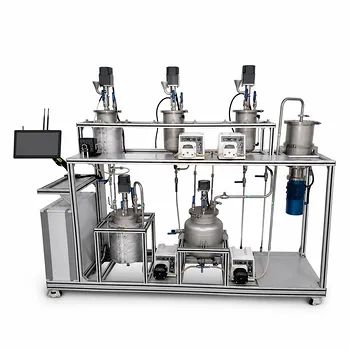
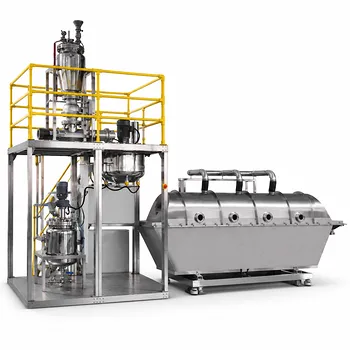
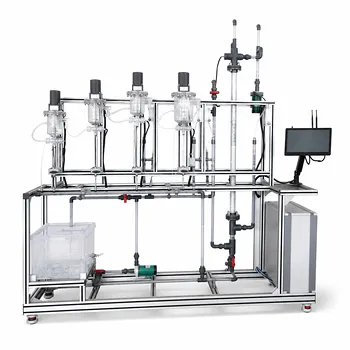
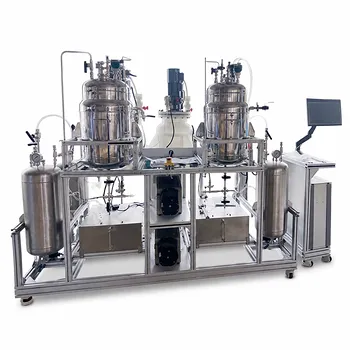
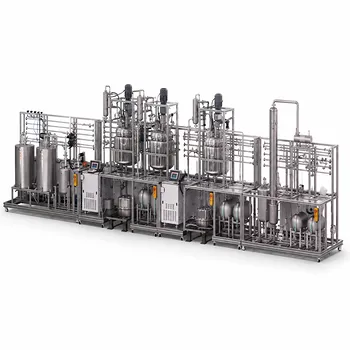
The simple act of shaking a flask of carrot roots masks a universe of engineering complexity that must be explicitly designed into an educational pilot plant. The transition requires converting every manual lab-scale operation—mixing, temperature control, reaction monitoring, and product extraction—into an engineered, scalable unit operation. At a minimum, this means integrating a stirred-tank bioreactor with precise cooling to maintain temperatures below 28°C, adjustable agitation to study oxygen transfer and shear, automated sensing to replace manual thin-layer chromatography (TLC), and modular downstream separation equipment. These features directly enable students to investigate mass transfer limitations, heat dissipation challenges, and parameter optimization, bridging the conceptual gap between benchtop chemistry and industrial biotechnology.
To teach scale-up, an educational pilot plant must do more than just run a biocatalytic reaction at larger volume. It must turn the invisible constraints of the laboratory flask—heat removal, oxygen delivery, mixing efficiency, and manual product recovery—into visible, measurable, and tunable engineering variables that students can manipulate and understand.
From Pipette to Pump: Capturing the Essence of the Lab Process
The laboratory-scale bioreduction of ketones using plant tissues, such as carrot roots, is deceptively simple. Students rely on manual shaking, ambient or incubated temperature control, TLC for reaction progress, and a benchtop extraction with a separatory funnel. Scaling this up for training purposes means deliberately engineering each of those steps so that the underlying physics become the curriculum.
The Flawed Simplicity of Flask-Scale Biocatalysis
In a typical undergraduate laboratory, a 250 mL Erlenmeyer flask holds the entire biocatalytic system. Mixing comes from an orbital shaker, temperature from the room or a basic incubator, and oxygen from the headspace. These conditions are homogeneous only because of the small scale. The moment you increase volume, concentration and temperature gradients appear, and the reaction no longer behaves as students expect. An educational pilot plant must make these gradients evident and measurable, not hidden.
The Non-Negotiable: Precise Temperature Control Below 28°C
Plant-tissue biocatalysts, like the carrot root system, require temperatures below 28°C to maintain enzyme activity and prevent degradation. At the flask scale, heat dissipation is effortless because the surface-area-to-volume ratio is enormous. In a pilot-plant bioreactor, that ratio plummets, and metabolic heat from even mild biological activity can create hot spots. Therefore, the primary design requirement is an active cooling system—cooling jackets, internal coils, or an external heat exchanger—capable of tightly controlling temperature and compensating for the reduced natural dissipation. This immediately teaches students the critical role of thermal management in scaling any bioprocess.
Engineering the Learning Environment: Core Reactor Design Requirements
Once temperature control is secured, the reactor itself becomes the vehicle for exploring mass transfer, shear, and mixing. The design must not merely automate the old flask; it must make the key engineering parameters adjustable and their effects observable.
Agitation and Mass Transfer: From Shaking to Stirring
In the flask, oxygen transfer is passive and unquantified. In the pilot plant, the bioreactor must include a variable-speed agitator and a controllable gas sparging system. This allows students to manipulate and measure:
- Volumetric oxygen transfer coefficient ($k_La$) by changing the agitation rate and airflow.
- Power-to-volume ratio (P/V) to compare mixing intensity across scales.
- Impeller tip speed and its link to shear stress, a prime cause of plant-cell damage.
By systematically varying these parameters, students directly experience why maintaining geometric similarity is not enough—dynamic similarity, governed by mixing time and mass transfer, often dictates the success of scale-up.
Automated Monitoring vs. TLC: Closing the Feedback Loop
Manual TLC is an efficient, low-cost monitoring method at the bench, but it provides only periodic snapshots. An educational pilot plant should replace this with inline or at-line sensors for dissolved oxygen, pH, and ideally reactant/product concentration (e.g., via near-infrared or Raman spectroscopy). This design choice transforms the plant from a scaled-up batch reactor into a platform for teaching process analytical technology (PAT) and feedback control. Students learn how a real industrial process is monitored and controlled without opening the vessel, a lesson impossible to convey with a silica gel plate.
The Hidden Half: Downstream Processing as a Design Imperative
Many educational programs treat downstream processing as an afterthought. The biocatalytic reduction of ketones into chiral alcohols, however, demonstrates that the product’s value is only realized after extraction and purification. An effective pilot plant must therefore incorporate the downstream unit operations right alongside the bioreactor.
Beyond the Reactor: Solid-Liquid Separation and Extraction
At the laboratory scale, the product is recovered by simply filtering out the plant tissue and performing a liquid-liquid extraction in a separatory funnel. The pilot-plant design must replicate this sequence with engineered equipment: a cross-flow filtration system or a decanter centrifuge for solid-liquid separation, and a continuous extraction column or mixer-settler for product recovery. By connecting these modules, students grapple with yield losses, solvent recycling, and the very real constraint that a bioreactor’s output quality is meaningless without an efficient harvest train.
Understanding the Trade-offs
No single pilot-plant design is perfect. Balancing pedagogical value with practical and financial limits forces deliberate choices.
- Geometric similarity versus standard components: True geometric scale-down of an industrial reactor often demands custom vessels and impellers. Using off-the-shelf glass bioreactors may sacrifice some similarity but gains visualization, cost savings, and ease of cleaning—often the right trade-off for teaching.
- Flexibility versus industrial realism: A modular plant with quickly interchangeable sensors, impellers, and downstream units teaches breadth. A fixed, highly automated skid mimics an industrial control room but can obscure the underlying physics. For education, exposing the process rather than hiding it behind a control panel usually provides deeper learning.
- Instrumentation density versus simplicity: Every added sensor is a potential point of confusion but also an opportunity. Over-instrumenting can overwhelm students; under-instrumenting fails to demonstrate why real-time data is transformative. The design must align with the specific learning objectives of the course.
- Shear protection versus mixing efficiency: Plant cells and tissues are shear-sensitive. Aggressive agitation can rupture cells and ruin the biocatalyst. The pilot plant must teach this tension by allowing students to observe how reducing impeller speed to protect biomass also reduces $k_La$ and, ultimately, reaction rate—a classic industrial optimization problem.
Making the Right Choice for Your Educational Goals
How you configure a bioprocess pilot plant depends entirely on what you want your students to internalize. Base your design decisions on the primary learning outcome.
- If your primary focus is teaching fundamental scale-up principles: Ensure the bioreactor has a transparent vessel, variable-speed agitation, and a sparging system that allows students to measure $k_La$ and mixing time, directly correlating power input with mass transfer.
- If your primary focus is complete process integration: Design the pilot plant with modular downstream units (filtration, extraction) directly adjacent to the bioreactor, so students experience the choreography and material-flow constraints of running an entire biocatalytic cascade.
- If your primary focus is process control and automation: Equip the system with real-time sensors for temperature, pH, dissolved oxygen, and product concentration, enabling students to develop and tune feedback control loops that replace manual TLC monitoring.
- If your primary focus is biocatalyst-specific handling: Select gentle agitation designs (marine impellers, axially pumping blades) and low-shear solid-liquid separation techniques, while including protocols for biomass viability monitoring.
A well-designed educational pilot plant does more than mimic industry—it demands that students confront the same physical laws that constrain all large-scale biocatalysis. When the humble carrot-root reduction becomes the vehicle for understanding heat transfer, mass transfer, and shear, the lesson lasts far beyond the laboratory.
Summary Table:
| Bioprocess Parameter | Laboratory Scale (Flask) | Educational Pilot Plant Design |
|---|---|---|
| Temperature Control | Ambient/Incubator (passive heat dissipation) | Active cooling (jackets/coils) to maintain < 28°C |
| Mixing & Mass Transfer | Passive orbital shaking | Variable agitator & gas sparging ($k_La$ & shear study) |
| Process Monitoring | Manual Thin-Layer Chromatography (TLC) | Inline sensors (DO, pH, PAT integration) for real-time control |
| Downstream Processing | Separatory funnel & basic filtration | Modular cross-flow filtration & extraction columns |
Scale Up Your Bioprocess Education with LABPARK
Bridging the gap between benchtop chemistry and industrial biotechnology requires hands-on, scalable equipment. LABPARK provides state-of-the-art Educational and Vocational Unit Operations Pilot Plants in chemical engineering, bioprocess & biotech, and environmental & water treatment.
Designed specifically for universities, research institutes, and enterprises, our modular and highly instrumented pilot plants empower students and researchers to master heat transfer, oxygen delivery, shear control, and downstream processing.
Ready to elevate your training facility? Contact our engineering experts today to find the perfect pilot plant configuration for your curriculum.
Related Products
- Bio-fermentation Ethanol Production Practical Training Unit Operations Pilot Plant
- Natural Product Extraction Unit Operations Training Pilot Plant
- High-Gravity Emulsification and Mass Transfer Educational Pilot Plant
- Continuous Batch Extractive Distillation Educational Pilot Plant
- Polymerization Granulation and Pellet Processing Educational Unit Operations Pilot Plant
People Also Ask
- Why Use PTFE & Hastelloy in Chemical Pilot Plants? Prevent Corrosion & Ensure Safety
- Why Compare Predicted and Experimental Excess Enthalpy? Key to Accurate Pilot Plant Scale-up
- Why is the chemical plant startup schedule crucial? De-risk scale-up with pilot plants.
- When to transition from PID to adaptive control in pilot plants? Key process indicators.
- Why must batch and fed-batch fermentation pilot plants be designed to accommodate changing rheological conditions?