Your chosen support material is the invisible hand that sets a pilot plant’s thermal and operational boundaries. ZnO/carbon entrapped sorbents lock you into low‑temperature, non‑regenerable polishing—they live at stack exit temperatures and act as a last‑line guard. ZnO/SiO2 entrapped sorbents, in contrast, are built for high‑temperature (≈400 °C) regenerable bulk H2S removal, often in a continuous batch mode. This binary choice immediately dictates the reactor heating load, the presence or absence of a regeneration loop, the allowable pressure drop, and the frequency of sorbent replacement. Add microfibrous entrapment and the same SiO2 chemistry can deliver a 14‑fold jump in ZnO utilization and nearly triple the breakthrough time, reshaping the pilot plant’s cycle length and bed dimensions.
The chemical carrier—carbon or silica—defines the thermal ceiling and regenerability, which in turn sets the pilot plant’s unit‑operation requirements; the physical architecture (entrapped vs. extruded) then fine‑tunes mass transfer, dictating breakthrough time, utilization, and pressure drop. Together they are the master switches that decide whether a pilot plant runs a simple, single‑use polishing trap or a complex, high‑temperature swing‑bed system.
The Support Material as the Architect of Pilot Plant Operations
Each support class opens a distinct operational pathway. Understanding these pathways explains why the choice ripples through every parameter an operator monitors.
Carbon‑Based Supports: Low‑Temperature Polishing Without Regeneration
ZnO/carbon entrapped sorbents are designed for the tail end of a gas stream. They operate at the relatively cool temperatures found after a process cooler or at stack conditions, typically below 200–250 °C.
Their carbon matrix cannot withstand high‑temperature oxidative regeneration without burning off. That makes them single‑use polishers. The pilot plant, therefore, needs no regeneration skid, no steam lines for regeneration, and no SO2 scrubbing—just a simple, once‑through, replaceable bed.
This support is chosen when the goal is to guarantee sub‑0.1 ppm sulfur slip, protecting a downstream synthesis catalyst or fuel cell from even trace poisons. The pilot plant’s main operational concern becomes bed life at a given inlet sulfur load, not thermal swing logistics.
Silica‑Based Supports: High‑Temperature Regenerable Bulk Capture
ZnO/SiO2 entrapped sorbents unlock the bulk‑removal regime. They thrive at 350–400 °C, right in the sweet spot where the reaction ZnO + H2S → ZnS + H2O is both kinetically fast and thermodynamically favorable.
The silica carrier provides thermal stability and a robust skeleton for repeated oxidation‑regeneration cycles. This enables a continuous batch mode: while one bed captures H2S, another is regenerated with an air‑steam mixture, converting ZnS back to ZnO and releasing SO2. The pilot plant must now include a high‑temperature furnace or heater, a regeneration gas supply, a switching valve network, and an off‑gas scrubber—all of which become primary operating parameters.
How Support Selection Translates to Operating Parameters
The carrier material doesn’t just sit there; it actively constrains the numbers on the pilot plant’s control screens.
Temperature Profile and Energy Input
With carbon‑entrapped ZnO, the pilot plant’s preheater may be small or absent—the sorbent operates at the temperature of the upstream process gas. The energy input is minimal, and the risk of thermal runaways is low.
With silica‑entrapped ZnO, the reactor must be held at a steady 350–400 °C. This demands a dedicated furnace or heat exchanger, a tight temperature control loop, and a measurable fraction of the pilot plant’s total utility consumption. Regeneration adds another thermal cycle, often requiring steam to moderate the exotherm and prevent sintering.
Regeneration and Bed Life Cycle
Carbon‑based sorbents are non‑regenerable. Their operational parameter is “saturation time”—when the bed is spent, the pilot plant shuts down for a sorbent swap. Bed life is a direct function of the inlet H2S concentration and the total bed capacity.
Silica‑based sorbents operate in a cyclic batch mode. The key parameters are the adsorption‑cycle duration (breakthrough time), the regeneration‑cycle duration, the number of cycles the sorbent can survive before physical degradation, and the switching frequency between beds. When microfibrous entrapment is used, breakthrough time can stretch from 4.5 hours to 12 hours, directly lengthening the adsorption cycle and reducing the number of switchovers per day.
Pressure Drop and Mass Transfer Efficiency
The physical form of the support—extrudate pellets vs. microfibrous entrapped sheets—radically alters mass transfer.
Traditional 1–2 mm ZnO/SiO2 extrudates show poor ZnO utilization (around 4 %) because most of the ZnO is buried in a diffusion‑limited interior. Microfibrous entrapment of nano‑dispersed ZnO cuts the diffusion path length to near zero, boosting utilization to 57 %. In the pilot plant, this means the same volume of sorbent does more work, permitting a shorter bed with a lower pressure drop for the same throughput—or a longer run time at the same pressure drop.
For carbon‑entrapped sorbents, the bed is usually thin, and pressure drop is rarely a primary constraint. The operational focus stays on sulfur capacity per kilogram of sorbent.
Understanding the Trade‑offs
Every choice forces a compromise. A clear‑eyed view of the downsides prevents misapplication in the pilot plant.
The Carbon Polishing Trap—Single Use and Sulfur Capacity
Carbon supports limit you to a once‑through consumable. Once the ZnO is fully sulfided, replacement is the only option. For streams with higher sulfur loads, bed life becomes inconveniently short, and the cost of sorbent replacement can dominate operating expenses. Carbon may also adsorb heavy hydrocarbons that foul the ZnO surface, further reducing effective capacity.
The Silica Regeneration Challenge—Thermal Energy and Sorbent Degradation
Silica‑based systems demand continuous high‑temperature operation and a regeneration infrastructure. The energy needed to heat the regeneration air and steam is a significant operating cost. Moreover, repeated oxidation cycles can sinter the ZnO clusters—especially if the regeneration exotherm spikes—gradually reducing the sorbent’s active surface area and its breakthrough time. The pilot plant must monitor regeneration temperature profiles closely to avoid irreversible capacity loss.
Making the Right Choice for Your Pilot Plant Goal
The best support material is the one that aligns with your specific demonstration objective. Let that objective guide the selection.
- If your primary focus is evaluating a final‑polishing solution for ultra‑low sulfur slip: Choose a ZnO/carbon entrapped sorbent and measure bed‑outlet H2S concentration, bed life, and sorbent exchange frequency under realistic stack‑gas temperatures.
- If your primary focus is demonstrating a regenerable, bulk‑desulfurization process in a continuous mode: Select a ZnO/SiO2 entrapped sorbent, preferably in a microfibrous form, and optimize the adsorption‑cycle temperature, regeneration‑gas composition, and switching timing to hit target breakthrough times and sorbent utilization.
- If your primary focus is studying mass transfer limitations and pressure‑drop trade‑offs: Compare microfibrous entrapped versus traditional extruded forms of the same silica‑supported sorbent, keeping all other parameters constant to isolate the impact of intraparticle diffusion on breakthrough and bed pressure drop.
The support material is not a minor detail; it is the decision that writes the pilot plant’s operating manual. Choose it deliberately, and the plant becomes a powerful tool for understanding real‑world desulfurization dynamics.
Summary Table:
| Support Material | Operating Temp | Regeneration | Main Application | Key Benefit |
|---|---|---|---|---|
| Carbon-Based | Low (<200–250 °C) | Non-regenerable (Once-through) | Trace H2S polishing | Low energy, sub-0.1 ppm slip |
| Silica-Based | High (350–400 °C) | Regenerable (Cyclic batch) | Bulk H2S removal | Long-term reuse, thermal stability |
Optimize Your Gas Purification Research with LABPARK
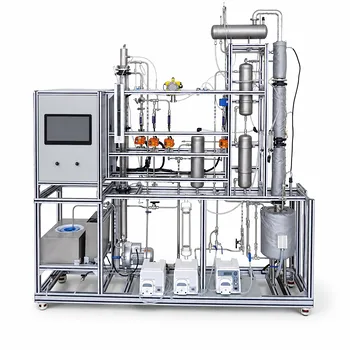
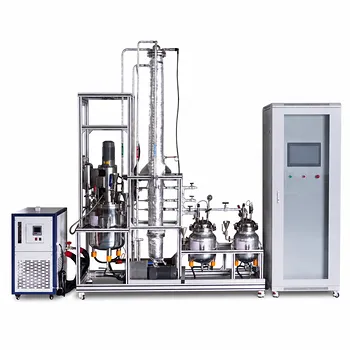
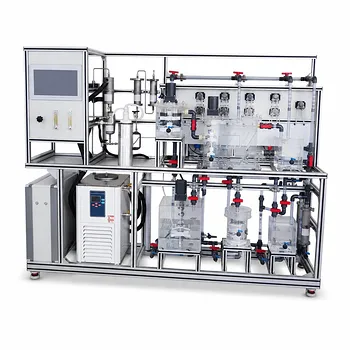
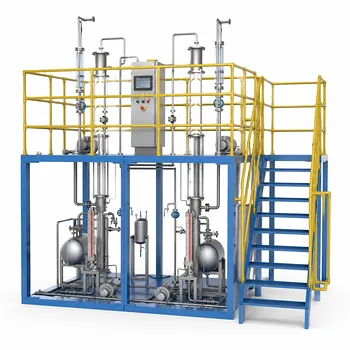
Are you looking to scale up your desulfurization studies? LABPARK provides premium Educational and Vocational Unit Operations Pilot Plants in chemical engineering, bioprocess & biotech, and environmental & water treatment. Designed for universities, research institutes, and enterprises, our systems deliver the precise thermal control and modular flexibility required to evaluate advanced sorbent technologies.
Contact our experts today to design a pilot plant tailored to your research goals!
Related Products
- Carbon Dioxide Absorption and Desorption Educational Pilot Plant for Carbon Capture Studies
- Carbon Material Thermal Pretreatment Multiphase Separation Educational Pilot Plant
- Absorption and Desorption Educational Unit Operations Pilot Plant
- Thermal Desorption Exhaust Gas and Tail Water Treatment Educational Pilot Plant
- Dual-Mode Gas Absorption and Desorption Unit Operations Training Pilot Plant
People Also Ask
- How does operating pressure influence the transition between absorption and desorption in a CO2 pilot plant?
- How do temperature variations affect CO2 transport models in pilot plants? Model vs Reality
- What unit operations are critical for CCUS training pilot plants? Build hands-on engineering expertise.
- How do electrolytes affect phase equilibrium in absorption pilot plants, and how to calculate it?
- Why is critical surface tension key in column internals? Optimize gas absorption pilot plant efficiency