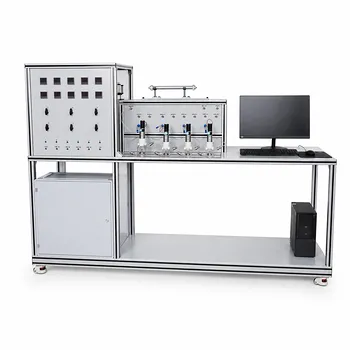
The fundamental difference lies in the engineering philosophy applied to a successful laboratory reaction. The traditional "scale-up" method takes a small reaction and makes the vessel larger, which inevitably alters the physical conditions of the chemistry itself. The continuous microreactor "scale-out" strategy completely bypasses this problem by replicating the exact, proven, small-scale channel geometry thousands of times, running these identical units in parallel. You are not making the reaction bigger; you are running many identical reactions side-by-side for longer periods.
The core insight is that scaling is a physical transport problem, not a volumetric one. Scale-out preserves the perfect mixing and heat transfer of the micro-world by simply multiplying it, a concept called "numbering up." This eliminates the most dangerous, time-consuming, and expensive phase of traditional chemical engineering: the iterative, empirical reactor redesign.
The Historical Problem with "Scale-Up"
To understand the advantage of scaling out, you must first appreciate the limitation of scaling up. Traditional chemical engineering relies on a predictive, yet often treacherous, path from the lab bench to the pilot plant.
The Non-Linear Physics of Larger Vessels
When you increase the volume of a stirred tank or a tubular reactor, the surface-area-to-volume ratio collapses. This single change fundamentally alters the behavior of a reaction. A flask that effortlessly dissipates heat on a magnetic stirrer becomes a dangerously insulated cauldron at 1000x volume, where runaway exotherms are a real risk.
The Re-Optimization Tax
Traditional scale-up is therefore a process of re-optimization. You must re-evaluate mixing dynamics because the fluid flow paths are completely different in a larger vessel. You must recalculate heat transfer coefficients to avoid hot spots that destroy product or cause safety incidents. Each step in size demands new pilot plant data to troubleshoot a reaction that already worked perfectly in the lab. This makes scale-up inherently slow and capital-intensive.
The "Scale-Out" Paradigm: Numbering Up
Continuous flow chemistry introduces a new physical domain where scaling is achieved through parallelization, not enlargement. The goal shifts from building a bigger box to deploying more of the same box.
Internal vs. External Numbering Up
Internal scale-up is a dangerous middle ground where you simply increase the channel diameter from, say, 100 microns to 2 millimeters. While tempting for a quick throughput boost, this immediately causes a significant loss in transport performance, reintroducing the very mixing and heat transfer limitations that microreactors are designed to solve.
True numbering-up preserves the critical micro-channel dimensions. By keeping the channel exactly as the chemist designed it, you maintain the extraordinarily high mass and heat transfer rates. For highly exothermic reactions, this isn't just beneficial—it's mandatory. Simple channel enlargement is insufficient; safety and purity demand the perfect thermal control only true micro-dimensions can provide.
Rigorous Chemistry from Milligrams to Kilograms
This strategy enables a direct translation of results. The research team develops a process on a single microfluidic chip producing micrograms per hour. To reach pilot-scale production of kilograms per day, the engineer simply deploys a stack of identical chips, fed by a precise fluid distribution system. The chemistry—its kinetics, selectivity, and thermal profile—remains untouched because the reaction environment is a carbon copy. You are not scaling a reaction; you are duplicating its preferred habitat.
Understanding the Trade-offs of Scale-Out
While philosophically superior for transport, the scale-out strategy is not a utopian solution. It introduces a new bottleneck: fluid distribution. Ensuring perfectly even flow and pressure drop across hundreds of parallel channels is a formidable engineering challenge. If one channel clogs or flows slightly faster, its reaction time changes, and product quality can plummet.
Furthermore, the true transition from a single lab chip to an industrial plant requires a holistic system design. It is insufficient to just stack reactors. A functional pilot plant must integrate large-capacity feed systems, standardized docking platforms, and advanced real-time sensorics for process control. The chemical synthesis must also be specifically re-engineered to tolerate the continuous nature of the flow, removing problematic solids or finding alternative solvents. The scale-out advantage is only as strong as its weakest distribution manifold.
Making the Right Choice for Your Transition
Your strategy depends entirely on what you are optimizing for. The pilot plant exists to verify behavior at an intermediate scale, and your approach should align with your end goal.
- If your primary focus is dangerous, highly exothermic chemistry: Scale-out via true numbering-up is not optional. The safety and selectivity provided by preserved micro-channel transport performance outweigh the complexity of the fluid distribution engineering.
- If your primary focus is getting to market with a fast, iterative pilot phase: Scale-out offers a massive speed advantage by eliminating the re-optimization tax. Once the lab process is defined, it is effectively a deployable production module.
- If your primary focus is a robust but simple process with low thermal risk: The economic trade-off may favor cautious internal scale-up or a traditional batch pilot, as the distribution engineering overhead of a full numbering-up system can be a complex burden without a safety-driven reason to adopt it.
The machine you build must replicate the perfect microenvironment, not just the container volume.
Summary Table:
| Feature | Traditional Scale-Up | Microreactor Scale-Out (Numbering Up) |
|---|---|---|
| Core Approach | Increase vessel size | Replicate identical micro-channels in parallel |
| Heat & Mass Transfer | Collapses as volume increases | Preserved due to constant micro-dimensions |
| Safety & Runaway Risk | High risk of exotherms | Minimal risk; precise thermal control |
| Re-optimization Need | High (demands new pilot-scale data) | Low (direct translation from lab scale) |
| Primary Challenge | Non-linear physics & mixing dynamics | Fluid & pressure distribution engineering |
Transition Safely from Lab to Pilot Scale with LABPARK
Successfully moving from laboratory discovery to pilot-scale chemical production requires reliable engineering and precise control. LABPARK offers advanced Educational and Vocational Unit Operations Pilot Plants in chemical engineering, bioprocess & biotech, and environmental & water treatment.
Whether you are a university, research institute, or enterprise, we deliver the robust, educational, and vocational pilot systems you need to master process scaling.
Contact our engineering team today to find the perfect pilot plant solution for your lab!
Related Products
- 100L Continuous Loop Hydrogenation Educational Unit Operations Pilot Plant
- Micro-Scale Gas-Solid Catalytic Reaction Educational Pilot Plant
- Continuous Batch Extractive Distillation Educational Pilot Plant
- Multi-Reactor Educational Pilot Plant for Reaction Engineering Unit Operations
- Multi-Functional Special Distillation Educational Pilot Plant
People Also Ask
- How do deviations in estimating latent heat impact pilot plant thermal systems? Avoid hardware mis-sizing.
- How to study gasification in pilot plants? Compare exit gas composition & efficiency
- Why Use PTFE & Hastelloy in Chemical Pilot Plants? Prevent Corrosion & Ensure Safety
- Why is the chemical plant startup schedule crucial? De-risk scale-up with pilot plants.
- Why Compare Predicted and Experimental Excess Enthalpy? Key to Accurate Pilot Plant Scale-up