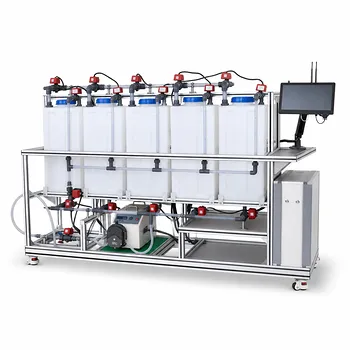
The efficiency and safety of your water treatment pilot plant hinge on the invisible dance of electrons. The atomic orbital energy level crossover in transition metals directly dictates their ability to change oxidation states, a property that determines how you design reduction tanks, optimize chemical dosing, and select real-time monitoring to turn toxic dissolved metals into removable particles.
At the heart of pilot plant design is leveraging this quantum phenomenon: the same crossover that gives iron, manganese, and chromium their variable oxidation states is what enables you to chemically convert a highly toxic species like Cr(VI) into the benign, precipitable Cr(III). Mastering this principle transforms a heavy metal from a threat into a manageable solid.
The Quantum Origin of Variable Oxidation States
The flexibility of transition metals in water treatment begins at the subatomic level.
How 4s and 3d Energies Switch
In lighter elements like potassium and calcium, the 4s orbital sits lower in energy than the 3d, so electrons fill it first. As you move across the periodic table, increasing nuclear charge and electron shielding cause a crossover: the 3d energy drops below the 4s. This creates a set of frontier orbitals—4s and 3d—that are extremely close in energy.
Impact on Transition Metal Behavior
Because the energy gap between these orbitals is so small, transition metals can lose or share electrons from both levels with minimal energetic penalty. This is the molecular basis for their multiple stable oxidation states. An iron atom can exist as Fe²⁺ or Fe³⁺; chromium as Cr(III) or Cr(VI); manganese as Mn(II), Mn(IV), or Mn(VII). The energy crossover makes these states readily interchangeable through simple chemical or biological redox reactions.
Translating Atomic Properties to Pilot Plant Operations
Your pilot plant must exploit this redox flexibility to meet discharge limits. The design and operation pivot on three practical pillars.
Designing Redox Steps for Toxic Oxidation States
The most critical application is chromium removal. Hexavalent chromium [Cr(VI)] is highly toxic and soluble, while trivalent chromium [Cr(III)] is an essential nutrient and readily precipitates as hydroxide. A pilot plant must include a dedicated chemical reduction unit—typically dosed with ferrous sulfate or sodium metabisulfite—to convert Cr(VI) to Cr(III) before any filtration step. The orbital crossover that enables this conversion is the only reason the treatment is chemically feasible under ambient conditions.
Optimizing Precipitation Through Oxidation State Control
For iron and manganese, the target oxidation state dictates the entire treatment chain. Dissolved Fe²⁺ must be oxidized to Fe³⁺ to form the insoluble Fe(OH)₃ floc, a process controlled by aeration and elevated pH. Manganese requires stronger oxidation (to MnO₂) often via potassium permanganate. Operators who understand that the destabilized 4s/3d electron configuration governs these reactions can precisely tune dissolved oxygen and redox potential, avoiding under-dosing that leaves metals in solution.
Leveraging Spectroscopic Monitoring
The unique electron configuration, including the post-crossover orbital energies, produces a distinct spectral fingerprint for each oxidation state. UV-Vis or atomic absorption spectrophotometers in a pilot plant detect these quantized electron transitions—for example, when a valence electron absorbs specific wavelengths to jump between d-orbitals. This allows real-time monitoring of Cr(VI) concentration at 540 nm after complexation, verifying that the reduction unit is fully converting the toxic form before the stream reaches a student sampling port or a downstream ion-exchange column.
Understanding the Trade-offs
While exploiting orbital crossover for redox treatment is powerful, several pitfalls demand objective consideration.
- Over-reduction or re-oxidation: If the reduction potential is pushed too far or dissolved oxygen is not stripped after treatment, Cr(III) can inadvertently re-oxidize back to Cr(VI), especially in the presence of free chlorine or manganese oxides.
- Sensor drift and interference: Spectroscopic methods that differentiate oxidation states often suffer from interference from turbidity or organic matter, requiring frequent recalibration that can stall a teaching lab operation.
- Chemical consumption complexity: Redox dosing is stoichiometrically linked to the incoming metal concentration. Without a reliable online oxidation-reduction potential (ORP) sensor, operators risk chemical overdosing that sludges the plant or under-dosing that violates discharge permits.
Making the Right Choice for Your Pilot Plant Goal
Your design should align the fundamental chemistry with the plant's specific research or training mission.
- If your primary focus is chromium remediation research: Install a packed-bed chemical reduction reactor and pair it with an online UV-Vis spectrophotometer to demonstrate and validate the Cr(VI)-to-Cr(III) conversion in real time.
- If your primary focus is teaching unit operations: Build explicit control loops for pH and dissolved oxygen around the iron/manganese oxidation tank, so students can directly observe how orbital energy concepts translate into floc formation.
- If your primary focus is optimizing chemical consumption: Use an ORP controller to meter the reducing agent, relying on the electrode to sense the abrupt potential shift that occurs when all metallic species with variable 4s/3d configurations have been fully converted to their target state.
Understanding the energy level crossover that governs these metals is not just an academic exercise—it is the key to transforming a pilot plant from a set of tanks and pipes into a precisely controlled molecular engineering platform.
Summary Table:
| Metal & State Change | Treatment Mechanism | Key Pilot Plant Design Element |
|---|---|---|
| Cr(VI) → Cr(III) | Chemical reduction (metabisulfite/ferrous) | Dedicated reduction tank & UV-Vis monitoring |
| Fe(II) → Fe(III) | Aeration and pH-controlled oxidation | Aeration tank, pH control loop, flocculator |
| Mn(II) → Mn(IV) | Strong chemical oxidation (permanganate) | Precision dosing pump & ORP controller |
Bring Molecular Chemistry to Life in Your Lab
Teaching how subatomic orbital crossover impacts real-world environmental engineering requires hands-on, highly precise equipment. LABPARK provides state-of-the-art Educational and Vocational Unit Operations Pilot Plants in chemical engineering, bioprocess & biotech, and environmental & water treatment.
Specifically engineered for universities, research institutes, and enterprises, our pilot plants feature advanced pH, DO, and ORP control loops that allow students and researchers to safely manipulate and monitor complex redox reactions in real time.
Ready to elevate your training curriculum or research scaling? Contact LABPARK today to discover our custom pilot plant solutions!
Related Products
- Electrochemical Water Treatment Educational Unit Operations Pilot Plant
- Thermal Desorption Exhaust Gas and Tail Water Treatment Educational Pilot Plant
- Ion Exchange Water Purification Educational Pilot Plant for Engineering Unit Operations
- Water Electrolysis Hydrogen Production and Storage Educational Pilot Plant
- Continuous Batch Extractive Distillation Educational Pilot Plant
People Also Ask
- What design features do educational electrochemical pilot plants utilize to manage gas liberation and water loss?
- How can unit operations pilot plants show lead-acid concentration vs state of charge? Real-time monitoring guide.
- How do educational electrochemical pilot plants scale up electrolysis? Master industrial engineering.
- How to Estimate Sulfate in Water Treatment Pilot Plant Deposits: Gravimetric Guide
- How can foaming be managed during steam generation experiments in water treatment unit operations pilot plants? Tips