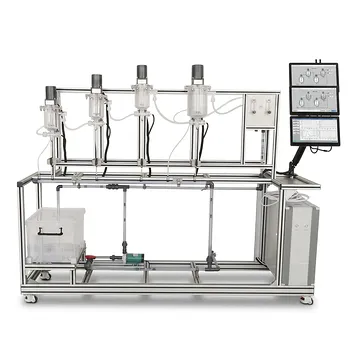
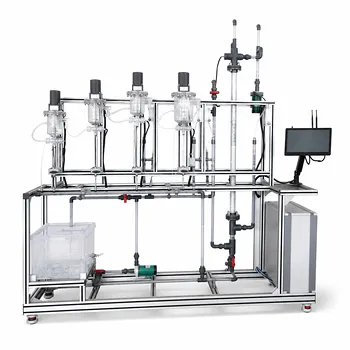
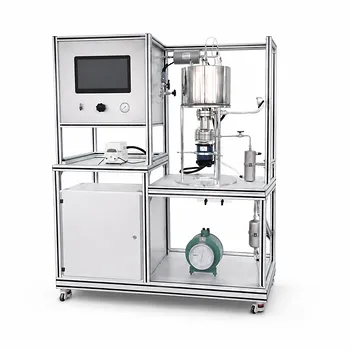
Parallel reactor arrays are the cornerstone of modern catalyst R&D, delivering the ability to screen dozens of catalyst formulations simultaneously while generating the high-fidelity data essential for reliable process scale-up. In academic research and vocational training, these platforms directly bridge the gap between micro-scale chemistry and pilot-plant reality. They compress months of sequential testing into days, give researchers and students precise control over reaction parameters, and build an intuitive understanding of how to transition a molecule from a laboratory concept to a commercial product.
The core insight is this: parallel reactor arrays don’t just accelerate screening—they fundamentally change the scale-up paradigm. By forcing every sample to compete under identical, industrially-relevant conditions, they provide inherently scalable data and serve as a living curriculum in process intensification and modern automation.
From Sequential to Simultaneous: The High-Throughput Advantage
The traditional single-reactor approach creates a bottleneck. Evaluating a catalyst library of 100 candidates requires running 100 individual experiments, each needing setup, stabilization, and cleanup. Parallel systems shatter this barrier.
How Simultaneous Operation Transforms Screening Speed
Instead of one sample at a time, these arrays test multiple catalysts concurrently under the same temperature, pressure, and flow conditions. This high-throughput capability turns the screening phase from a months-long survey into a targeted sprint. In naphtha isomerization research, for example, systems generate thousands of data points across a wide parameter space in a fraction of the time, rapidly isolating which zeolite-based formulations outperform traditional chlorinated alumina.
This acceleration is not just about speed—it fundamentally changes how researchers ask questions. They can afford to map a much broader compositional space, exploring combinations that would have been dismissed as too low-probability in a sequential world. This leads to unexpected, high-performance leads.
Building a Scalable Data Foundation
The value of speed is lost if the data don’t translate to larger reactors. That’s why the design of these arrays centers on plug-flow hydrodynamics and precise, individualized temperature measurement inside each catalyst bed. By miniaturizing the reactor while retaining the fundamental mass and heat transfer characteristics of industrial units, the kinetic data collected is representative. When a candidate stands out in the array, the results are already a first-pass validation, not just a curiosity from a micro-titer plate.
Ensuring Data That Scales: The Heart of Process Development
A catalyst that works beautifully in a 100-microliter channel can fail dramatically in a 100-liter bed due to heat transfer limitations or unanticipated fluid dynamics. The parallel array’s design directly addresses this, embedding the principles of scale-up into the discovery workflow.
Operating in the Staged Development Workflow
The power of parallel screening becomes clear when placed in the full innovation pipeline: Parallel -> Micro/Lab -> Pilot -> Demo -> Commercial. The array is the front-end filter. It rapidly winnows a large candidate pool down to one or two viable leads. Those leads then graduate to unit-operations pilot plants, where engineers validate performance under the realistic flow patterns and holdup times that only a larger, integrated system can provide.
Understanding this flow is critical training for students. They learn firsthand that a high-throughput “hit” is a candidate for scale-up, not a finished product. The array teaches them to design experiments that anticipate the demands of the pilot plant, focusing on stability, selectivity, and impurity profiles rather than just conversion.
The Automation and Control Layer
Precision isn’t manual. These systems rely on tightly integrated automation and informatics modules, typically orchestrated via platforms like LabVIEW. The hardware must execute fully unattended, multi-step protocols: ramping temperatures, adjusting flow rates, triggering gas chromatograph injections, and activating safety alarms—all for every reactor in parallel. This real-time control ensures that the “identical conditions” promise is kept and creates a rich, timestamped dataset for kinetic modeling. For a student, learning to configure and troubleshoot this automation is a direct lesson in Industry 4.0 manufacturing techniques.
Parallel Systems as a Vocational Training Accelerator
Vocational and undergraduate chemical engineering programs must produce graduates who are immediately productive, not just theoretically aware. Parallel reactor installations are a concentrated training environment.
Safe, Hands-On Exposure to Complex Processes
These systems operate with very small reactant volumes, which inherently enhances safety. This allows students to safely study complex, industrial-grade gas-phase reactions—like syngas conversion to alkanes or C5 isomerization—that would be too risky or expensive in a full pilot plant. They can make mistakes, push control limits, and observe the consequences without catastrophic failure.
Teaching Process Intensification by Doing
The array is a physical embodiment of modern chemical engineering principles: microfluidics, process intensification, and real-time informatics. Instead of reading about plug-flow reactors, students design a test campaign for them. They load catalysts with microliter-scale precision, monitor individual bed temperatures, and correlate that data directly with their yields. This moves the curriculum from abstract math to a tangible, problem-solving experience that mirrors the daily work in a R&D lab.
Understanding the Trade-offs of Parallel Arrays
For all their power, these systems are not a panacea. A technically sound evaluation must acknowledge their limitations and the demands they place on the lab.
The Hidden Cost of High-Volume Data
While the operation and maintenance costs are lower than equivalent sequential testing, the initial capital outlay for a quality, multi-channel system with full automation is significant. Moreover, the flood of data requires robust informatics planning. Without a clear strategy for data capture, labeling, and analysis, a lab can quickly drown in unprocessed chromatograms, making the speed advantage meaningless.
Ensuring True Comparability is an Active Struggle
The central promise is that all reactors experience identical conditions. In reality, flow maldistribution, minute differences in catalyst packing density, or a 1°C offset in a thermocouple can introduce systematic bias. The design must include rigorous individual channel control, and the user must constantly verify uniformity with standard catalyst baselines. For vocational training, this is actually a benefit—it teaches critical troubleshooting—but for a screen that must be bulletproof, it requires constant vigilance.
The Gap Between Screening and Realistic Scalability
Even the best parallel array approximates, but does not fully replicate, the hydrodynamics of a large-scale, integrated pilot plant. There is always an inherent risk that a catalyst optimized in a micro-channel will not withstand the mechanical and thermal strains of a multi-kilogram bed over weeks of continuous operation. The array accelerates the screening phase but does not eliminate the necessity of dedicated pilot-plant runs.
Making the Right Choice for Your Research or Training Goal
The implementation of a parallel reactor array must be guided by a clear primary objective. The system specification and operational philosophy change depending on whether you are optimizing for discovery, validation, or education.
- If your primary focus is rapid catalyst screening: Prioritize the number of parallel channels and the depth of automation. Your goal is to exhaustively map parameter space, so invest in informatics that can handle thousands of data points and find patterns without human bias.
- If your primary focus is generating directly scalable data: Obsess over the quality of a few reactors. Ensure each channel has verified plug-flow characteristics and individual bed thermocouples. Your success metric is not speed but the predictive accuracy when a candidate moves to the pilot plant.
- If your primary focus is vocational training excellence: Select a robust, safe system with transparent, configurable automation. The array should be a platform for teaching modular design, sensor calibration, and process troubleshooting, not just a black box for producing results. Downtime for learning is an investment, not a failure.
By aligning the system’s design with your core mission, a parallel reactor array becomes far more than a piece of equipment—it becomes your laboratory’s engine for innovation and its most profound teaching tool.
Summary Table:
| Aspect | Key Benefits | Challenges & Trade-offs |
|---|---|---|
| Catalyst Screening | High-throughput testing, rapid parameter mapping, faster discovery | High data volume requires robust informatics and analysis strategy |
| Process Scale-up | Representative kinetic data, plug-flow hydrodynamics, predictable translation | Micro-channel dynamics do not fully replicate large pilot plants |
| Vocational Training | Safe hands-on experience, Industry 4.0 automation, active troubleshooting | Significant initial capital cost; requires regular calibration |
Elevate Your Chemical Engineering Research and Training with LABPARK
Are you looking to bridge the gap between laboratory discovery and industrial scale-up? LABPARK provides advanced Educational and Vocational Unit Operations Pilot Plants tailored for universities, research institutes, and enterprises across key sectors:
- Chemical Engineering (including parallel reactors & catalyst screening platforms)
- Bioprocess & Biotechnology
- Environmental & Water Treatment
Our systems empower students with hands-on, safe industrial training while providing researchers with the high-fidelity, scalable data needed for commercial success.
Contact LABPARK today to design the ideal pilot plant solution for your laboratory or training facility!
Related Products
- Multi-Stage Stirred Tanks in Series Residence Time Distribution and Mixing Performance Determination Educational Pilot Plant
- Multi-Reactor Educational Pilot Plant for Reaction Engineering Unit Operations
- Residence Time Distribution and Reactor Flow Characteristics Determination Educational Pilot Plant
- Multi Functional Catalytic Reaction and Reactor Evaluation Educational Unit Operations Pilot Plant
- Methane Cracking Educational Unit Operations Pilot Plant
People Also Ask
- How does MRF model impeller rotation in CFD? Key Boundary Conditions Explained
- How can a CSTR pilot plant demonstrate reactor staging? Visualize volume savings.
- What parameters to monitor transitioning from Batch to CSTR? Master Pilot Plant Setup
- How does steady-state multiplicity affect the operation and safety of exothermic reactions within a CSTR pilot plant? - Guide
- Why is temperature regulation via a cooling jacket a critical feature in CSTR pilot plants used for laboratory training?