Polar mixtures defy ideal-gas assumptions. Standard vapour-phase models, which treat the gas phase as ideal or use simple cubic equations of state, consistently under-predict non-idealities when molecules carry strong dipoles or hydrogen-bond. The Hayden-O’Connell correlation solves this by directly embedding molecular descriptors—dipole moment, mean radius of gyration, and a chemical-association parameter—into the calculation of the second virial coefficient. This yields accurate vapour-phase fugacity coefficients for polar‑polar and polar‑non‑polar pairs, dramatically improving vapour‑liquid equilibrium (VLE) predictions in unit operations like distillation, absorption, and stripping, particularly in pilot‑plant settings.
Vapour‑liquid equilibrium models for polar mixtures collapse when the vapour phase is treated as ideal. The Hayden‑O’Connell correlation restores physical realism by translating molecular structure into the second virial coefficient, closing the gap between simulation predictions and actual pilot‑plant performance.
Why Standard Vapour‑Phase Models Fail for Polar Mixtures
The Ideal‑Gas Assumption and Its Limits
Many early VLE calculations rely on the ideal‑gas law for the vapour phase, setting all fugacity coefficients to unity.
This simplification works for non‑polar hydrocarbons at low pressure, but it ignores the strong dipole‑dipole forces and association that polar molecules experience.
When methanol or trimethylamine are present, the vapour phase behaves far from ideal even at modest pressures.
Ignoring these forces leads to incorrect K‑values, which cascade into erroneous tray‑to‑tray profiles and unrealistic product specifications.
When Simple Cubic Equations Fall Short
Standard cubic equations of state (Peng‑Robinson, Soave‑Redlich‑Kwong) improve on the ideal‑gas assumption by introducing attractive and repulsive terms.
However, their generic mixing rules are not parameterized for specific polar interactions like hydrogen‑bonding or chemical dimerization.
These equations are often fitted to vapour‑pressure and critical properties of non‑polar fluids.
In a polar system, the missing physics manifests as large systematic errors in the vapour‑phase fugacity, especially for associating components such as organic acids or amines.
How the Hayden‑O’Connell Correlation Captures Real Behaviour
The Second Virial Coefficient as a Bridge to Reality
The virial equation of state expresses the compressibility factor Z as a series:
(Z = 1 + \frac{B}{V} + \frac{C}{V^2} + ...)
Truncating after the second virial coefficient (B) retains precisely the term that captures pairwise molecular interactions—the most important source of vapour‑phase non‑ideality at low to moderate pressures.
Hayden‑O’Connell provides a predictive method to estimate (B) (and cross‑coefficients (B_{ij})) without relying on experimental mixture data.
This turns the virial equation into a practical, physically grounded tool for polar systems.
Molecular Parameters That Define Polar Interactions
The correlation builds (B) from three ingredients that directly reflect molecular reality:
- Dipole moment: quantifies the permanent charge asymmetry that drives strong alignment forces between polar molecules.
- Mean radius of gyration: represents molecular size and shape, accounting for steric effects and the distance over which interactions occur.
- Association parameter (η): explicitly models chemical association, such as the dimerization of carboxylic acids or the hydrogen‑bond networks of water and alcohols.
These parameters are either available from property databases or estimated from group-contribution methods, making the approach accessible even for novel molecules.
By folding them into expressions for the second virial coefficient, Hayden‑O’Connell injects the missing physics directly into the vapour‑phase fugacity calculation.
Predicting Cross‑Interactions for Mixed Systems
In a mixture, the cross‑coefficient (B_{ij}) describes how two dissimilar molecules interact.
Hayden‑O’Connell uses combining rules for the molecular parameters, so the polar‑to‑polar or polar‑to‑non‑polar interaction is predicted from pure‑component data alone.
This capability is essential for whole‑plant simulations where a distillation column might handle a dozen components.
It ensures that the vapour‑phase correction for each binary pair is physically consistent, not just a tuned empirical match.
Practical Impact on Pilot Plant and Unit Operation Modelling
Matching Simulation to Real Distillation Trains
In a pilot‑plant distillation column separating methanol from trimethylamine, an ideal‑vapour model would underestimate the vapour‑phase fugacity of the associating components.
The simulated temperature profile would not match the measured temperatures, and the predicted composition break would be off.
By switching the vapour‑phase model to Hayden‑O’Connell, the second virial coefficient automatically introduces the correct fugacity corrections.
The simulated overhead and bottoms compositions then align with pilot‑plant data, giving researchers confidence in the model for scale‑up.
Enabling Accurate Process Scale‑Up
Reliable VLE is the foundation of every equilibrium‑stage calculation in distillation, absorption, and stripping columns.
When the vapour‑phase model accounts for polar non‑idealities, the required number of stages, reflux ratio, and heat duties become trustworthy.
That trust is what allows an engineer to scale from a pilot‑plant column to a commercial unit without expensive over‑design.
Hayden‑O’Connell effectively bridges the gap between a simple thermodynamic model and the complex reality of polar mixtures.
Understanding the Trade‑offs
The correlation is designed for the gas‑phase fugacity only.
It must be paired with an accurate liquid‑phase activity‑coefficient model (e.g., NRTL, UNIQUAC) to fully describe VLE; it does not replace the liquid‑side treatment.
The virial equation truncated at the second coefficient is valid only at low to moderate densities—typically below 1.5–2 bar or where the reduced density is small.
At higher pressures, higher‑order virial coefficients or more complex equations of state are required.
Obtaining reliable dipole moments, radii of gyration, and association parameters can require additional effort for atypical molecules.
When estimated parameters are poor, the prediction will degrade, though the structure of the correlation still provides a better starting point than ignoring polar effects entirely.
Making the Right Choice for Your System
After a brief introductory sentence, here are specific recommendations based on different engineering goals:
- If your primary focus is pilot‑plant validation of a polar separation: Use Hayden‑O’Connell for the vapour phase from day one—it will eliminate the systematic VLE error that otherwise forces you to tweak stage efficiencies or empirical parameters to match data.
- If your primary focus is designing a new distillation column for an associating mixture: Pair Hayden‑O’Connell with a modern activity‑coefficient model; the combined model gives you the reliable K‑values needed to set tray counts and heat duties with minimal over‑design.
- If your primary focus is teaching or process simulation coursework: Introduce students to the correlation early so they learn that vapour‑phase non‑ideality is not a fringe issue—it’s the reason their idealized simulation cannot reproduce what they measure in the lab.
- If your primary focus is screening many alternative solvents for extraction or azeotropic distillation: Use the correlation in process simulators to rank candidate solvents, knowing it will capture the polar cross‑interactions that simpler vapour models would miss.
In every case, the Hayden‑O’Connell correlation transforms an otherwise hidden error into a predictable, physics‑based correction—aligning your process model with the real behaviour of polar mixtures.
Summary Table:
| Feature | Standard Models (Ideal/Cubic) | Hayden-O'Connell Correlation |
|---|---|---|
| Polar Interactions | Ignores dipole forces & association | Captures dipoles & hydrogen-bonding |
| Key Parameters | Generic critical properties | Dipole moment, radius of gyration, association parameter ((\eta)) |
| Vapor-Phase Fugacity | Often assumed ideal (unity) | Predicted via second virial coefficient ((B)) |
| Applicability Limit | High pressures (cubic equations) | Low to moderate pressures (< 2 bar) |
Validate Your Thermodynamic Models with LABPARK Pilot Plants
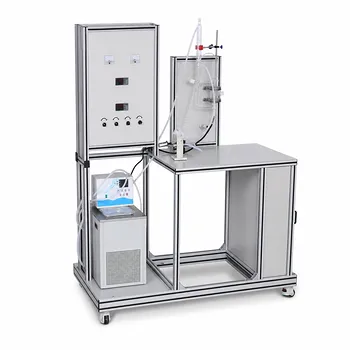
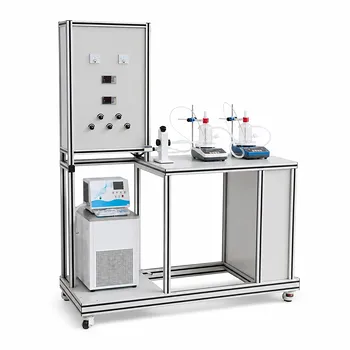
Bridge the gap between VLE theory and real-world process performance. LABPARK provides premium Educational and Vocational Unit Operations Pilot Plants in chemical engineering, bioprocess & biotech, and environmental & water treatment.
Engineered specifically for universities, research institutes, and enterprises, our pilot plants enable you to run precise distillation, absorption, and extraction trials to validate advanced thermodynamic correlations like Hayden-O'Connell under real operating conditions.
Ready to elevate your research and training capabilities? Contact LABPARK today to explore our pilot plant solutions!
Related Products
- Binary System Vapor Liquid Equilibrium Data Determination Educational Unit Operations Pilot Plant
- Ternary Liquid-Liquid Equilibrium Educational Pilot Plant
- Liquid-Liquid Mass Transfer Coefficient Determination Educational Pilot Plant
People Also Ask
- How can pilot plants assist in validating VLE models? Bridge theory and physical reality.
- Why Collect Isothermal vs. Isobaric VLE Data? Key Pilot Unit Advantages
- How Do Equations of State Predict VLE in Pilot Plants? Optimize Your Separation Design
- How do intermolecular forces and molecular kinetic energy govern gas liquefaction and vaporization? Explore VLE pilot plants
- For VLE Experiments: Fugacity vs. Activity Coefficient Method Selection Criteria