The oxidizing power of your treatment chemical is not just about what you add—it is tightly controlled by solution pH. In environmental water treatment pilot plants, pH directly governs the oxidation-reduction potential (ORP) and the efficiency of chemical oxidation reactions. According to the Nernst equation, any redox process that involves hydrogen ions (H⁺) loses driving force as the pH rises. A dichromate-based system, for example, can see its electrode potential plummet from 1.50 V to 0.95 V when the H⁺ concentration drops from 10 mol/dm³ to 10⁻³ mol/dm³—a dramatic loss of oxidizing capability that can derail an entire treatment step.
Maintaining optimal chemical oxidation in pilot-scale treatment is not simply about selecting the right reagent—it is about using precise pH control to lock in the necessary ORP. Ignoring the pH-ORP relationship leads to incomplete pollutant degradation, ineffective disinfection, and costly reagent waste.
Why pH Is the Master Variable for ORP
The Nernst Equation and the H⁺ Dependency
For any half-reaction that consumes hydrogen ions, the electrode potential E is inversely related to pH. The Nernst equation quantifies this drop: as H⁺ concentration falls, the potential shifts downward, reducing the thermodynamic driving force for oxidation. The dichromate example from pilot-plant practice is striking—a thousand-fold decrease in H⁺ delivers a 0.55 V penalty, turning a strong oxidizer into a sluggish one. Without active pH correction, the ORP signal in your reactor will mirror this decline, and treatment performance will suffer accordingly.
Speciation Changes Alter Redox Chemistry Entirely
pH does more than move the equilibrium potential—it can replace the active oxidant with a weaker species. Chlorine disinfection is the classic case. In acidic media, hypochlorous acid (HOCl) dominates, carrying a standard reduction potential of 1.61 V. In alkaline media, hypochlorite (OCl⁻) takes over, with a standard potential of only 0.66 V. The difference is not minor; it is a collapse of oxidizing power by nearly a full volt. A pilot plant that lets pH drift above 7.5 is effectively switching from HOCl to OCl⁻ chemistry, which is why disinfection efficacy craters unless pH is tightly regulated.
Metal-Based Oxidants and the Hydrolysis Trap
High-valence metal cations such as iron, aluminum, and copper are powerful oxidants or catalysts, but they are also polyprotic acids. As pH rises, these ions undergo stepwise hydrolysis, release H⁺, and finally precipitate as insoluble hydroxides. The active oxidant literally leaves the solution. To keep the metal ions dissolved and reactive, a calculated amount of strong acid must be added to the feed. The higher the metal’s charge-to-radius ratio (ionic potential), the more aggressively pH must be suppressed to avoid system-clogging precipitation.
From Bench Theory to Pilot-Plant Reality: Practical pH Control
Multi-Stage pH Engineering for Sequential Redox Reactions
Real wastewater rarely contains a single pollutant with a single redox need. Chromium treatment is the definitive example. Toxic Cr(VI) must first be reduced to Cr(III). This reduction is fast and complete only in acidic solution, where the Cr(VI)/Cr(III) couple exhibits a standard potential of 1.36 V—a strong driving force. Once the Cr(III) is formed, however, the goal shifts: it must be precipitated as Cr(OH)₃. That requires a deliberate shift to alkaline pH. A well-designed pilot plant integrates at least two distinct pH zones, with precise inter-stage dosing and rapid mixing to avoid wasting reagent or generating mixed-potential dead zones.
ORP Monitoring as a Real-Time Control Variable
Combining an ORP probe with a pH electrode creates a closed-loop control system that can dose acid or base in response to the actual redox state of the water. The ORP reading is not a true thermodynamic equilibrium potential in many practical solutions, but it serves as a reliable process indicator once correlated with contaminant removal. Pilot operators must calibrate their ORP setpoints at the target pH, because the same ORP value at different pH levels corresponds to vastly different chemical conditions.
Buffering Capacity and Acid Demand
Wastewater naturally contains carbonates, phosphates, and organic ligands that buffer against pH changes. A pilot plant must determine the actual acid or base demand through jar tests, not stoichiometric calculation alone. Underestimating buffering leads to pH drift and a gradual loss of ORP; overdosing wastes chemicals, raises the total dissolved solids, and may push the pH so low that equipment suffers.
Understanding the Trade-offs and Common Pitfalls
The Hidden Costs of Aggressive pH Control
Lowering pH to boost ORP is not free. Strong acids increase the corrosion risk for stainless steel components and can generate toxic off-gases—for example, dropping pH too low in a chlorinated stream can release gaseous Cl₂. Every unit of acid added also raises the salt load (TDS) of the effluent, which may create a secondary disposal problem.
When Over-Acidification Creates New Problems
Adding excess acid to keep metals soluble or to maximize ORP can push the system into a regime where unwanted side reactions occur. Acidic conditions may dissolve iron from the piping itself, introducing new metal ions that participate in Fenton-like reactions, consume the intended oxidant, and form additional sludge. The pilot-plant operator must find the sweet spot—low enough pH to drive the desired oxidation, but not so low that the process becomes self-destructive.
The Misleading ORP Signal
An ORP reading always reflects a mixed potential influenced by multiple redox couples and kinetic barriers. After a pH adjustment, the ORP may drift slowly as true equilibrium is approached or as secondary reactions (e.g., hydrolysis, precipitation) settle. Relying on a single snapshot ORP value without observing its time trend is dangerous. Effective pilot-plant protocols track both the steady-state ORP and the rate of change, correlating them with direct contaminant analysis.
How to Apply This to Your Pilot Plant
The pH-ORP relationship is not a theoretical curiosity—it is the operating lever for your entire treatment train. With that in mind, align your pH strategy to your primary objective.
- If your primary focus is maximizing chemical oxidation of recalcitrant organics: Continuously monitor pH and ORP, and operate at the acidic setpoint where your chosen oxidant’s standard potential is highest—use the Nernst equation to predict the potential loss if pH drifts and set your alarm limits accordingly.
- If your primary focus is consistent chlorine disinfection: Maintain the pH below 7.5 to keep the active HOCl species dominant, ensuring the high ORP necessary for pathogen inactivation; even a small upward drift will cut the effective oxidant concentration sharply.
- If your primary focus is treating metal-laden wastewater (e.g., chromium): Design a two-stage pH strategy—first acidify to drive the reduction of Cr(VI) to Cr(III), then shift to alkaline conditions to precipitate the hydroxide—with rapid inter-stage mixing and real-time ORP feedback.
- If your primary focus is avoiding system clogging from metal hydroxide fouling: Pre-acidify the feed to keep high-valence metals soluble, using pilot jar tests to determine the exact acid demand for your specific water matrix before scaling up.
Ultimately, pH is not just a measurement in your pilot plant—it is the lever that controls the oxidizing potential of your entire treatment train. Master the pH, and you master the reaction.
Summary Table:
| Process / Reagent | pH Level | Active Species / Potential | Impact on Pilot Plant Operations |
|---|---|---|---|
| Chlorine Disinfection | Acidic (pH < 7.0) | Hypochlorous Acid (HOCl) / 1.61 V | High oxidizing power and rapid disinfection. |
| Chlorine Disinfection | Alkaline (pH > 7.5) | Hypochlorite (OCl⁻) / 0.66 V | Significant drop in ORP and disinfection efficiency. |
| Chromium Reduction | Acidic (pH 2 - 3) | Cr(VI) to Cr(III) / 1.36 V | Fast, complete reduction of toxic Cr(VI). |
| Chromium Precipitation | Alkaline (pH 8 - 9) | Chromium Hydroxide [Cr(OH)₃] | Complete precipitation and removal of metal ions. |
| Metal-Based Catalysts | High pH | Insoluble Metal Hydroxides | Catalyst precipitation leading to system-clogging. |
Optimize Your Water Treatment Research with LABPARK Pilot Plants
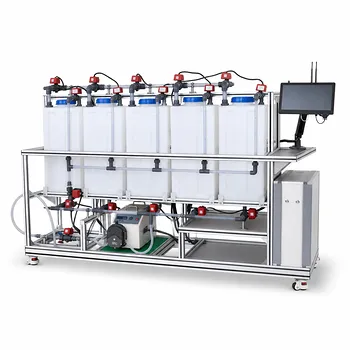
Are you looking to master pH-ORP control and chemical oxidation dynamics in your lab or training facility? LABPARK provides state-of-the-art Educational and Vocational Unit Operations Pilot Plants in chemical engineering, bioprocess & biotech, and environmental & water treatment.
Designed specifically for universities, research institutes, and enterprises, our pilot plants deliver:
- Precise Control Systems: Real-time pH and ORP monitoring with automated dosing to simulate real-world industrial conditions.
- Robust Scale-Up Data: Reliable, reproducible pilot data to safely transition from bench scale to full-scale wastewater treatment.
- Hands-on Vocational Training: Safe, visual, and highly functional modular plants to train future engineers and technicians.
Empower your research and training today—contact LABPARK now to find the perfect pilot plant configuration for your application!
Related Products
- Electrochemical Water Treatment Educational Unit Operations Pilot Plant
- Thermal Desorption Exhaust Gas and Tail Water Treatment Educational Pilot Plant
- Ion Exchange Water Purification Educational Pilot Plant for Engineering Unit Operations
- Water Electrolysis Hydrogen Production and Storage Educational Pilot Plant
- Continuous Batch Extractive Distillation Educational Pilot Plant
People Also Ask
- What design features do educational electrochemical pilot plants utilize to manage gas liberation and water loss?
- How can unit operations pilot plants show lead-acid concentration vs state of charge? Real-time monitoring guide.
- How do educational electrochemical pilot plants scale up electrolysis? Master industrial engineering.
- How to Estimate Sulfate in Water Treatment Pilot Plant Deposits: Gravimetric Guide
- How can foaming be managed during steam generation experiments in water treatment unit operations pilot plants? Tips