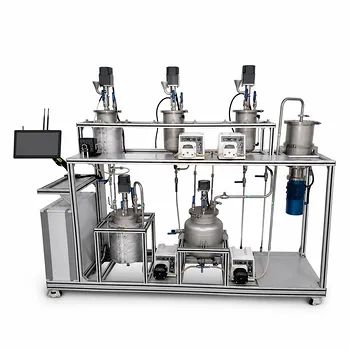
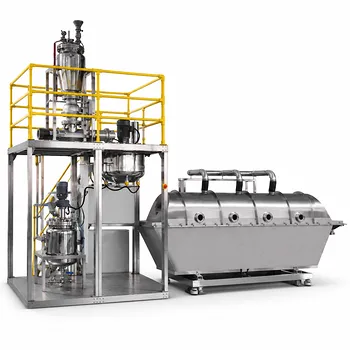
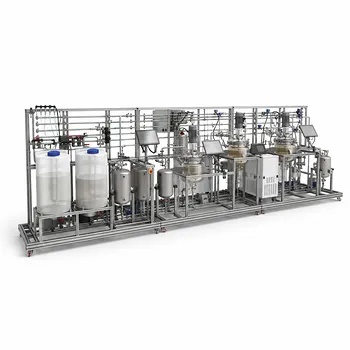
Product inhibition directly throttles microbial growth rates, imposing a hard ceiling on achievable product titers. In a bioreactor, as the microbial product accumulates, it increasingly interferes with the microorganism’s own metabolic machinery—lowering the specific growth rate (µ) in a concentration-dependent manner. Bioprocess pilot plants provide the controlled, scalable platform needed to quantify this kinetic drag and to engineer continuous-removal strategies that keep the inhibitor below its toxic threshold.
The true bottleneck in many fermentations is not the substrate supply but the accumulating product. By using a pilot plant to measure the exact inhibition constant and then integrating in-situ product recovery, you transform a self-limiting batch process into a sustained, high-productivity operation.
The Kinetic Core: How Product Inhibition Cripples Growth
Understanding product inhibition begins not with the equipment but with the mathematics of microbial growth. The effect is simple: the more product that builds up, the slower the cells divide.
The Math Behind the Slowdown
In classic noncompetitive product inhibition, the inhibitor (product P) binds to an enzyme or regulatory site independently of the substrate, effectively reducing the maximum achievable growth rate. The specific growth rate can be expressed as:
µ = (µ_max * S) / (K_s + S) * (1 / (1 + P/K_I))
Here, K_I is the inhibition constant—the product concentration at which growth is halved. In competitive inhibition, the product competes directly with the substrate for binding, altering the apparent affinity (K_s), but the end result is the same: a depressed µ at any given substrate level.
Why This Matters in a Real Bioreactor
In practice, this means a fermentation that starts vigorously will stall well before substrate is exhausted. The microbe effectively poisons its own environment. Without intervention, you hit a hard titer limit that no amount of extra sugar or oxygen can overcome.
The Pilot Plant as a Kinetic Microscope
A bioprocess pilot plant is far more than a larger benchtop reactor. It is the ideal environment to isolate, measure, and then disrupt the inhibition mechanism.
Decoupling the Variables
In a typical fermentation, product concentration, cell density, and growth rate all shift simultaneously. A pilot plant allows you to decouple these factors. You can run a series of steady-state chemostat cultures or perform pulse-and-shift experiments where a known concentration of exogenous product is added to a growing culture. By measuring the immediate drop in specific growth rate, you directly observe the inhibition effect.
Estimating the Inhibition Constants
Operators can run fermentations at multiple controlled product concentrations (spiked into the feed or accumulated naturally) and record the corresponding specific growth rates. Fitting this data to the inhibition model—often using a linearized double-reciprocal plot (1/µ vs. P) for noncompetitive systems—yields a reliable K_I value. This number becomes the operational compass for the entire downstream process strategy.
From Data to Design Space
Once K_I is known, you can define a critical inhibitor concentration (C_crit) that must not be exceeded. The pilot plant then serves as the testbed for verifying that your chosen mitigation strategy can consistently keep the product concentration below that line, even during scale-up stress tests.
Mitigation Strategies: From Measurement to Action
The real value of a pilot plant lies in its ability to seamlessly integrate process analytics with separation technologies. Measurement is only the first step; the goal is to continuously export the inhibitor.
The “Keep It Low” Strategy: Fed-Batch and Extractive Fermentation
The simplest mitigation is a fed-batch protocol that extends the growth phase while carefully metering substrate to avoid a rapid product surge. More powerfully, you can shift to extractive fermentation, where a secondary phase (solvent, resin, or membrane) pulls product out of the broth in real time. The pilot plant is precisely where you test the timing and capacity of such integrated systems.
In-Situ Product Recovery (ISPR) Techniques
Modern pilot plants often include membrane filtration units, continuous chromatography, or liquid-liquid extraction columns connected directly to the bioreactor. By recirculating the cell-free permeate back into the reactor while the product is trapped and removed, you achieve in-situ product recovery (ISPR). This not only relieves inhibition but also boosts overall mass transfer and volumetric productivity.
Immobilized Cells for Resilience
Another route tested in pilot plants is the use of immobilized cell systems. Entrapping or adhering cells to a support matrix can enhance their catalytic stability, making them more tolerant to higher local product concentrations. A pilot plant with a packed-bed or membrane bioreactor allows you to compare the inhibition response of free cells versus immobilized cells under identical hydraulic conditions, quantifying the exact protective benefit.
Understanding the Trade-offs
No mitigation is without cost. Engineering around product inhibition introduces complexities that must be acknowledged.
- Added Process Complexity: Integrating ISPR units like membranes or chromatographic columns demands precise pressure, flow, and sterility control. This raises both capital expenditure and the risk of mechanical failure.
- Fouling and Longevity: In membrane-based ISPR, protein build-up or cell debris can rapidly foul the surface, reducing separation efficiency and requiring aggressive cleaning cycles that disrupt the bioprocess.
- Mass Transfer Limitations: Immobilized cell systems, while more tolerant, often suffer from diffusional limitations. Substrate and product gradients form within the immobilization matrix, leading to non-uniform growth and potential dead zones.
- Model Validity at Scale: Inhibition constants measured in a well-mixed pilot-plant reactor may not perfectly translate to a production-scale vessel with heterogeneous mixing. A safety margin must always be applied to the C_crit threshold.
Making the Right Choice for Your Goal
Your approach to product inhibition should be dictated by your ultimate objective. Use the pilot plant to align the process with your primary need.
- If your primary focus is maximizing product titer: Invest heavily in ISPR integration. Use the pilot plant to identify the exact combination of extraction method (e.g., membrane plus chromatography) and dilution rate that maintains product levels consistently below the K_I value.
- If your primary focus is process simplicity and sterility: First exhaust fed-batch optimization. A well-tuned feeding profile that matches the metabolic rate can delay inhibition without introducing external separation loops.
- If your primary focus is long-term catalyst stability: Test immobilized cell reactors in the pilot plant. Compare the durability and specific productivity of the immobilized system against a free-cell reference over multiple batches to verify the economic benefit.
- If your primary focus is academic research and kinetic modeling: Use the pilot plant to generate clean, decoupled data sets for competitive versus noncompetitive inhibition models. This foundational understanding is the prerequisite for any sophisticated process design.
Turning a self-limiting fermentation into a continuous, high-yield operation is not a matter of trial and error—it is a systematic exercise in measuring a microbe’s toxic threshold and then engineering the bioreactor to stay miles away from it.
Summary Table:
| Mitigation Strategy | Operating Principle | Key Advantages | Primary Trade-offs |
|---|---|---|---|
| Fed-Batch Protocol | Controls substrate feeding to match metabolic rates | Simple operation; maintains sterility | Delays but does not eliminate inhibition |
| In-Situ Product Recovery (ISPR) | Continuously extracts products using membranes/chromatography | Relieves inhibition; boosts yield | Increased complexity; membrane fouling |
| Cell Immobilization | Entraps cells in matrices to protect from bulk concentration | Reusable biomass; higher resilience | Diffusional and mass transfer limits |
Optimize Your Bioprocess Scale-Up with LABPARK
Overcoming kinetic bottlenecks like product inhibition requires robust, scalable, and controllable experimental platforms. LABPARK provides state-of-the-art Educational and Vocational Unit Operations Pilot Plants in chemical engineering, bioprocess & biotech, and environmental & water treatment.
Tailored for universities, research institutes, and enterprises, our pilot plants enable you to:
- Model kinetics accurately: Identify precise inhibition constants ($K_I$) in controlled environments.
- Test mitigation techniques: Integrate and evaluate membrane filtration, ISPR, and fed-batch strategies.
- Enhance training & research: Bridge the gap between theoretical microbial kinetics and industrial-scale production.
Ready to scale your bioprocess research? Contact LABPARK today to find the perfect pilot plant solution for your facility!
Related Products
- Bio-fermentation Ethanol Production Practical Training Unit Operations Pilot Plant
- Natural Product Extraction Unit Operations Training Pilot Plant
- Electrolyte Distillation Purification and Formulation Educational Pilot Plant
- Continuous Batch Extractive Distillation Educational Pilot Plant
- High-Gravity Emulsification and Mass Transfer Educational Pilot Plant
People Also Ask
- Why Use PTFE & Hastelloy in Chemical Pilot Plants? Prevent Corrosion & Ensure Safety
- Why Compare Predicted and Experimental Excess Enthalpy? Key to Accurate Pilot Plant Scale-up
- Why is the chemical plant startup schedule crucial? De-risk scale-up with pilot plants.
- When to transition from PID to adaptive control in pilot plants? Key process indicators.
- Why must batch and fed-batch fermentation pilot plants be designed to accommodate changing rheological conditions?