Particle shrinkage isn't just a kinetic curiosity—it is the central design constraint for any continuous fluidized-bed pilot plant. Because the solid reactant is consumed during noncatalytic gas-solid reactions, the particle size distribution is never static. This directly forces the adoption of continuous solid feeding and discharge systems instead of simpler batch setups, while also destabilizing the bed's hydrodynamics, altering residence-time distribution, and creating a cascade of operational control challenges.
While the textbook problem is simply maintaining a material balance, the real operational impact is a dynamic shift in fluidization regime and elutriation rate as particles shrink. The success of a pilot plant hinges not just on verifying the shrinkage kinetic model, but on actively managing the fines generation and carryover that the shrinkage creates.
The Inevitable Requirement for Continuous Operation
A batch reactor is fundamentally incompatible with a reaction where the solids vanish. The primary reference correctly identifies this necessity, but the implications for pilot-plant design are profound.
Continuous Feeding is Not Optional
When the solid acts as a reactant, its mass decreases toward zero over time. A batch system would eventually see the bed height collapse, the gas bypass the remaining few solids, and the reaction quench.
A pilot plant must simulate steady-state operation with a constant feed stream and at least two discharge streams: the main product bottoms and the overhead elutriation stream. This allows operators to "sample the exit stream" to verify kinetic models, but it introduces the complexity of controlling a solid flow loop.
The Material Balance is a Moving Target
The core operational puzzle is closing the solid mass balance. The feed rate is known, but the distribution between coarse product and elutriated fines is a function of the real-time particle size distribution inside the bed.
A pilot plant operator cannot simply set a discharge rate. They must measure both streams continuously to verify that conversion aligns with the governing shrinkage law, whether it's a film-diffusion controlled linear model or a surface-reaction controlled one.
The Hydrodynamic Cascade from Shrinking Particles
The impact of shrinkage extends far beyond the system's architecture. It creates an unstable hydrodynamic environment that is the true test of a pilot plant's control strategy.
Disruption of Fluidization Regime
As the mean particle diameter decreases, the terminal velocity of the particles drops. A gas velocity that originally provided gentle bubbling fluidization for a 1 mm particle can become a full elutriating velocity for a shrinking 0.1 mm particle.
This pushes the bed towards entrainment. The operation transitions from stable bubbling to a turbulent, high-fines environment where the boundary between the dense bed and the freeboard blurs, challenging the very definition of "bed height" for sampling and control.
Explosive Elutriation and Fines Management
The most acute operational headache is the generation and carryover of fines. Supplementary references confirm that particle disintegration and attrition break down the reactant into a dust that is easily swept out.
These fines adhere to cyclone walls, causing recovery issues and directly limiting overall carbon conversion to 85-90% in some pilot gasifiers. The operator must contend with having a significant fraction of the reactant leaving the reactor unconverted not as coarse particles, but as a fine carbon-rich dust.
Reduced Residence Time for Large Solids
A counter-intuitive consequence is the loss of unreacted core material. If large particles feed into the bed and fail to shrink uniformly, they can segregate and short-circuit to the bottom discharge before achieving full conversion.
A properly designed pilot plant must operate with enough freeboard height and a deep enough bed to prevent these larger, denser particles from immediately settling out and exiting. The overall conversion is not just a function of the average particle size but the entire distribution's trajectory.
Understanding the Trade-offs in Pilot Plant Strategy
Managing particle shrinkage is an exercise in managing conflicting constraints. Every operational decision involves a significant trade-off.
Recycling Fines vs. Accepting Carbon Loss
The first major decision is whether to recycle elutriated fines. Capturing them in a cyclone and returning them to the bed can boost conversion but often backfires.
The recycled fines are so light that they are re-entrained instantly, spending essentially zero additional time in the dense bed for conversion. Worse, they can dilute the bed density, worsening gas-solid contact. The alternative—injecting secondary oxygen to combust them in the freeboard—sacrifices them as a heat source, accepting a hard ceiling on solids conversion efficiency.
Gas Velocity: Conversion vs. Carryover
This is the classic fluidization dilemma, made fatal by shrinkage. A high velocity is needed to process a high throughput of coarse feed solids and maintain good heat and mass transfer. The interstitial gas flow is already streamline, and with small particles, the mass transfer coefficient is near its lower limit, so high velocity is crucial.
However, that same velocity guarantees catastrophic elutriation as soon as the particles shrink. The pilot plant is constantly tuned on a knife-edge between providing enough gas for the reaction and blowing the fines out of the reactor.
Selecting Feedstocks: Attrition-Resistance vs. Reactivity
Particle attrition is a parallel, amplifying phenomenon to chemical shrinkage. A highly reactive but mechanically weak solid will shatter into fines instantly.
A pilot plant must carefully select a particle with enough hardness to minimize attrition, as its rate is a function of the bed mass and excess velocity. Using a fragile solid will cause immediate material loss and block downstream cyclones, not because of chemical shrinkage, but purely from mechanical breakdown, corrupting any attempt to isolate the kinetic shrinkage model.
Making the Right Choice for Your Pilot Plant Goal
Your operational strategy must be dictated by your primary objective for the continuous pilot run.
- If your primary focus is verifying a kinetic model: Isolate the chemical shrinkage from physical attrition. Run with a hard, narrow-sieve-cut feed at a low, steady velocity, and measure both the overflow product and cyclone fines streams meticulously to close the material balance.
- If your primary focus is maximizing carbon conversion: Accept a high fluidization velocity for good mass transfer but immediately implement a secondary oxygen injection strategy to combust elutriated fines in the freeboard, converting a material loss into usable process heat.
- If your primary focus is ensuring stable, long-duration operation: Prioritize a mechanically strong particle and operate with a limited bed depth to reduce attrition. Use a continuous feed and a non-selective bottom discharge to maintain a steady, although potentially sub-optimal, particle size distribution that avoids extreme elutriation.
Controlling a fluidized bed during particle shrinkage is fundamentally about managing a distribution that is rapidly populating itself with dust-sized fines. Your plant's success is measured by how effectively you can either contain these fines, consume them, or use them to verify the first principles that predict their formation.
Summary Table:
| Impact Area | Operational Challenge | Recommended Strategy |
|---|---|---|
| System Design | Continuous feeding needed; batch setups fail as solids shrink | Implement non-selective bottom discharge |
| Hydrodynamics | Shifting fluidization regimes, entrainment, and fines | Balance gas velocity and design high freeboard |
| Fines Management | Carryover of unreacted dust, lowering conversion | Recycle fines or use secondary oxygen injection |
| Feedstock Choice | Attrition mimics and amplifies chemical shrinkage | Select mechanically strong, attrition-resistant solids |
Optimize Your Fluidized-Bed Operations with LABPARK
Managing complex kinetics like particle shrinkage requires precision-engineered systems. LABPARK provides state-of-the-art Educational and Vocational Unit Operations Pilot Plants in chemical engineering, bioprocess & biotech, and environmental & water treatment for universities, research institutes, and enterprises.
Our systems are built to help you accurately model kinetics, maintain hydrodynamic stability, and achieve reliable scale-up data. Contact us today to discuss your pilot plant needs and get a customized solution!
Related Products
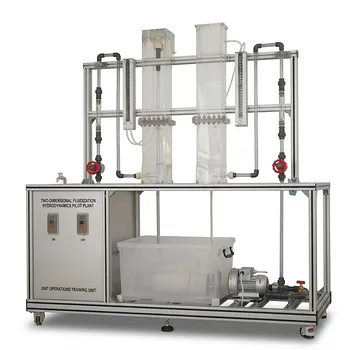
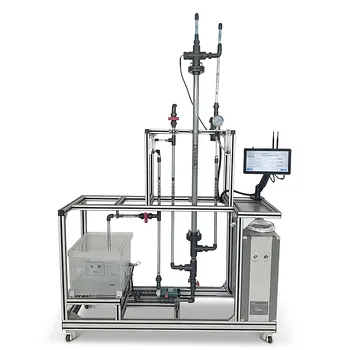
- Two-Dimensional Fluidization Hydrodynamics Educational Pilot Plant for Unit Operations Training
- Continuous Sieve-Plate Distillation Pilot Plant for Unit Operations Laboratory Education
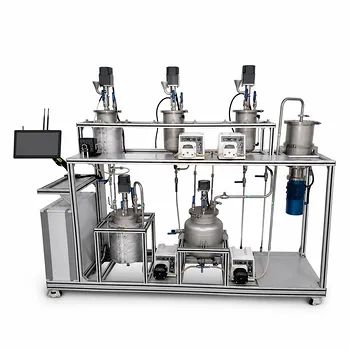
- Multi-Reactor Educational Pilot Plant for Reaction Engineering Unit Operations
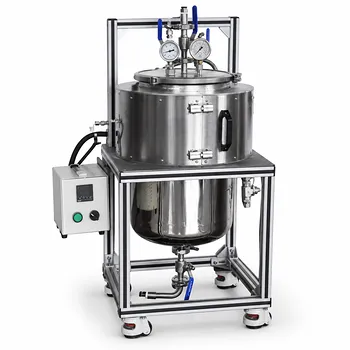
- 100L Continuous Loop Hydrogenation Educational Unit Operations Pilot Plant
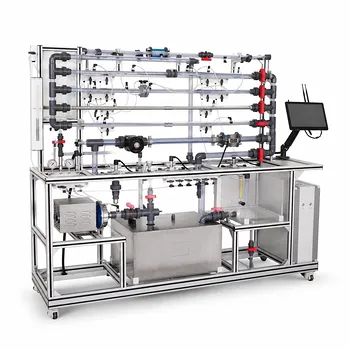
- Multi Pump Fluid Transport Process Piping Unit Operations Training Pilot Plant
People Also Ask
- What pressure drop characteristics should students & researchers monitor in a fluidization pilot plant?
- How does active time pulsing mixing enhance fluid homogenization? Configuration Guide for Educational Pilot Plants
- How can acoustic chemometrics prevent reactor clogging in educational fluidized bed pilot plants?
- What is the operational significance of solids feed rate on emulsion phase dynamics in fluidized bed pilot plants?
- Why is UB/Ui critical in fluidized bed pilot plant modeling? Master Gas-Solid Contact