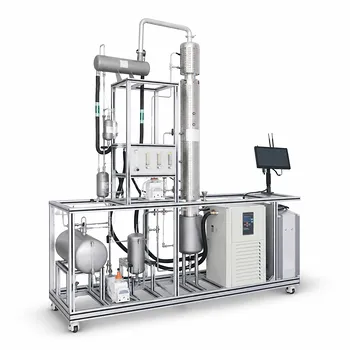
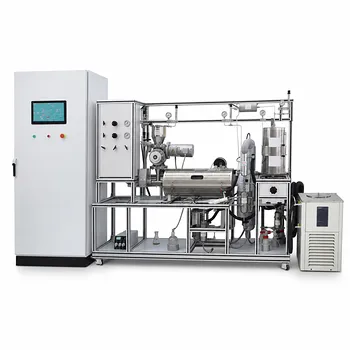
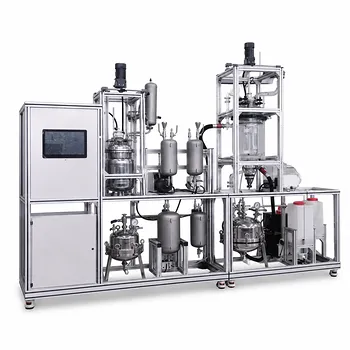
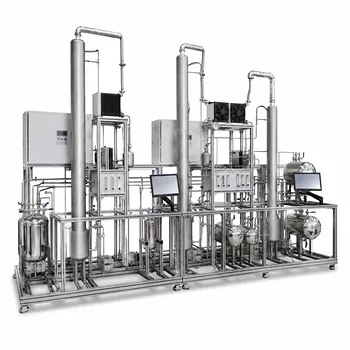
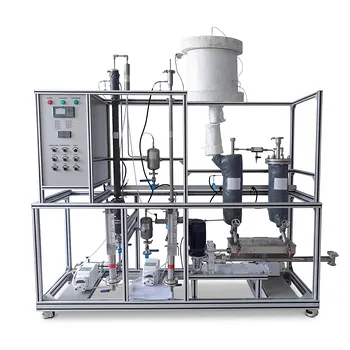
Liquid metal or organic solvent, the physics doesn’t change. Metal refining by distillation—commonly found in chemical metallurgy texts for separating volatile metals like zinc or mercury—translates directly into practical training on chemical engineering unit operations pilot plants because it operates on the same fundamental unit operation principles: vapor-liquid equilibrium, mass transfer, and column hydraulics. Instead of running a column at 900°C with molten metal, students use safe organic or aqueous mixtures at moderate temperatures to master exactly the same design, operation, and optimization logic. The result is a set of portable skills that apply immediately to high-temperature thermal separation and refining columns.
The translation from textbook metallurgical distillation to a university pilot plant is not a dilution—it’s a deliberate, risk-managed abstraction that preserves every essential engineering lever. Students learn to size stages, set reflux ratios, and diagnose column performance using systems that behave predictably, building direct competence for industrial metal purification.
The Core Distillation Principles That Translate Directly
The surface question often masks a deeper need: “Will I actually learn what matters for real high-temperature refining?” The answer is yes, because the underlying physics are identical across every distillation scenario—only the materials change. Educational pilot plants are designed to make those physics visible and measurable.
Vapor-Liquid Equilibrium and Relative Volatility
Every distillation—whether of zinc-cadmium mixtures or ethanol-water—is governed by relative volatility. Metal refining exploits the fact that one metal (e.g., zinc) has a significantly higher vapor pressure than another (e.g., lead) at a given temperature. On a pilot plant, students study the same phenomenon through binary or multicomponent liquid mixtures, measuring vapor-liquid equilibrium data and learning how to manipulate temperature and pressure to enhance separation.
The Fenske-Underwood-Gilliland (FUG) shortcut method bridges theory and real hardware. Students first use this method to estimate the minimum number of stages ((N_{min})), minimum reflux ratio ((R_{min})), and optimal feed location—exactly the calculations a metallurgical engineer would perform when designing a vacuum distillation unit for volatile metal purification.
Mass Transfer and Column Hydraulics
What happens inside a packed or trayed column does not depend on whether the fluid is mercury or hexane. Mass transfer rates, flooding points, weeping, and entrainment are all governed by the same transport phenomena. On a pilot plant, students deliberately vary boil-up rates, measure pressure drops, and observe column performance under different loading conditions.
Thermodynamic equilibrium is local, but the column’s behavior is global. By solving the MESH (Material, Equilibrium, Summation, Heat) equations rigorously—often using the Naphtali-Sandholm method—students learn how temperature profiles and concentration gradients evolve in real time. This directly mirrors the rigorous simulation workflow an engineer would use to scale a metal distillation column from lab to production.
How Pilot Plants Replicate the Logic of High-Temperature Refining
Metallurgists rarely call their setup a “pilot plant,” but the operational logic is the same. Educational unit operations labs reconstruct that logic using benign chemicals, providing a safe yet fully representative environment.
Total Reflux: The Baseline for Separation Capability
One of the most powerful teaching moments is running the column at total reflux. In this mode, no product is withdrawn, the reflux ratio becomes infinite, and the column achieves the maximum possible separation with a given number of stages. The Fenske equation tells us this requires the minimum number of stages ((N_{min})) for a target split.
For metal refining, the total-reflux condition is the design starting point. Whether you are purifying mercury by distillation or separating zinc from an alloy, you first determine the column’s inherent separating power. On a pilot plant, students establish total reflux, sample top and bottom compositions, and calculate (N_{min}); then they systematically move to finite reflux and compare performance. This hands-on exercise maps 1:1 to the approach a process engineer would use for a new metal refining column.
Shortcut and Rigorous Design Methods
Designing a column for a volatile metal rarely starts with a supercomputer. Engineers first apply the FUG shortcut method, designating Light Key (LK) and Heavy Key (HK) components (e.g., zinc as LK and copper as HK). Students on a pilot plant perform exactly the same exercise with a surrogate organic mixture, learning to interpret the relative volatility of key components and set realistic reflux ratios.
Rigorous calculations come next, and pilot plants offer real-time validation. When students solve MESH equations for the column and compare the predicted temperature and composition profiles with actual sensor data, they close the loop between simulation and physical operation. In a high-temperature vacuum distillation plant for zinc, the same rigorous model (adjusted for metallurgical thermodynamics) would be used for control and scale-up—so the mental framework transfers intact.
Reactive Distillation and Process Intensification
Some refining processes are not purely physical—reactions can accompany separation. A reactive distillation pilot plant demonstrates process intensification, where a chemical reaction and distillation happen in the same vessel. In the context of metal refining, analogous concepts arise when, for example, a volatile metal halide is formed and then subsequently decomposed in a downstream zone.
By training on reactive distillation, students learn the “window of operation” trade-off. Temperature and pressure must simultaneously satisfy kinetic requirements and vapor-liquid equilibrium. This exact tension appears in advanced refining schemes that combine chemical conversion with thermal separation, making the pilot plant exercise a direct conceptual rehearsal.
Understanding the Limitations of Pilot-Scale Training
No unit operations lab teaches you to handle molten zinc. That candor matters. The educational translation is abstract by design, and it inherently omits the extreme-environment engineering challenges of metallurgical distillation.
High-temperature materials, refractory linings, vacuum systems, and metal vapor safety are absent. Students will not practice operating vacuum pumps capable of 1 Pa or selecting corrosion-resistant alloys for liquid lead. These are critical skills for a metallurgical plant engineer, but they are context-specific details that rest on top of the distillation fundamentals—fundamentals the pilot plant teaches with precision.
The risk is a false sense of completeness. An educator or student must recognize that the pilot plant provides the process engineering core; the peripheral challenges of high-temperature metal refining (e.g., dust formation, splash, condensation of metal fog) must be layered on later through specialized courses or industrial exposure. The fundamental column design and operational logic, however, are unchanged.
Making the Right Choice for Your Training Goal
How you use a distillation pilot plant depends on which part of the refining challenge you need to master. The same piece of equipment can serve very different educational objectives.
If your primary focus is process design: Use the pilot plant to test shortcut and rigorous methods, validate stage efficiency predictions, and learn to choose between trayed and packed configurations based on pressure drop constraints—just as you would when specifying a metal distillation unit.
If your primary focus is operational control: Spend your time running total reflux experiments, then partial reflux, while monitoring the column’s dynamic response to upsets. The intuition you build for temperature profile shifts and endpoint control directly applies to a production-scale metal distillation column’s control strategy.
If your primary focus is process intensification: Explore reactive distillation or steam distillation variants. The principles of in situ product removal to drive conversion—or using an immiscible vapor to lower the boiling point—mirror the thermodynamic levers available in vacuum or carrier-gas-assisted metal purification.
You can build a career on metal refining by learning distillation on a glass column filled with ethanol and water—because the separation science is universal, and the engineering discipline it instills is exactly what high-temperature columns demand.
Summary Table:
| Core Principle | Metallurgical Application (High Temp) | Pilot Plant Surrogate (Safe Temp) |
|---|---|---|
| Vapor-Liquid Equilibrium (VLE) | Separating volatile metals (e.g., Zinc/Lead) | Separating organic/aqueous mixtures (e.g., Ethanol/Water) |
| Design Methodology | FUG shortcut calculations & MESH modeling | Dynamic simulation validation & stage efficiency testing |
| Column Hydraulics | Molten metal vapor & liquid flow dynamics | Visible organic/aqueous liquid-vapor mass transfer |
| Process Intensification | Metal halide formation & separation | Safe reactive distillation pilot runs |
Elevate Engineering Training with LABPARK Pilot Plants
Bridge the gap between complex industrial thermodynamics and hands-on operational excellence. LABPARK designs and delivers high-performance Educational and Vocational Unit Operations Pilot Plants in chemical engineering, bioprocess & biotech, and environmental & water treatment for universities, research institutes, and enterprises.
Our advanced pilot systems empower students and researchers to master core distillation, mass transfer, and hydraulic principles in a safe, controlled environment.
Ready to transform your laboratory capabilities? Contact LABPARK today to request a technical consultation and customized proposal!
Related Products
- Multi-Functional Special Distillation Educational Pilot Plant
- Continuous Sieve-Plate Distillation Pilot Plant for Unit Operations Laboratory Education
- Green Anhydrous Ethanol Refining Practical Training Pilot Plant
- Multi-Modal Distillation Unit Operations Training Pilot Plant
- Continuous Batch Extractive Distillation Educational Pilot Plant
People Also Ask
- Why does simple distillation yield higher efficiency than flash distillation? Key thermodynamic differences.
- How does double temperature difference control improve distillation pilot plants? Stabilize purity.
- Why is the acentric factor important in pilot plants? Fluid property prediction.
- How to Integrate Spectroscopy in Distillation Pilot Plants for Advanced Process Control
- How Batch vs Continuous Configuration Affects Distillation Pilot Plant Versatility & Footprint