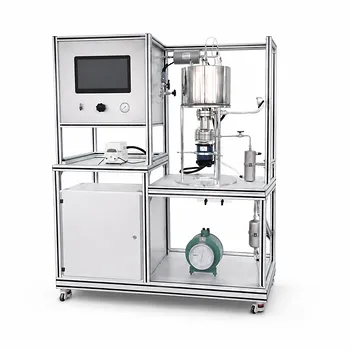
A pool reactor is a masterclass in process intensification packed into a single vessel.
It demonstrates this concept by merging two sequential reaction steps—the exothermic condensation of ammonia and carbon dioxide into ammonium carbamate, and the endothermic dehydration of that carbamate into urea—within one compact reactor body. The exothermic heat is used directly, in-situ, to drive the endothermic step and generate steam, eliminating the need for separate reactors and external heat exchangers. This slash in equipment and energy use makes the pool reactor an ideal, real-world showcase for the core principles of chemical process intensification.
The pool reactor crystallizes process intensification for learners: integrate multiple unit operations, reuse waste heat directly, and shrink the equipment footprint without sacrificing throughput. It turns abstract PI theory into a tangible lesson in sustainable design.
Deconstructing the Pool Reactor
Two Reactions, One Vessel
In conventional urea synthesis, carbamate condensation (highly exothermic) and carbamate dehydration (endothermic) could be performed in separate, interconnected equipment.
The pool reactor collapses these stages into a single liquid‑phase reaction pool, where bubbles of ammonia and carbon dioxide react immediately.
This merging of unit operations is process intensification at its most visible: condensator and reactor are no longer distinct pieces of hardware.
Direct Thermal Coupling as the Hidden Engine
The heat released during carbamate formation does not escape to an interstage cooler or steam generator downstream.
Instead, it is transferred directly within the same liquid to supply the dehydration reaction and to raise low‑pressure steam inside an integrated coil.
This eliminates the multitude of shell‑and‑tube heat exchangers that would otherwise be needed, drastically reducing capital cost and plot space.
It also gives a near‑autothermal behavior, a classic hallmark of intensified processes.
Why the Pool Reactor Is an Unmatched Educational Tool
Bringing the “Integration” Mandate to Life
In a pilot plant, a pool reactor is a single piece of stainless steel where two distinct chemistry steps are happening simultaneously.
Standing in front of it, students can literally see functional consolidation—no separate condensation tower, no lengthy piping, no interstage pumps.
Such a setup parallels other PI demonstrations like reactive distillation or membrane‑integrated separations, but with even simpler interpretability.
It shows that intensification is not about shrinking molecules, but about reducing the number of distinct physical processing steps.
Making Energy Efficiency Measurable
The pool reactor allows learners to monitor temperatures at multiple points and calculate how much heat is being reused internally rather than rejected.
They can contrast it with a hypothetical multi‑vessel flowsheet and quantify the energy savings—making the “energy minimization” pillar of PI concrete.
Miniaturization Without Sacrificing Production
Because the heat transfer is internal and mass transport is intimate, the volume required for a given urea output is far smaller than a classic cascade of reactors.
This is precisely the promise of PI: more production from less hardware, lower material intensity, and a greener overall footprint.
For a vocational or university pilot plant, that compactness also saves space and allows more experiments in the same bay.
Understanding the Trade-offs of a Single‑Vessel Approach
When Combined Reactions Become a Control Puzzle
Merging a large exothermic and endothermic step in one pool means the energy balance is tightly coupled.
A small disturbance—excess ammonia flow, a brief temperature dip—can swing yields or create localized hot spots, demanding sophisticated process control strategies.
In an educational context, this is a bonus: it forces students to confront the operational complexity that intensification can introduce alongside its benefits.
The Risk of Over‑Integration
Not every chemistry pair is a good candidate for a pool reactor.
If the optimal temperatures or residence times of the two steps differ widely, forcing them into one vessel compromises selectivity or conversion.
A pool reactor works for urea because the exothermic and endothermic steps mesh naturally; trying to replicate this with a less‑compatible reaction set would backfire.
This is a vital lesson for pilot‑plant designers: process intensification is not universally better; it is a design choice that must be validated against fundamental kinetic and thermodynamic constraints.
Making the Right Choice for Your Educational or Pilot Plant Goal
The pool reactor is a superb demonstrator, but its value depends on what you want to teach or research.
- If your primary focus is illustrating fundamental PI concepts: Place the pool reactor at the center of your unit; let students trace how one vessel replaces multiple unit operations and internal heat exchange erases external exchangers.
- If your primary focus is energy integration and sustainability: Use the reactor’s internal temperature profile to calculate energy reuse; compare the theoretical hot‑utility demand of a two‑stage system to show real savings.
- If your primary focus is teaching practical trade‑offs: Run duplicate experiments with a conventional sequential setup and the pool reactor, then discuss when the intensified route outperforms—and when it creates controllability or selectivity drawbacks.
When a pilot plant reveals that a single, well‑designed vessel can do the work of many, learners leave with a visceral understanding of what process intensification truly means.
Summary Table:
| Feature | Conventional Setup | Intensified Pool Reactor |
|---|---|---|
| Vessel Count | Multiple (separate condenser & reactor) | Single integrated vessel |
| Heat Integration | External heat exchangers & utility lines | Direct internal thermal coupling (in-situ) |
| Physical Footprint | Large, requires extensive piping & space | Compact, space-saving design |
| Control Dynamics | Decoupled and easier to control | Tightly coupled, requires advanced control |
| Energy Efficiency | Higher thermal losses | Autothermal behavior with steam generation |
Bring Advanced Process Intensification to Your Facility
Visualizing complex thermodynamic and kinetic integration requires hands-on tools. LABPARK provides state-of-the-art Educational and Vocational Unit Operations Pilot Plants in chemical engineering, bioprocess & biotech, and environmental & water treatment. Designed specifically for universities, research institutes, and enterprises, our pilot plants make abstract principles like process intensification tangible and measurable.
Ready to elevate your training and research capabilities? Contact LABPARK today to discuss your project!
Related Products
- 100L Continuous Loop Hydrogenation Educational Unit Operations Pilot Plant
- Multi-Stage Stirred Tanks in Series Residence Time Distribution and Mixing Performance Determination Educational Pilot Plant
- Fluidized Bed Gas Solid Catalytic Reaction Educational Pilot Plant
- Multi Functional Catalytic Reaction and Reactor Evaluation Educational Unit Operations Pilot Plant
- Tubular Reactor Flow Characteristics Determination Educational Unit Operations Pilot Plant
People Also Ask
- How to study gasification in pilot plants? Compare exit gas composition & efficiency
- How do deviations in estimating latent heat impact pilot plant thermal systems? Avoid hardware mis-sizing.
- Why Use PTFE & Hastelloy in Chemical Pilot Plants? Prevent Corrosion & Ensure Safety
- Why is the chemical plant startup schedule crucial? De-risk scale-up with pilot plants.
- Why Compare Predicted and Experimental Excess Enthalpy? Key to Accurate Pilot Plant Scale-up