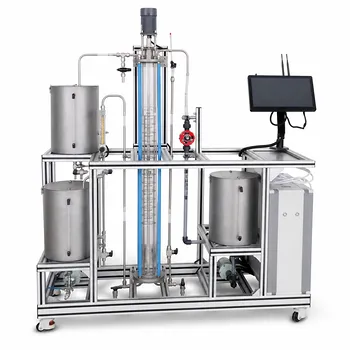
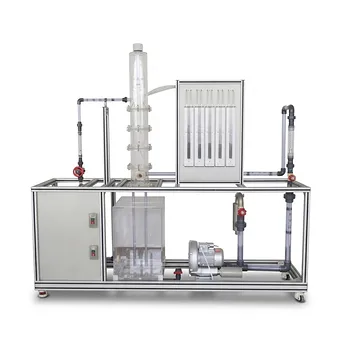
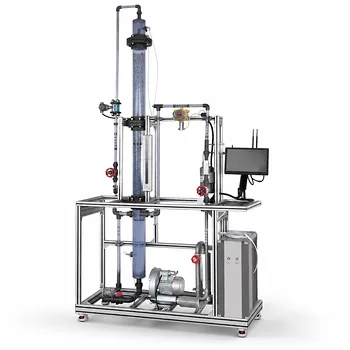
The short answer, before we dive deeper: In a distillation column pilot plant, trays facilitate mass and heat transfer by forcing rising vapor into direct, intimate contact with a flowing liquid layer. This bubbling action creates a simultaneous exchange where condensing heavy molecules release heat, directly vaporizing the escaping light molecules on that same stage. Educational pilot plants make this invisible thermodynamic exchange visible, often through transparent column walls, turning abstract theory into observable fluid dynamics for students.
Understanding a single tray is the key to unlocking the entire column's behavior. A tray is not a filter; it's a controlled, miniature phase-change reactor. The core challenge for a student is to connect the visible physics—bubble size, froth height, liquid flow—to the invisible chemistry of changing component concentrations, a connection that a well-designed pilot plant brings to life.
The Core Mechanism: A Stage for Phase-Change Equilibrium
A distillation tray performs its separation work by creating a specific, repeatable environment for mass and heat transfer. It's a physical stage where a new equilibrium is targeted.
The Macroscopic Exchange of Latent and Sensible Heat
The primary heat transfer on a tray is deeply coupled with mass transfer. Hot vapor, entering from below, bubbles through the cooler liquid flowing across the tray deck.
This is not simple heating. Heavier, less volatile components in the vapor condense into the liquid. As they condense, they release their latent heat of vaporization. This precise amount of energy is immediately absorbed by the lighter, more volatile components in the liquid, giving them the energy needed to vaporize and join the rising vapor stream. The net result is a direct thermal swap, not just an energy dump.
How Composition Evolves on a Single Tray
This simultaneous condensation and vaporization is the engine of separation. The vapor leaving the tray has shed its heavy baggage and is now enriched with light components. The liquid, having lost its light components and gained heavier ones, flows over the weir and down the downcomer to the tray below, now richer in the heavy component. Each tray enforces this one-step purification, and a column stacks these steps in series.
The Training Advantage: Visualizing What Theory Describes
The unique power of a tray-type pilot plant in chemical engineering training lies in its ability to make theoretical models tangible. A McCabe-Thiele diagram on a whiteboard becomes a physical, observable process.
Correlating Theory with Observed Hydrodynamics
The transparent column sections common in educational pilot plants are not just for show; they are essential diagnostic tools. Students can visually confirm if the tray is operating correctly and link the physical state directly to process variables. This visual feedback loop is critical for learning to operate real-world equipment.
The visible evidence includes:
- Froth Regime: The ideal, violent mixing zone above the tray deck. Students see how vapor velocity and liquid rate affect froth height and contact time.
- Weeping: At low vapor loads, liquid visibly dripping through the sieve holes instead of being held aloft. This directly demonstrates a loss in efficiency as unprocessed liquid bypasses the tray.
- Entrainment and Flooding: At high vapor loads, a plume of liquid droplets being carried to the tray above, or the column completely filling with a turbulent mixture. This is the physical limit of throughput, shown safely in a controlled environment.
Measuring Efficiency: The Sensitive Tray
Theory teaches that controlling a column requires finding the "sensitive tray"—the stage where a small change in a manipulated variable causes the largest and most rapid temperature change. In a pilot plant, students can experimentally locate this tray by introducing a disturbance and monitoring the temperature profile on every tray. This transforms a classical control heuristic into a hands-on experiment, proving why that specific tray is crucial for maintaining product quality.
Understanding the Design Trade-offs
A pilot plant's value also lies in demonstrating that no single tray design is perfect. It's a study in compromises, where a gain in one area creates a loss in another.
Geometric Parameters Are Control Variables
The physical dimensions of a tray are not arbitrary; they are deliberate choices that dictate performance, which students can alter and test:
- Weir Height (WH): Setting a higher weir increases the liquid height (HL) and residence time on the tray. This provides more contact time, which can improve mass transfer efficiency up to a point. However, it directly increases the pressure drop per tray.
- Active Area (AA) and Hole Area (SLOTAREA): The ratio of these zones sets the vapor velocity through the holes for a given load. A smaller hole area increases velocity, preventing weeping but raising pressure drop and the potential for entrainment.
The Sieve, Valve, and Bubble Cap Trinity
Training with a pilot plant that can be configured with different trays teaches a fundamental lesson in selection:
- Sieve Trays: Simple, high-capacity, and cost-effective, but with a narrow operating range. They are highly susceptible to weeping at low vapor rates, providing a stark lesson in turndown limitations.
- Valve Trays: Feature a variable-opening orifice that adjusts to vapor load. They offer a far wider operating flexibility than sieve trays, a clear demonstration of adaptive design for varying feed rates.
- Bubble Cap Trays: The workhorses for stable, low-vapor-rate operation. Their physical design prevents weeping completely, but this stability comes at the highest cost and pressure drop, a clear illustration of a trade-off prioritizing operational stability over energy efficiency.
The Danger of Liquid Maldistribution
On a larger tray, efficiency isn't just about vertical contact; it's also about lateral flow. A pilot plant with a viewable tray deck reveals flow patterns that undercut performance. Students witness how stagnant zones and backflow create a non-uniform residence time distribution, meaning some of the liquid has far less time to transfer mass than it should. This makes abstract concepts like the Péclet number and Murphree plate efficiency tangible, showing why real-world efficiency is always less than the theoretical ideal.
Making the Right Choice for Your Training Goal
The decision to use a tray column over a packed column in a pilot plant is driven by the specific learning objectives. It is a deliberate choice to prioritize transparency and configurability over cost and pressure drop.
-
If your primary focus is visualizing fundamental hydrodynamics: A tray column is non-negotiable. It uniquely allows observation of weeping, froth formation, entrainment, and flooding—phenomena hidden within a packed bed.
-
If your primary focus is demonstrating process control fundamentals: A tray column with sensors on multiple stages is essential. It enables the experimental identification of the sensitive tray, providing a live demonstration of a critical control concept for high-purity separations.
-
If your primary focus is teaching the trade-offs in equipment design: A pilot plant with swappable internals (sieve, valve, and bubble cap trays) is required. It allows students to directly measure, compare, and understand the consequences of a design choice on pressure drop, turndown ratio, and efficiency.
-
If your primary focus is on small-scale, cost-sensitive, or low-pressure-drop experiments: A packed column is the more practical choice. It excels in demonstrating concepts like HETP (Height Equivalent to a Theoretical Plate) and is generally safer and easier to operate with smaller diameters or hazardous fluids.
The tray in a pilot plant is far more than a piece of hardware; it is a dynamic stage that turns theoretical equilibrium stages into a lived experience, making the invisible energetic exchange of separation a visible, measurable, and unforgettable lesson in process engineering.
Summary Table:
| Tray Type | Operating Stability | Turndown Ratio | Main Advantage for Training |
|---|---|---|---|
| Sieve Trays | Low (weeps at low vapor) | Narrow | Clearly demonstrates weeping and flooding limits |
| Valve Trays | Medium to High | Wide | Shows adaptive design and operational flexibility |
| Bubble Cap Trays | High (prevents weeping) | Very Wide | Illustrates stable operation at the cost of high pressure drop |
Bring Chemical Engineering Theory to Life with LABPARK
Are you looking to upgrade your chemical engineering laboratory? LABPARK provides state-of-the-art Educational and Vocational Unit Operations Pilot Plants in chemical engineering, bioprocess & biotech, and environmental & water treatment. Our custom-designed distillation column pilot plants allow universities, research institutes, and enterprises to bridge the gap between abstract thermodynamic theory and hands-on operational reality.
Contact LABPARK Today to request a quote and discover how our advanced pilot plants can elevate your training curriculum!
Related Products
- Continuous Sieve-Plate Distillation Pilot Plant for Unit Operations Laboratory Education
- Multi-Functional Special Distillation Educational Pilot Plant
- Multi-Modal Distillation Unit Operations Training Pilot Plant
- Continuous Batch Extractive Distillation Educational Pilot Plant
- Dual-Mode Rectification Pilot Plant for Practical Training Unit Operations
People Also Ask
- What are the primary reflux ratio control strategies? Master Distillation Unit Operations
- Why is vacuum operation capability an essential feature for a distillation unit operations pilot plant? Unlock Efficiency
- How can real-time carbon number prediction improve distillation pilot plants? Optimize control.
- How does catalyst water concentration affect distillation pilot plant design? Key separation train choices.
- How to select the right activity coefficient model (Wilson, NRTL, UNIQUAC) for distillation pilot plants?