The geometry of your random packing is the single most powerful variable you can control in a pilot-scale column. A Raschig ring, a Pall ring, and a Cascade mini ring may all be dumped into the same glass column, but their internal structures create three fundamentally different fluid dynamic environments. The simple cylindrical shape of a Raschig ring encourages liquid to cascade down the column wall, causing poor gas-liquid contact and high pressure drop. Pall rings solve this by using punched-inward tabs to redirect liquid into the packing’s interior, slashing pressure drop by roughly half while boosting gas capacity. Cascade mini rings go further with a crushed, low-aspect-ratio cylinder and a flared edge, which minimizes nesting, improves mechanical strength, and delivers the most uniform distribution and lowest pressure drop of the three.
The transition from simple cylinders to internally structured, low-aspect-ratio shapes is a masterclass in solving the core problem of packed columns: maximizing gas-liquid surface area renewal while minimizing energy loss. Each geometric innovation—windows and tabs, a height-to-diameter reduction, and a flared edge—directly translates into a measurable improvement in pressure drop, flooding limits, and mass transfer efficiency within a pilot plant.
The Evolution of Random Packing Geometry
All three packing types fit within the same column shell. What changes is the void space, the path for fluids, and the distribution of surface area. Understanding this progression is the key to interpreting experimental results.
Raschig Rings: The Simple Cylinder with a Hidden Flaw
A Raschig ring is a plain cylinder, with its height equal to its diameter. There are no internal features. When dumped into a column, these rings create a high fraction of void space, but the empty interior of each ring remains largely unutilized because liquid tends to flow around the exterior surfaces.
The main performance penalty is severe wall flow. Liquid clings to the inner wall of the column and flows down in a preferential channel, bypassing the bulk of the packing. This leads to a very high Height Equivalent to a Theoretical Plate (HETP) for mass transfer.
Additionally, the simple geometry causes high-pressure drop. Gas must navigate through a labyrinth of thick, flat edges, and the liquid holdup is significant because there is no mechanism to break up and re-distribute the liquid flow inside the ring.
Pall Rings: Opening the Interior with Punched-In Tabs
A Pall ring is the same cylinder, but with one to two rows of rectangular windows cut into the wall. The critical feature is that the metal or plastic from these windows is not removed; it is bent inward as tongues or tabs.
These internal tabs are miniature liquid distributors. They catch the descending liquid film and redirect it into the center of the ring, breaking it into droplets and rivulets. This action dramatically increases the utilization of the packing’s internal surface area.
As a direct result, the gas can flow through the larger, opened windows, reducing form drag. This geometric change halves the pressure drop compared to an equivalent-sized Raschig ring. The improved redistribution also increases the gas velocity at which the column floods, pushing the flooding point to higher throughputs. For a pilot plant, swapping Raschig rings for Pall rings immediately shows a flatter pressure-drop curve and a distinct shift in the flooding limit.
Cascade Mini Rings: The Low-Aspect-Ratio Evolution
Cascade mini rings represent a more radical geometric change. Their height is significantly less than their diameter—often a fraction of it. This low aspect ratio prevents the rings from nesting into each other, a problem that can create dead zones in a bed of Pall rings when they settle.
The most distinctive geometric feature is the flared edge. Instead of a straight-cut end, the rim of the ring is turned outward. This serves two purposes: it adds massive mechanical strength, preventing deformation under the weight of the bed, and it creates another drip point that further aids liquid distribution.
The combined effect is a packing that exhibits the lowest pressure drop per theoretical stage and the best gas-liquid distribution of the three. In an absorption or distillation experiment, a Cascade mini ring bed will show the highest turndown ratio and most consistent efficiency across a range of boil-up rates, because the geometry resists maldistribution even at low liquid loads.
Impact on Key Performance Metrics
These geometric differences surface as three quantifiable performance indicators in your pilot-scale data log.
Pressure Drop (ΔP)
Pressure drop is the most immediate effect a student can measure. The primary reference data is clear: Pall rings cut the pressure drop of a Raschig ring bed by approximately 50%. Cascade mini rings reduce it further because the shaped edge and low aspect ratio present a more streamlined profile to the upflowing gas, lowering the drag coefficient. At identical gas velocities, you will record the highest ΔP for Raschig rings and the lowest for Cascade mini rings.
Flooding and Turndown
Flooding occurs when gas velocity is so high that liquid is held up in the column and eventually blows out. The geometric features of Pall and Cascade mini rings increase the flooding velocity by allowing gas to slip past through the enlarged open areas. Practically, this means a column packed with Cascade mini rings can operate at higher throughputs and offers a wider operating window. Raschig rings, by contrast, flood earlier and more abruptly because channelling creates localized zones of high liquid holdup.
Mass Transfer Efficiency (HETP)
The goal is a small HETP—a short bed height needed to achieve one theoretical stage of separation. While Pall rings and Cascade mini rings both offer lower HETP than Raschig rings in well-wetted beds, Cascade mini rings maintain that efficiency over a broader range of liquid rates. This is due to their superior resistance to maldistribution. In a pilot-scale column, this translates to more reproducible HETP values that are less sensitive to pre-wetting procedures and bed settling.
Understanding the Trade-offs
Mechanical and operational trade-offs exist, and an objective view must account for them.
While Raschig rings are demonstrably less efficient, they are also the cheapest to manufacture. In an educational setting, this makes them useful for establishing a performance baseline. However, their severe wall flow makes them tricky for really small-diameter pilot columns (e.g., less than 50 mm), where the wall-flow fraction becomes even larger, skewing results.
Pall rings improve matters, but the inward-pointing tabs can, in certain services with fouling or viscous liquids, trap solids or create stagnant zones. The packing’s ability to handle high liquid viscosities may require careful evaluation.
Cascade mini rings, while offering the best hydraulic performance, often come at a higher cost. Their flared edge provides strength, but for corrosive applications, the specific material options might be a limitation. Furthermore, in very low-velocity regimes, the open structure might lead to an under-wetting condition if the liquid distributor is not designed properly, though this is less common than with other high-performance packings.
Making the Right Choice for Your Pilot-Scale Goal
The choice of packing is an experimental variable, not a commodity decision. Select based on the specific lesson or data you need to generate.
- If your primary focus is demonstrating the historical evolution of packing technology: Start with Raschig rings to establish a clear, high-pressure-drop baseline, then swap to Pall rings to show the benefit of internal redistribution.
- If your primary focus is quantifying mass transfer efficiency and HETP over a wide operating range: Use Cascade mini rings. Their low pressure drop and resistance to maldistribution will produce the most consistent, reproducible efficiency curves.
- If your primary focus is teaching the fundamental relationship between geometry and flooding: Directly compare Pall rings and Cascade mini rings. Students can observe how the flared edge and open structure push the flooding point to significantly higher gas velocities under the same liquid load.
Choosing the packing is choosing the parameters of your transport phenomenon experiment; the geometry of a single ring becomes the blueprint for the entire column’s behavior.
Summary Table:
| Packing Type | Key Geometric Feature | Pressure Drop (ΔP) | Flooding Limit | Mass Transfer (HETP) |
|---|---|---|---|---|
| Raschig Rings | Plain cylinder (1:1 aspect ratio) | High (severe wall flow) | Low (floods early) | High HETP (lower efficiency) |
| Pall Rings | Punched-inward tabs & windows | Medium (~50% reduction) | Medium-High | Medium HETP (improved efficiency) |
| Cascade Mini Rings | Flared edge, low aspect ratio | Lowest | Highest | Lowest HETP (highest efficiency) |
Optimize Your Chemical Engineering Lab with LABPARK
Looking to demonstrate transport phenomena or optimize absorption and distillation columns in your curriculum or research?
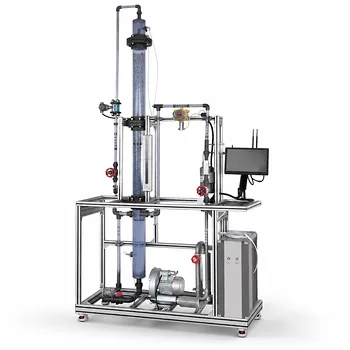
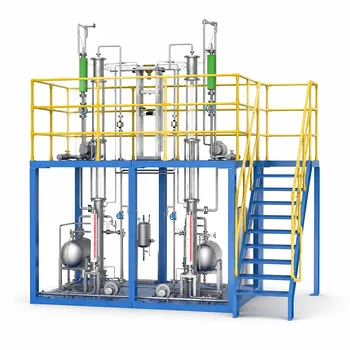
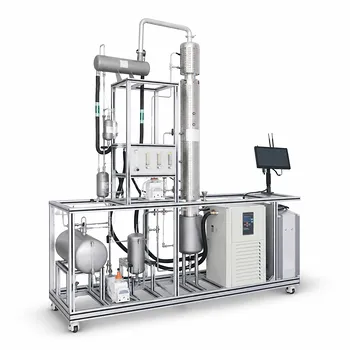
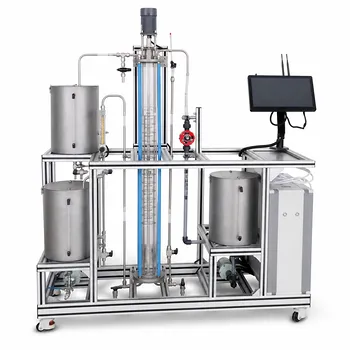
LABPARK provides state-of-the-art Educational and Vocational Unit Operations Pilot Plants in chemical engineering, bioprocess & biotech, and environmental & water treatment. Designed specifically for universities, research institutes, and enterprises, our pilot setups allow students and researchers to analyze packing geometries, flooding limits, and mass transfer efficiency with hands-on precision.
Ready to upgrade your laboratory capabilities? Contact LABPARK today to request a catalog or discuss your custom pilot plant requirements!
Related Products
- Packed Bed Absorption Educational Unit Operations Pilot Plant
- Absorption and Desorption Educational Unit Operations Pilot Plant
- Multimodal Absorption and Desorption Pilot Plant for Unit Operations Training
- Multi-Modal Distillation Unit Operations Training Pilot Plant
- Multi-Functional Special Distillation Educational Pilot Plant
People Also Ask
- How Do Flow Regimes Transition in Packed Bed Pilot Plants? Key Scale-up Insights
- How does reactant concentration determine absorption column control? Gas-film vs. dual-film.
- How is the packing height of an absorption column calculated? Master HTU & NTU Concepts
- How does static vs. operating holdup affect pilot plant calibration? Avoid Critical Scale-Up Errors
- Why is counter-current flow selected for gas absorption? Maximize Pilot Plant Efficiency