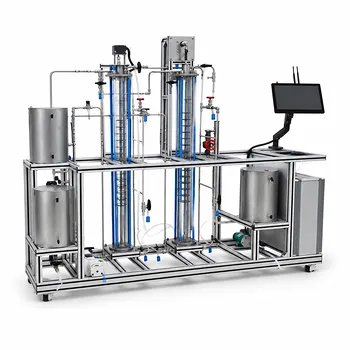
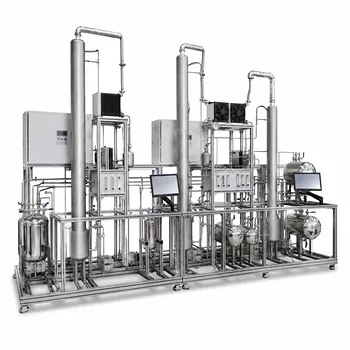
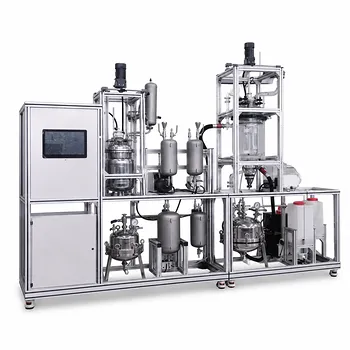
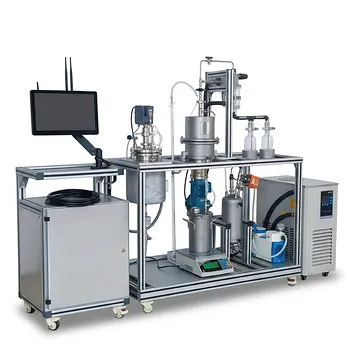
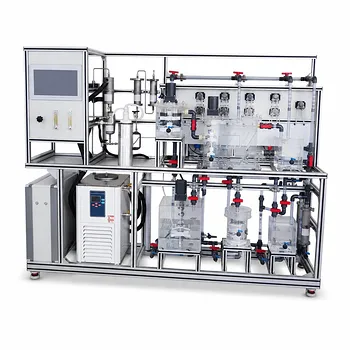
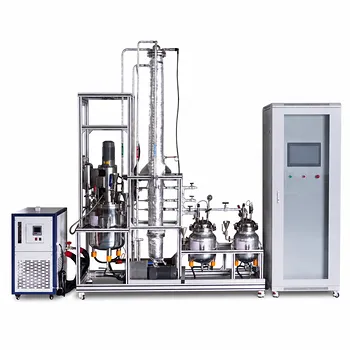
A single-stage extraction uses a deluge of fresh solvent to chase a target recovery; a multistage countercurrent setup gets the same—or better—result with a fraction of the flow. In a countercurrent column, feed and solvent move in opposite directions, so the leanest raffinate always meets fresh solvent. Pilot plants equipped with both batch vessels and continuous countercurrent columns let engineers run side-by-side mass balances, proving that the countercurrent route can slash solvent consumption by roughly 76% while boosting extraction efficiency well above 97%.
The core trade‑off is between simplicity and resource intensity. Countercurrent multistage extraction delivers the highest solute recovery with the least fresh solvent—and pilot‑scale demonstrations make that advantage measurable, not just theoretical.
Understanding the Configurations
Single‑Stage Extraction: Simple but Solvent‑Heavy
In a single‑stage unit, feed and solvent mix once in a batch vessel or decanter.
A single equilibrium contact limits how much solute moves into the extract. To push recovery higher, operators must use a large excess of fresh solvent or run multiple one‑stage batches in sequence—each one gulping fresh solvent.
Even when several single‑stage steps are chained, overall solvent consumption stays high. Data shows that a series of single‑stage extractions typically plateaus at lower efficiencies (around 76–89%) compared with a true countercurrent cascade.
Multistage Countercurrent Extraction: Efficiency Through Staging
Here, feed and solvent enter opposite ends of a train of stages.
The richest feed contacts the most solute‑laden solvent, while the almost‑stripped raffinate meets pure, entering solvent in the final stage. This preserves a high average concentration driving force across every stage.
The result is a dramatic jump in separation efficiency—often exceeding 97%—with substantially less fresh solvent. One illustrative pilot‑plant run showed that a three‑stage countercurrent column required only 24% of the solvent needed by an equivalent sequence of single‑stage batches for the same separation target.
How Pilot Plants Make the Difference Measurable
Comparative Mass Balances and Solvent Savings
A well‑instrumented unit‑ops pilot plant runs both modes with the same feed mixture. Students or researchers collect samples at each stage, measure solute concentrations in raffinate and extract, and close overall material balances.
Those numbers translate directly into solvent‑consumption ratios. Seeing a 76% reduction in solvent demand on the same bill of materials turns an abstract design principle into a compelling economic argument.
Concentration Profiles and Stage Efficiency
Sampling ports along a countercurrent column reveal the concentration gradient that drives mass transfer. By plotting these values against equilibrium data on ternary phase diagrams, users construct operating lines and step off theoretical stages.
The exercise bridges textbook graphical methods and real hardware. It also exposes actual stage efficiencies, which are always lower than the ideal equilibrium assumption—reinforcing why pilot‑scale verification is essential before scale‑up.
Understanding the Trade‑offs
Increased Complexity and Capital Cost
A countercurrent column requires pumps, instrumentation, and robust phase separation internals. A single‑stage batch vessel is far simpler to build, clean, and maintain.
For very small production volumes or frequent product changeovers, the operational simplicity of single‑stage extraction can outweigh the solvent savings of a continuous countercurrent train.
Operational Stability and Phase Control
Countercurrent columns are sensitive to flow disturbances, entrainment, and flooding. Maintaining a stable interface and steady‑state profile demands more attention than a single batch mixing step.
Pilot‑plant sessions often highlight this: students quickly learn that the theoretical efficiency gains vanish if the unit is run incorrectly, underlining the need for robust control strategies.
Applying These Insights to Your Process Design
- If your primary focus is minimizing solvent cost and waste: Choose a multistage countercurrent configuration. The 76‑percent reduction in fresh solvent demand directly lowers operating expenses and environmental footprint.
- If your primary focus is process simplicity and flexibility: A single‑stage batch setup may be the right starting point. It delivers acceptable recovery with minimal equipment complexity, ideal for early‑stage development or small‑scale campaigns.
- If your primary focus is maximum product purity and extract concentration: Lean into countercurrent staging. The countercurrent profile concentrates the solute in the extract and strips the raffinate to near‑total depletion.
A pilot‑plant comparison gives you the concrete data to make that choice with confidence, not guesswork.
Summary Table:
| Feature | Single-Stage Extraction | Multistage Countercurrent |
|---|---|---|
| Solvent Consumption | High (requires excess fresh solvent) | Low (slashes solvent demand by ~76%) |
| Extraction Efficiency | Lower (typically 76–89%) | Higher (exceeds 97%) |
| System Complexity | Low (simple batch vessel) | High (requires columns, pumps & controls) |
| Best For | Small-scale runs, process flexibility | Maximum solute recovery & purity |
Scale Up Your Chemical Engineering Education with LABPARK
Want to provide your students and researchers with hands-on experience in mass balance and extraction optimization? LABPARK provides high-quality Educational and Vocational Unit Operations Pilot Plants in chemical engineering, bioprocess & biotech, and environmental & water treatment for universities, research institutes, and enterprises.
Equip your laboratory with reliable hardware that makes complex chemical processes measurable. Contact us today to explore our pilot plant solutions!
Related Products
- Natural Product Extraction Unit Operations Training Pilot Plant
- Continuous Batch Extractive Distillation Educational Pilot Plant
- Comprehensive Liquid-Liquid Extraction Pilot Plant for Engineering Education
- Green Anhydrous Ethanol Purification Extractive Distillation Unit Operations Training Pilot Plant
- Constant Pressure Filtration Educational Unit Operations Pilot Plant
People Also Ask
- How to Demo Solubility Sensitivity in SFE Pilot Plants? Practical Thermodynamics
- How do pilot plants differentiate physical vs chemical extraction? Enhance Chemical Engineering Training
- How are HTU and NTU applied to determine extraction column height? Guide to Pilot Plant Scaling
- How can Hotelling's T² & Q statistics detect pilot plant abnormalities? Optimize Safety
- Why use split-plot designs in pilot plants instead of CRD? Optimize process parameters effectively.