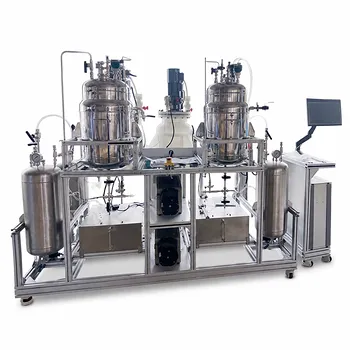
They act as a physical insurance policy. Research institutes and enterprises use miniplants and pilot plant equipment to systematically validate chemical processes under realistic, continuous conditions long before committing to a full-scale commercial facility. By physically simulating the integrated plant with its recycle streams, real feedstocks, and long run-times, they expose hidden risks—like catalyst deactivation or impurity build-up—that remain invisible in short-term laboratory experiments. This direct validation of thermodynamics, kinetics, and system dynamics converts the high-stakes gamble of direct scale-up into a controlled, step-by-step risk mitigation process.
The journey from a laboratory beaker to a commercial reactor is littered with unvalidated assumptions. Miniplants and pilot plants serve as the definitive verification layer, transforming theoretical flow sheets into physical evidence. This intermediate step ensures that the final design is not merely possible in theory, but proven in practice, preventing catastrophic financial losses and safety failures.
Beyond the Bench: Closing the Critical Gap Between Lab and Market
The underlying need is not just to test if a reaction "works"—it is to ensure the entire production concept is profitable, safe, and robust. The gap between a gram-scale synthesis and a thousand-tonne plant is vast and dangerous, filled with unknown unknowns.
The Scale-Up Deficit of Laboratory Data
Bench-scale experiments are inherently optimistic. They typically use high-purity starting materials and run for short durations, which fails to account for the complex reality of a commercial plant. This creates a dangerous blind spot.
Continuous recycle loops introduce hidden failure modes. Low-level impurities or by-products, benign in a single pass, can accumulate to inhibitory concentrations over time when streams are recycled. Long-term piloting is the only way to detect this "silent killer" of processes before it poisons a commercial-scale operation. Similarly, a catalyst's activity measured over a few hours in the lab rarely predicts its stability over months of continuous service against real-world feedstocks, where coking or poisoning mechanisms emerge slowly.
The Prototype Principle in Process Engineering
In process development, a miniplant or pilot plant is the physical prototype of the future factory. This aligns with core product development methodologies where a working model is non-negotiable for verifying system integration.
It’s not enough for the reactor, the distillation column, and the centrifuge to work independently. The physical prototype validates their choreography. Testing the complete integrated system uncovers unforeseen interactions, such as controllability issues during startup, or identifies where cheaper materials of construction can be safely substituted before procurement scales up.
Three Pillars of Technical Risk Mitigation
Relying solely on computational fluid dynamics and simulation creates a cybersecurity-like "simulation gap." Risk mitigation requires generating empirical data that validates those models. This is achieved across three critical dimensions.
Validating the Flow Sheet and Continuous Dynamics
The journey begins by transforming a paper flow sheet into a functioning physical entity. Miniplants are designed directly as scale-downs of the projected commercial plant, including all primary recycle paths.
This physical instantiation validates the critical assumption that the mass and energy balances close under dynamic, continuous operation. Engineers can observe how a process responds to a sudden pressure drop or a fluctuating cooling water temperature, generating the data needed to harden the final design against process upsets. This step also provides the first reliable data for separation feasibility, moving beyond theoretical plates to real-world column performance.
Uncovering Long-Term Stability and Real-World Feedstock Effects
The greatest technical risks are often a function of time. Short-duration tests are inherently incapable of revealing chronic degradation mechanisms. These pilot units operate continuously for weeks or months to accelerate and uncover these issues.
This endurance testing directly verifies catalyst deactivation rates, quantifying a key economic variable that determines catalyst change-out frequency and lifecycle costs. Furthermore, it allows for parallel testing of different raw material formulations. A seemingly identical, cheaper feedstock can be evaluated to see if it introduces unexpected fouling or side-reactions, directly optimizing the cost of goods (COGs) before lock-in.
Stress-Testing Process Boundaries and Safety
Knowing a process works at the optimal point is insufficient; risk mitigation requires defining the boundaries of safe operation. Pilot-scale unit operations equipment provides a contained environment to deliberately introduce failures. Engineers can safely test multivariate "what-if" scenarios—from runaway reaction conditions to total cooling loss—without the catastrophic consequences of a full-scale incident.
This generates the empirical data necessary to substantiate process safety margins and validate dynamic, multivariate models. The goal is to identify the process’s absolute limits and critical control points, creating a data-backed envelope of safe operation that informs the final hazard analysis.
Understanding the Trade-offs: Miniplant vs. Pilot Plant
Risk mitigation isn't free, and choosing the right tool requires balancing resource investment against data fidelity. The spectrum runs from low-flowrate miniplants to larger pilot facilities.
Miniplants, operating at about 0.01 to 1 kg/h, offer maximum insight per dollar spent. Their low cost and high flexibility, often built from re-usable lab components, create a sandbox for process innovation. When coupled with rigorous mathematical simulation, a well-executed miniplant campaign can bridge the data gap so completely that it entirely eliminates the need for a far more expensive large-scale pilot plant stage.
Larger pilot plants (10-100 kg/h) provide data closer to commercial reality but at a vastly higher price. They are necessary when validating commercially-sized unit operations equipment, like a specific high-volume extruder or centrifuge, where geometry cannot be scaled down equivalently for fluid dynamics. The trade-off is a loss of flexibility and a massive increase in material and capital cost, making them a targeted tool rather than a first-line exploration strategy.
Making the Right Choice for Your Development Stage
The decision of when and how to pilot is a strategic pivot point. The approach must be tailored to the specific technical risks you face.
- If your primary focus is speed-to-market and cost minimization: Start with a miniplant integrated with dynamic process simulation. Aim to gather such high-fidelity continuous data for your entire recycle scheme that you can make a data-driven decision to skip the large-scale pilot plant entirely.
- If your primary focus is validating a novel, high-risk unit operation: You may need to invest in a larger pilot plant. This is necessary when the physical geometry of a specific piece of equipment is itself the critical process parameter that cannot be simulated or scaled down.
- If your primary focus is ensuring long-term safety and reliability: Prioritize endurance runs over weeks or months in your pilot campaign. Focus on studying impurity accumulation profiles and catalyst deactivation rates, and deliberately introduce process upsets to validate the limits of your safe operating envelope.
In the high-stakes world of chemical technology development, the most expensive mistake is not running the pilot plant—it is building a commercial plant that fails.
Summary Table:
| Feature | Miniplants (0.01 – 1 kg/h) | Pilot Plants (10 – 100 kg/h) |
|---|---|---|
| Primary Goal | Validate mass/energy balances and recycle loops | Verify physical geometry and fluid dynamics of unit ops |
| Flexibility | High (modular, cost-effective setup) | Low (high capital and material investment) |
| Best For | Early-stage process innovation & catalyst life testing | Pre-commercial validation of large-scale equipment |
Bridge the Gap from Lab to Market with LABPARK
Ensure your chemical, bioprocess, or water treatment scale-up is safe, efficient, and cost-effective. LABPARK designs and delivers high-performance Educational and Vocational Unit Operations Pilot Plants tailored for universities, research institutes, and enterprises.
Whether you need to validate thermodynamics, test catalyst stability, or train the next generation of engineers, our systems provide the reliable, real-world data required to eliminate technical risks.
Take the uncertainty out of your process development—contact LABPARK today to find the perfect pilot plant solution for your facility!
Related Products
- Micro-Scale Gas-Solid Catalytic Reaction Educational Pilot Plant
- Multi-Functional Membrane Separation Educational Pilot Plant for Unit Operations Lab
- Natural Product Extraction Unit Operations Training Pilot Plant
- Rising and Falling Film Evaporation Educational Unit Operations Pilot Plant
- Multi Functional Membrane Crystallization Educational Unit Operations Pilot Plant
People Also Ask
- Fluidized vs. Fixed Bed Reactors: Comparing Heat & Complexity in Pilot Plants
- Why is a multibed configuration necessary for exothermic reactions? Optimize your pilot plant trajectory.
- Why is thermal management a major challenge in methane oxidative coupling? Reactor Solutions for Pilot Plants
- How does the Mears criterion evaluate transport resistance? Key Guide to Intrinsic Kinetics
- How do reactor pilot plants safely study gas-solid reactions? Master kinetics with thermal & flow control.