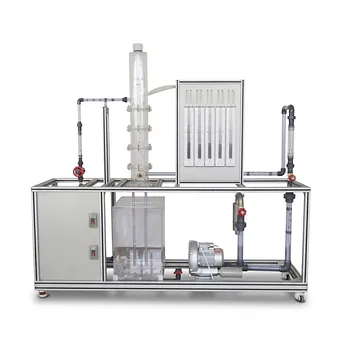
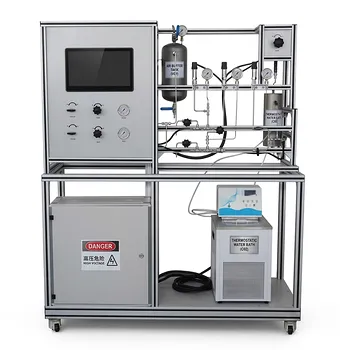
Modern educational pilot plants transform theoretical process intensification (PI) guidelines into tangible learning experiences. By integrating precisely controllable equipment—such as advanced heat exchangers, micro-channel reactors, and customizable mixing systems—these plants enable students to directly observe and manipulate the factors that drive PI, like driving forces and mixing uniformity, in a safe, hands-on environment. The result is a deep, intuitive grasp of how to design smaller, safer, and more efficient chemical processes.
The true value of educational pilot plants lies not in simply demonstrating PI principles, but in allowing students to experiment with the complex interplay between driving forces, mixing, and reaction outcomes. This builds the practical intuition required to design and operate intensified processes in industry—exactly the expertise the current workforce urgently needs.
Bridging the Gap Between Theory and Industrial Reality
Process intensification promises dramatic reductions in equipment size and energy use. Yet its adoption has been slow because traditional engineering curricula often lack hands-on PI training. Classroom theory alone cannot convey the delicate balances required to make an intensified process work reliably.
The Missing Piece: Practical Experience with Intensified Systems
A key barrier to industrial PI adoption is the lack of in-depth expertise among engineers. They may understand the concepts but have never operated a microreactor or tuned a static mixer to maximize selectivity. Educational pilot plants fill this void by offering a risk-free sandbox where students can commission, control, and troubleshoot intensified unit operations themselves.
From Abstract Guidelines to Measurable Results
PI guidelines like "maximize driving forces" or "ensure uniform molecular exposure" sound straightforward in a lecture. In a pilot plant, students connect those words to real-time data—temperature profiles across a compact heat exchanger, residence time distributions in a static mixer, and the resulting yield from a microreactor. That direct feedback loop cements a visceral understanding no textbook can provide.
How Pilot Plants Make Driving Force Optimization a Hands-On Skill
Modern educational pilot units are designed to isolate and amplify the effect of driving forces. They move students from passive learning to active experimentation.
Manipulating Temperature and Concentration Gradients
Advanced compact heat exchangers and micro-channel reactors in the pilot plant offer extreme surface-to-volume ratios. Students can deliberately vary the temperature of a heating medium or the concentration of a reactant and instantly see how the heat or mass transfer rate—and hence the reaction rate—responds. The system’s precise instrumentation turns the classic ( \text{Rate} = k \cdot \Delta \text{DrivingForce} ) into a live, plottable trend.
Testing the Limits of Transport
When reactions become fast, transport limitations can bottleneck the entire process. In a controlled setting, students can push flow rates or reduce catalyst particle sizes and observe the point where mass transfer ceases to keep up. This direct experience teaches them to recognize and prevent transport-limited regimes—a critical skill for designing the next generation of intensified reactors.
Achieving and Analyzing Uniform Mixing
Mixing in PI is about far more than just stirring. It’s about giving every molecule the same processing history. Pilot plants dedicated to PI education make this principle both visible and measurable.
Controllable Mixing Technologies at Your Fingertips
These plants feature highly controllable mixing systems—customized stirrers with variable speed and impeller geometry, or precise static mixer configurations. Students can swap mixing elements, alter rotational speeds, or modify flow patterns, then directly sample the outlet to measure product selectivity. They see for themselves how a small change in mixing can drastically shift the purity or yield.
The Direct Link Between Hydrodynamics and Selectivity
In fine chemical or pharmaceutical reactions, poor mixing leads to side products. By introducing a tracer or taking concentration profiles along the reactor, students correlate velocity fields and turbulence metrics with reaction outcomes. The lesson is unmistakable: investing in mixing uniformity is not an accessory—it’s the central lever for reaction performance in an intensified process.
Understanding the Trade-offs: Safety, Complexity, and Scale
While pilot plants make PI accessible, they also reveal its inherent challenges. A well-structured educational program exposes students to the full picture.
Intensified Processes Demand Superior Control
Smaller volumes mean less thermal inertia. A temperature excursion that would be a minor blip in a large vessel can become dangerous in a microreactor. Consequently, pilot plants are equipped with industrial-grade control valves, sensors, and safety interlocks. Students learn that PI is inseparable from advanced automation and reliable safety relief systems. They practice handling simulated deviations—cooling failures, pressure buildups—and observe how rupture discs and emergency shutdown systems respond.
Reduced Residence Time, Increased Operational Rigor
Intensified systems operate with very short residence times. While this boosts throughput, it also shrinks the window for corrective action. Students discover that start-up and shut-down procedures must be meticulously planned, and that steady-state conditions are reached and lost quickly. This hands-on experience instills a discipline essential for future plant managers.
The Footprint-Capability Paradox
A microreactor is tiny, but its supporting infrastructure (pumps, pre-heaters, separators) may not scale down as easily. In the pilot plant, students confront this reality: they see how the promise of a drastically smaller reactor can be offset by the complexity of the balance-of-plant. Recognizing this systems-level trade-off is crucial for making balanced, economically sound PI decisions.
Making the Right Choice for Your Educational or Training Program
The design of the pilot plant experience should match the program’s primary objective. Use the following guide to align your technology selection with learning outcomes.
- If your primary focus is reaction engineering fundamentals: Choose a plant with interchangeable microreactors and compact heat exchangers. The priority is the ability to isolate and measure the impact of transport phenomena on intrinsic kinetics.
- If your primary focus is process safety and hazard mitigation: Prioritize a unit with comprehensive safety interlocks, emergency shutdown systems, and the ability to simulate process deviations. The core learning is how to manage the acute risks that accompany intensification.
- If your primary focus is process control and Industry 4.0 integration: Look for a plant with advanced, distributed control systems that log all process variables in real time. Students should be able to tune control loops on an inherently fast, nonlinear system.
- If your primary focus is sustainable design and footprint reduction: Select a facility that integrates multiple functions—like reactive distillation columns or combined reactor-heat exchangers. The goal is for students to measure energy consumption and waste reduction directly.
The key is to never treat the pilot plant as a mere demonstration tool. When students are empowered to design their own experiments, make mistakes, and iterate, the abstract guidelines of process intensification become a permanent part of their professional toolkit—precisely the outcome our industry needs.
Summary Table:
| Learning Focus | Recommended Pilot Plant Features | Key Learning Outcome |
|---|---|---|
| Reaction Engineering | Interchangeable microreactors & compact heat exchangers | Measure transport phenomena impact on kinetics |
| Process Safety | Safety interlocks, emergency shutdown systems | Manage acute risks & simulate process deviations |
| Process Control | Distributed control systems, real-time data logging | Tune control loops on fast, non-linear systems |
| Sustainable Design | Integrated functions (e.g., reactive distillation) | Measure energy consumption & waste reduction |
Bring Process Intensification to Life with LABPARK
Are you looking to equip your students or research team with practical, industry-ready engineering skills? LABPARK provides state-of-the-art Educational and Vocational Unit Operations Pilot Plants in chemical engineering, bioprocess & biotech, and environmental & water treatment.
Designed specifically for universities, research institutes, and enterprises, our pilot plants bridge the gap between classroom theory and real-world industrial operations, allowing students to safely optimize driving forces, mixing uniformity, and advanced process controls.
Ready to elevate your engineering curriculum or training program? Contact LABPARK today to find the perfect pilot plant solution for your institution!
Related Products
- Multi-Functional Special Distillation Educational Pilot Plant
- Multi-Reactor Educational Pilot Plant for Reaction Engineering Unit Operations
- Multi-Functional Membrane Separation Educational Pilot Plant for Unit Operations Lab
- Micro-Scale Gas-Solid Catalytic Reaction Educational Pilot Plant
- High-Gravity Emulsification and Mass Transfer Educational Pilot Plant
People Also Ask
- How does operating pressure influence Methylal/Methanol VLE? Discover its impact on distillation
- Why does simple distillation yield higher efficiency than flash distillation? Key thermodynamic differences.
- How to Estimate Distillation Pilot Plant Tray Efficiency? O'Connell's Correlation Guide
- How to Integrate Spectroscopy in Distillation Pilot Plants for Advanced Process Control
- Why is the acentric factor important in pilot plants? Fluid property prediction.