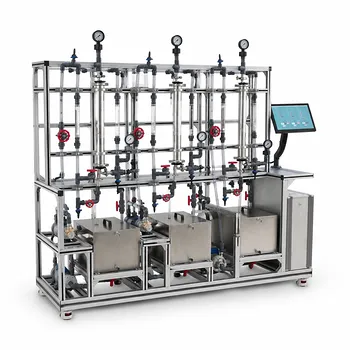
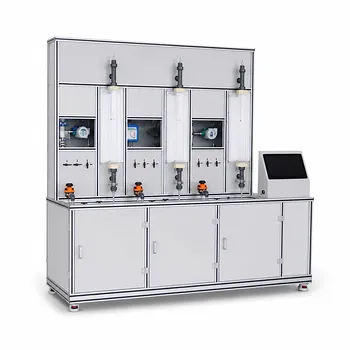
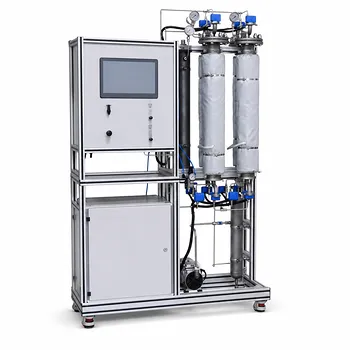
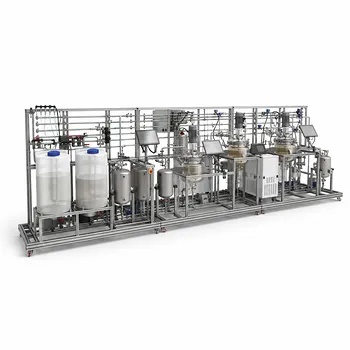
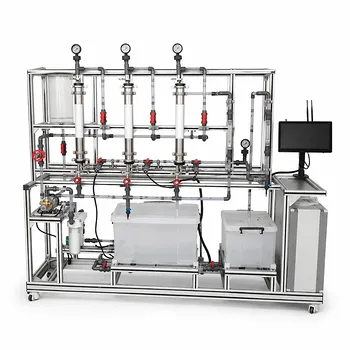
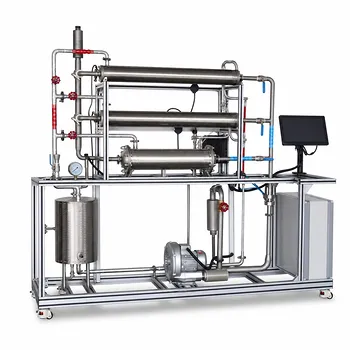
If you’re wondering whether a miniplant can truly replace a larger pilot plant, the direct answer is yes—often, it can. Miniplants operate at 0.01 to 1 kg/h, sharply lower than the 10 to 100 kg/h typical of large-scale pilot units, yet they replicate the entire continuous process, including all recycle loops. When paired with rigorous mathematical process simulation, this small-footprint approach delivers scale-up data that is so reliable it frequently allows you to bypass the expensive, time-consuming pilot plant stage altogether.
Miniplants combine high operational flexibility with dramatically lower capital and operating costs. Their true power lies in integrating physical testing with simulation to mimic full commercial plant dynamics, enabling rapid, safe, and cost-effective process validation that can leapfrog traditional scale-up steps.
The Definitive Comparison: Scale, Scope, and Data Quality
The difference between a miniplant and a larger pilot plant is not just about throughput. It’s a fundamental shift in philosophy. While a pilot plant aims to demonstrate the viability of an individual unit operation at near-commercial scale, a miniplant demonstrates the viability of the entire flowsheet in an integrated, continuous loop.
Throughput and Physical Footprint
Miniplants operate at very low production rates, often using standardized, reusable laboratory components. This drastically reduces initial investment.
Large-scale pilot plants require bespoke equipment, significant infrastructure, and substantial raw material quantities. They are expensive to build, modify, and operate.
The small scale of a miniplant means you can run dozens of iterations. You can swap out catalysts, change separation sequences, or test new reactor configurations with an agility a full-scale pilot simply cannot match.
The Simulation-Data Feedback Loop
Miniplants are not stand-alone. They are inextricably linked with mathematical process simulation. The data you generate in the miniplant—recycle stream compositions, pressure drops, impurity profiles—is fed directly into a simulation model.
This validated model can then predict the behavior of the commercial-scale plant with high confidence. This is the core of the miniplant advantage: it produces the data needed to build a trustworthy model, which in turn makes the intermediate pilot scale redundant.
In contrast, a larger pilot plant often generates data that is scaled up using empirical correlations, a process that still carries significant uncertainty if the underlying chemistry and physics change with scale.
Closing the Recycle Gap
Bench-scale laboratory experiments are inherently linear. They use pure starting materials and run for short durations, failing to account for the accumulation of impurities or by-products in recycle streams.
Miniplants and larger pilot plants share the critical ability to operate continuously for weeks or months with full recycle. This reveals the real-world behavior you will see commercially:
- Impurity build-up from real or synthesized feedstocks.
- Long-term catalyst deactivation due to coking, sintering, or poisoning—phenomena invisible in short-term bench tests.
- Start-up and shut-down procedures and their impact on product quality and equipment stress.
The miniplant captures these phenomena at a fraction of the cost of a pilot plant.
Understanding the Trade-offs: When Miniplants Are Not Enough
The miniplant methodology is powerful, but not universal. An objective assessment demands that we recognize its limitations, which define where a larger pilot plant remains essential.
The Risk of Extrapolating Fluid Dynamics
A miniplant cannot perfectly scale down complex fluid dynamics. If your commercial design involves a novel reactor geometry where mixing patterns, mass transfer, or heat transfer are dominated by physical dimensions, the miniature version may fail to reproduce those conditions.
In such cases, a larger pilot plant unit of the specific reactor is non-negotiable to validate the fluid dynamic models. Skipping this step risks catastrophic scale-up failure.
Mechanical and Metallurgical Integrity
Miniplants rarely use the same materials of construction or full-scale mechanical designs. They cannot test long-term corrosion, erosion, or vibration in a way that is representative of a production plant.
If your process involves highly corrosive fluids at extreme pressures, a larger pilot plant built with the intended commercial materials is a prudent investment to avoid future equipment failure.
Market Development and Product Qualification
A 1 kg/h miniplant cannot produce the tonnage of material required for customer qualification, market testing, or regulatory trials. If you need hundreds of kilograms of product to give to potential clients, a larger pilot plant operating at 50–100 kg/h is the necessary tool.
The miniplant derisks the technical process; the pilot plant derisks the commercial supply.
Making the Right Choice for Your Goal
Your decision hinges entirely on what problem you are trying to solve. The best approach often sequences these tools.
- If your primary focus is validating the integrated chemistry and recycle stream: Begin with a miniplant. It will rapidly and cheaply uncover fatal flaws in your process concept before you invest heavily in scale.
- If your primary focus is developing a predictive, scale-independent simulation model: Pair a miniplant with rigorous simulation. The validated model will be your most valuable asset for design and optimization.
- If your primary focus is proving a novel reactor’s hydrodynamics or validating construction materials: You cannot skip a larger pilot plant for those specific unit operations. Plan for it from the start.
- If your primary focus is generating market samples in kilogram-to-ton quantities: A larger pilot plant is the only physically capable option to meet that logistical requirement.
Ultimately, the miniplant is not just a smaller pilot plant; it is a strategic tool for front-loaded learning. By shifting the discovery of problems from the expensive construction site to a flexible laboratory bench, you compress timelines, burn less capital, and build a foundation of knowledge that de-risks every subsequent decision.
Summary Table:
| Feature | Miniplants (0.01 - 1 kg/h) | Large-Scale Pilot Plants (10 - 100 kg/h) |
|---|---|---|
| Primary Focus | Validating integrated flowsheet & recycle loops | Demonstrating unit operations & physical scaling |
| Cost & Agility | Low capital cost; rapid configuration changes | High investment; complex and slow to modify |
| Simulation Role | Directly integrated to build predictive models | Relies more on empirical scale-up correlations |
| Key Limitations | Cannot test complex fluid dynamics or metallurgy | High raw material consumption & operational costs |
| Output Volume | Grams to kilograms (process validation only) | Kilograms to tons (for market/customer trials) |
Optimize Your Process Scale-Up with LABPARK
Bridging the gap between laboratory benchwork and commercial production requires the right testing infrastructure. LABPARK designs and provides premium Educational and Vocational Unit Operations Pilot Plants in chemical engineering, bioprocess & biotech, and environmental & water treatment.
Tailored for universities, research institutes, and industrial enterprises, our systems offer the reliability and flexibility you need to validate processes, train future engineers, and scale up with confidence.
Ready to elevate your research or training capabilities? Contact us today to find the ideal pilot plant solution for your facility!
Related Products
- Micro-Scale Gas-Solid Catalytic Reaction Educational Pilot Plant
- Multi-Functional Membrane Separation Educational Pilot Plant for Unit Operations Lab
- Multi-Functional Special Distillation Educational Pilot Plant
- Continuous Batch Extractive Distillation Educational Pilot Plant
- Two Phase Flow Pattern Velocity Resistance Measurement Educational Pilot Plant
People Also Ask
- Fluidized vs. Fixed Bed Reactors: Comparing Heat & Complexity in Pilot Plants
- Why is a multibed configuration necessary for exothermic reactions? Optimize your pilot plant trajectory.
- Why is thermal management a major challenge in methane oxidative coupling? Reactor Solutions for Pilot Plants
- How does the Mears criterion evaluate transport resistance? Key Guide to Intrinsic Kinetics
- How do reactor pilot plants safely study gas-solid reactions? Master kinetics with thermal & flow control.