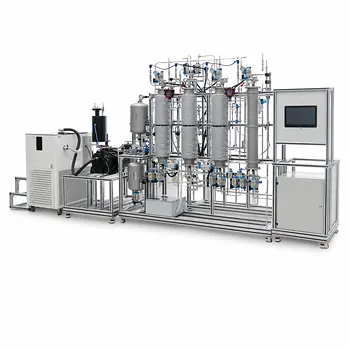
High temperatures and pressures dramatically reduce the energy required for water electrolysis by minimizing overvoltages and ohmic resistance. At supercritical conditions—above 374°C and 221 bar—water’s decomposition potential virtually disappears, electrodes become nearly non-polarizable, and you can push extremely high current densities at very low voltages. However, this electrochemical utopia comes at a cost: it introduces catastrophic material corrosion, requires complex gas-separation systems for fully miscible hydrogen and oxygen, and demands a complete redesign of pressure vessel architecture to withstand creep and strength loss.
While supercritical water electrolysis creates a near-ideal thermodynamic environment by collapsing overvoltages, the practical engineering challenge for a pilot plant pivots entirely to material science and safety. You are no longer just building a cell; you are designing a system to contain and separate explosive gas mixtures in a highly corrosive, superheated fluid that attacks standard metals.
The Electrochemical Catalyst: Why Temperature and Pressure Transform Electrolysis
The primary reference cuts to the core of the phenomenon. The behavior isn't just a linear improvement—it's a fundamental phase change in how water interacts with electricity. Your need to understand this shift is as much about safety as it is about performance.
The Collapse of Resistance at Supercritical Extremes
Standard electrolysis faces energy losses from activation overpotentials and ohmic resistance in the electrolyte. Increasing temperature and pressure is a direct attack on these inefficiencies.
At 25°C, water molecules are strongly hydrogen-bonded, and ion mobility is sluggish. As you increase the temperature, the kinetic energy of the molecules and ions skyrockets. High pressure acts in the same direction by pushing molecular species closer together. The combined effect is a massive increase in ion mobility and the diffusion constants of neutral molecules like dissolved hydrogen and oxygen. These are the direct drivers of lower resistance.
Once you cross the supercritical point (~374°C, 221 bar), the behavior becomes non-intuitive. Organic compounds and permanent gases like O₂ and H₂ become completely miscible with supercritical water. There is no phase boundary between liquid and gas. The primary reference notes that electrodes become "almost non-polarizable," and the decomposition potential is "no longer clearly visible." This means you can drive extremely high current densities with a very low thermodynamic voltage push.
The Hidden Consequence of a Higher Ion Product
Your supplementary references reveal the chemical "catch." It's not just about lower resistance; the water itself becomes a different solvent. At room temperature, water's ion product (Kw) is a minuscule (10^{-14} \text{ mol}^2/\text{L}^2). At 500°C and a density of 1 g/cm³, Kw jumps to roughly (10^{-8}).
This is a hundred-thousandfold increase in the concentration of hydrogen (H⁺) and hydroxyl (OH⁻) ions in the fluid, even before any external current is applied. This highly dissociated state means the water itself is an aggressive catalyst for hydrolysis reactions. For a pilot plant, this isn't just about making H₂ and O₂ faster; it means the process fluid will aggressively dissolve or attack vessel walls, seals, and electrode components, even stable alkali salts.
The Engineering Gauntlet: Translating Thermodynamics into a Safe Pilot Plant
Your deep need isn’t just to know the science, but to translate it into a physical, operable pilot unit. The electrochemical benefits create a perfect storm of engineering design constraints. You are no longer selecting standard components; you are specifying a system to survive a hostile, high-energy environment.
Material Selection for Severe High-Temperature Corrosion
The primary reference explicitly warns about "severe high-temperature corrosion (accelerated by supercritical steam and dissolved heavy metal complexes)." Standard 316L stainless steel is completely inadequate here. The supercritical water, with its high Kw, acts as a powerful polar solvent that leaches metal ions from the vessel.
Your material choice must address three simultaneous failure modes identified in the design references:
- Loss of Mechanical Strength: Low-carbon steel drops from 450 N/mm² tensile strength at 25°C to 210 N/mm² at 500°C. You cannot just use a thicker piece of the same material; you need alloys that retain strength at 500°C+.
- Creep Deformation: Under constant load at these temperatures, metal doesn't just weaken—it deforms slowly over time. Supplementary reference 3 is clear: high-stress, high-temperature zones demand specialized alloys with high creep resistance. This is a non-negotiable design input for reactor internals and heater tubes.
- Regulatory Compliance: Pressure vessel codes like ASME BPV set hard limits. Standard carbon steel plates cannot be used in pressure vessels with design temperatures above 482°C (900°F). The code forces your hand: you must jump to a solution like a high-nickel alloy (e.g., Inconel 600, Incoloy 800).
Rethinking Pressure Vessel Architecture
Achieving a 500°C, 350 bar operating window in a single laboratory-scale cell forces you beyond conventional vessel design.
If you try to build a standard single-wall monobloc vessel for pressures above 200 bar, the required wall thickness becomes immense. Fabrication becomes nearly impossible as deep welding thick sections introduces flaws and residual stresses. Supplementary reference 5 offers the solution in two key options, often used together:
- Code-Compliant High-Stress Design: You can transition your design standard to codes like ASME Section VIII, Division 2. This methodology allows for a more precise stress analysis, permitting higher maximum allowable stresses in the vessel wall. The result is a thinner, more manufacturable wall while maintaining safety factors.
- Multi-Layer Vessel Construction: This technique is critical for extreme cyclic fatigue resistance. Thin shells are wrapped or shrunk-fit concentrically. The outer layers pre-load the inner shell with a compressive residual stress. When your pilot plant is at 400 bar, the tensile hoop stress generated by the internal pressure first has to overcome this built-in compression. This drastically reduces the probability of crack propagation and failure.
Understanding the Trade-offs: Efficiency vs. Complex Control
Selling the efficiency gain without the operational peril is a disservice. The very property that makes supercritical electrolysis efficient—the complete miscibility of O₂ and H₂—creates its greatest hazard.
The Gas-Separation Nightmare
In a conventional alkaline electrolyzer, the liquid electrolyte is the separation medium; gas bubbles rise and are mechanically separated. At supercritical conditions, this phase boundary is gone. Your pilot plant produces a single, homogeneous, supercritical fluid containing a potentially explosive mixture of hydrogen and oxygen. The primary reference demands "precise phase boundary and gas-separation control systems."
This isn't a simple gravity separator. You will likely need to exploit the thermal properties of the mixture and use a controlled, rapid quench or a selective membrane at a point where the fluid is brought back below critical conditions. Empirical data in this separation regime is scarce.
The Reliance on Empirical Data
The final supplementary references hit on a deep truth for this type of pilot plant: you are building it because theoretical models are unreliable near critical points.
The behavior of multi-component, electrically charged mixtures in the critical region is notoriously difficult to predict. Extrapolating low-temperature thermodynamic data to 500°C is not just inaccurate—it's dangerous. Your pilot plant isn't just a proof-of-concept for hydrogen production; it's an essential instrument to gather empirical data on phase equilibria, validate your thermodynamic models, and identify stable hydrate phases under your operating conditions before any scale-up is attempted.
Making the Right Choice for Your Goal
Your pilot plant design is not a single path; it's a series of hard trades you must navigate based on your ultimate research or production goal.
- If your primary focus is maximizing overall energy efficiency: You must design for the supercritical regime, accepting the full operational difficulty. This means specifying a pressure vessel made of Inconel or similar high-nickel alloy, designed under ASME VIII Div. 2, possibly with a multi-layer construction for cyclic safety.
- If your primary focus is operational safety and simpler gas separation: You should operate a high-temperature, high-pressure plant in the subcritical region. Here, a liquid phase still exists to separate gases, and you can use a broader range of materials (e.g., careful selections of superaustenitic stainless steels). The efficiency gain is smaller, but the engineering risk drops dramatically.
- If your primary focus is generating reliable scale-up data: Budget your pilot plant as both a reactor and a thermodynamic measurement cell. Your design must integrate precise pressure and temperature sensors, along with sampling loops that can safely quench the supercritical fluid to analyze composition, validating the models your commercial design will depend on.
This is not just an electrochemical challenge; it is a profound high-temperature, high-pressure chemical engineering project where the vessel material and its design code are the true enablers of performance.
Summary Table:
| Parameter/Regime | Operating Conditions | Electrochemical Key Effect | Major Engineering Challenge |
|---|---|---|---|
| Standard Electrolysis | 25°C, 1 bar | High overvoltage & ohmic resistance | Standard materials suffice |
| Subcritical Electrolysis | High T & P (below critical) | Reduced resistance, phase boundary remains | Material selection, safe phase separation |
| Supercritical Electrolysis | >374°C, >221 bar | Collapse of overvoltages, gas miscibility | Extreme corrosion, creep, explosive gas mixtures |
Accelerate Your Process Scale-Up with LABPARK
Designing high-pressure, high-temperature pilot plants requires rigorous engineering and compliance. LABPARK provides state-of-the-art Educational and Vocational Unit Operations Pilot Plants in chemical engineering, bioprocess & biotech, and environmental & water treatment.
We help universities, research institutes, and enterprises transition from lab-scale concepts to robust, safe, and code-compliant pilot systems.
Ready to elevate your research or industrial process? Contact LABPARK today to discuss your pilot plant requirements with our engineering specialists!
Related Products
- Carbon Dioxide Hydrogen Methanol Synthesis Educational Unit Operations Pilot Plant
- Electrochemical Water Treatment Educational Unit Operations Pilot Plant
- Methanol Synthesis and Catalyst Performance Evaluation Educational Unit Operations Pilot Plant
- Electrolyte Distillation Purification and Formulation Educational Pilot Plant
- Educational Pressure Swing Adsorption Ethylene Capture Unit Operations Pilot Plant
People Also Ask
- How do temp & pressure affect methanol synthesis pilot plants? Optimize equilibrium and catalyst performance.
- Why is a purge system necessary when operating a gas recirculation loop in a methanol synthesis pilot plant? (Guide)
- Why do modern methanol pilot plants operate at lower pressures? Catalyst & Feed Requirements Explained
- What are the operational requirements for catalyst activation? Safe Methanol Pilot Plant Operation
- Why is the chemical plant startup schedule crucial? De-risk scale-up with pilot plants.