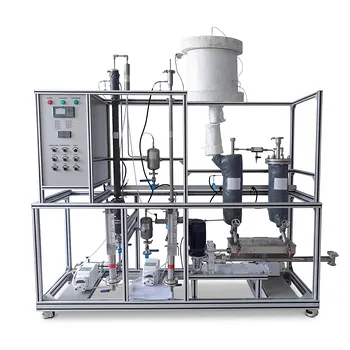
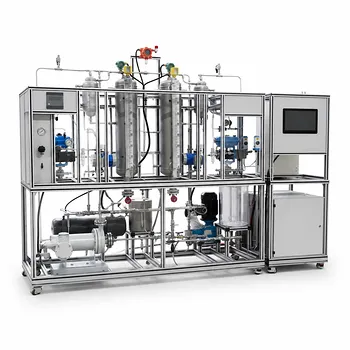
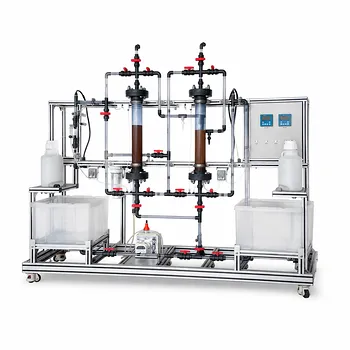
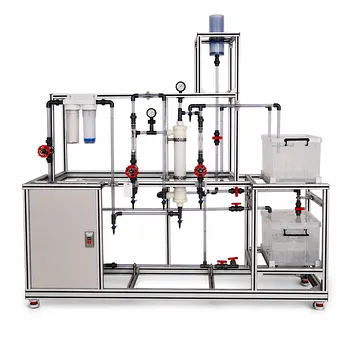
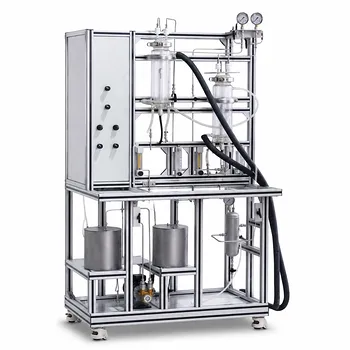
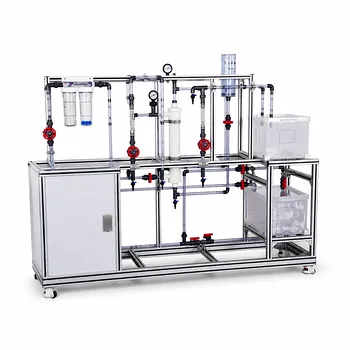
An educational pilot plant demonstrates prevention by using a two‑stage membrane cascade that removes heavy hydrocarbons before they reach the hydrogen‑selective glassy layer. The first stage employs an organophilic elastomeric membrane to strip out the larger hydrocarbon molecules that would otherwise condense downstream. This ensures the dew point is never reached at the surface of the glassy polymer membrane, eliminating the liquid condensation that causes swelling and irreversible structural damage. Students then measure concentration profiles and pressure changes across both stages to see exactly how the synergy keeps the glassy membrane safe.
The core lesson is not about making a single membrane bulletproof—it’s about managing the hydrocarbon dew point upstream. A smart multi‑stage design turns a destructive condensation threat into a controllable separation task, giving students a hands‑on blueprint for protecting fragile glassy membranes in real hydrogen purification trains.
Why Liquid Condensation Destroys Glassy Membranes
The Vulnerability of Glassy Polymer Structures
Glassy membranes used for hydrogen separation rely on a rigid, densely packed polymer matrix to sieve molecules by size and affinity.
When liquid hydrocarbons form on the membrane surface, they penetrate the polymer network, causing it to swell.
This swelling distorts the selective pathways, permanently degrading both permeance and selectivity—a failure mode that cannot be reversed by simple cleaning.
The Dew Point as the Hidden Enemy
The condensation problem is not about the total hydrocarbon concentration alone; it’s about whether the hydrocarbon partial pressure crosses the saturation line at operating temperature.
Even a stream that looks “dry” on paper can create localized condensation near the membrane if the dew point margin is too thin.
An educational pilot plant makes this invisible threat visible by showing how measured dew points shift after each stage—demonstrating that prevention is a thermodynamic dance, not just a filter choice.
The Two‑Stage Design: A Hands‑On Demonstration of Protection
Stage 1 – Organophilic Elastomeric Membranes for Heavy Hydrocarbon Stripping
The pilot plant first feeds the mixed gas stream to an elastomeric (rubber‑like) membrane that has a strong affinity for heavier hydrocarbons.
Because rubbery polymers are inherently sorption‑selective, they readily dissolve C3+ and C4+ components while letting lighter gases like hydrogen pass at a much lower rate.
This step pulls the hydrocarbon partial pressure down before the stream ever encounters the glassy membrane, effectively shifting the dew point to a safer level.
Stage 2 – Protected Hydrogen‑Selective Glassy Membranes
Cleaned of the bulk heavy hydrocarbons, the stream then enters the second stage containing the glassy polymer membrane optimized for H₂/CH₄ or H₂/N₂ separation.
Here, the gas‑phase environment remains safe because the condensation‑prone molecules have already been removed.
The glassy membrane operates well within its stable performance window, free from liquid‑induced swelling—students observe steady‑state permeate composition over time, a stark contrast to the rapid deterioration they would see with an unprotected single‑stage system.
Measuring the Synergy Through Real‑Time Data
Educational pilot plants are instrumented to capture concentration profiles and pressure drops before and after each membrane module.
Students can track how the hydrocarbon loading drops across stage 1 and confirm that the glassy membrane inlet stream remains comfortably above its dew point.
This data‑driven approach turns an abstract “pre‑treatment” concept into a quantifiable protection margin, reinforcing that the two‑stage synergy is a measurable engineering decision, not guesswork.
Understanding the Trade‑offs and Practical Limitations
The Cost of Protection
Adding a pre‑treatment stage introduces additional capital equipment, control complexity, and pressure drop that must be paid for against the longer life of the glassy membrane.
In an educational setting, students quickly see that protecting the glassy membrane is not free—the elastomeric module has its own selectivity limits and permeance trade‑offs that affect overall hydrogen recovery.
Elastomeric Membrane Aging and Fouling
While the elastomeric membrane saves the glassy one, it can itself be degraded by heavy hydrocarbon plasticization or fouling if the feed contains entrained liquids or particulates.
Good pilot plant design often includes a knock‑out drum or pre‑filter upstream of the elastomeric stage, teaching that membrane protection is a layered defence.
The Dew Point Margin Illusion
A purely thermodynamically “safe” dew point at the glassy membrane inlet can still be compromised by process upsets, pressure fluctuations, or ambient temperature drops.
Students can simulate these disturbances to learn that a robust protection strategy requires a dynamic safety margin, not just a single steady‑state calculation.
Making the Right Choice for Your Purification Goal
- If your primary focus is on educational demonstration: Build a two‑stage pilot plant with both elastomeric and glassy modules and instrument it to capture composition and pressure data between stages—this makes dew point management a tangible, measurable lesson.
- If your primary focus is on maximizing hydrogen recovery in a real process: Evaluate whether a heavier hydrocarbon removal step (membrane or otherwise) can reduce glassy membrane replacement costs enough to justify the extra equipment and pressure drop.
- If your primary focus is on protecting the most sensitive membrane element: Design the system so that the elastomeric pre‑treatment bears the brunt of the condensation risk, and pair it with simple upstream filtration to extend its own life—creating a cascade where each membrane sacrifices for the one behind it.
The real power of the educational pilot plant is that it transforms a catastrophic failure mode into a teachable sequence—showing that protecting a membrane is never about a single material, but about orchestrating the whole gas path.
Summary Table:
| Stage | Membrane Type | Primary Function | Prevention Mechanism |
|---|---|---|---|
| Stage 1 (Upstream) | Organophilic Elastomeric | Strips heavy hydrocarbons ($C_{3+}$) | Lowers hydrocarbon partial pressure, shifting the dew point |
| Stage 2 (Downstream) | Glassy Polymer | Separates $H_2$ from $CH_4$ / $N_2$ | Operates in dry gas phase, eliminating swelling and damage |
Bring Advanced Gas Separation Concepts to Life with LABPARK
Looking to equip your laboratory with hands-on learning systems? LABPARK provides state-of-the-art Educational and Vocational Unit Operations Pilot Plants in chemical engineering, bioprocess & biotech, and environmental & water treatment.
Our custom-engineered pilot plants empower universities, research institutes, and enterprises to demonstrate complex thermodynamic processes—such as dew point control and multi-stage membrane protection—with real-time data visualization.
Ready to elevate your training and research capabilities? Contact LABPARK today to request a quote or discuss your custom pilot plant specifications.
Related Products
- Steam Methane Reforming Hydrogen Production and Purification Educational Pilot Plant
- Multifunctional Membrane Separation Educational Pilot Plant with Ultrafiltration, Nanofiltration, Reverse Osmosis
- Alkaline Membrane Water Electrolysis Educational Pilot Plant Unit Operations Training System
- Multi-Functional Membrane Separation Educational Pilot Plant for Unit Operations Lab
- Ion Exchange Water Purification Educational Pilot Plant for Engineering Unit Operations
People Also Ask
- How Do Temp, Pressure & S:C Ratio Affect Methane Reforming? Optimize Your Pilot Reactor
- What are the differences between steam reforming and ATR in pilot plants? Key Design Guide
- How to Integrate WGS & Purification in Steam Reforming Pilot Plants to Protect Fuel Cells from CO Poisoning
- How is carbon deposition controlled in steam reforming? The Critical Role of S/C Ratio
- What is the difference between allothermal and autothermal steam reforming in pilot plants?