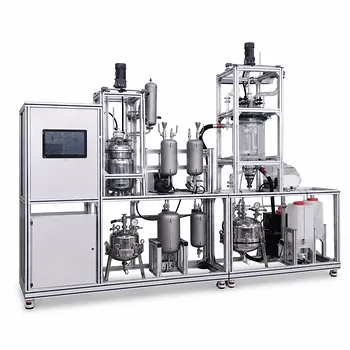
The direct visual evidence lies in a single, contrasting pair of experiments, not a complex lecture. Educational chemical engineering training systems don't just talk about galvanic and electrolytic cells—they let you watch them wage war on a piece of metal in real-time. The difference is demonstrated by reversing the fundamental flow of energy: one setup generates a current to protect steel (a galvanic cell using a sacrificial anode), while the other consumes a current to force protection (an electrolytic cell using an external DC source). This highlights the shift from a spontaneous natural reaction driven by a material's potential to a non-spontaneous forced reaction controlled by an external voltage.
The most profound visual lesson in corrosion control is that a galvanic cell is a battery you discharge to save a structure, while an electrolytic cell is a battery you charge. Training systems make this tangible by letting students measure the spontaneous current flow from a dissolving zinc anode versus the forced current from a power supply, connecting abstract electrochemistry to a directly observable protective outcome.
The Core Pedagogical Challenge: Why This Contrast Matters
To the untrained eye, corrosion is just rust. The deep need of any training system is to transform this invisible, time-lapse electrochemical process into a clear, immediate, and measurable distinction.
Students must internalize that the direction of energy conversion is the fundamental governing principle. A misunderstanding here leads to catastrophic design failures, like connecting a sacrificial anode backwards or misconfiguring a rectifier.
Visualization Through Instrumentation, Not Just Sight
Pure visual observation of a metal sample has severe limitations. The true "visualization" in a chemical engineering context comes from the integrated instruments that display the silent flow of electrons and ions.
Current meters serve as the primary eyes. In a galvanic cell, the meter will register a net negative current, indicating that electrons are being produced by the corroding anode and flowing to the protected cathode. This is a spontaneous power source.
Voltage regulators are the non-negotiable control element that visually and functionally defines the electrolytic cell. The simple physical act of seeing an external power supply in the circuit, with its dial turned to force an opposing voltage, is the first-order "visual" difference.
The Chemical Proof: Revealing the Invisible Reaction
A metal turning from shiny to pitted is a slow, qualitative observation. Smart training systems accelerate and make this quantitative.
They achieve this through chemical testing ports. By injecting an indicator like potassium ferricyanide, the system creates an immediate, localized visual revelation. Areas actively producing ferrous ions (the anode) will instantly develop a deep Prussian blue color—a stark, undeniable visual marker of anodic dissolution.
The Galvanic Cell Demo: The Spontaneous Protector
This setup visualizes the natural, energetic motivation for corrosion and how to cleverly redirect it. The core lesson is that damage is inherently selective.
Setting Up the Sacrificial Visual
The training unit physically connects two dissimilar metals: a steel sample (the structure) and a zinc block (the sacrificial anode). A high-impedance voltmeter placed between them immediately shows a measurable potential difference—this is the thermodynamic driving force for a reaction.
Watching the Anode's Energetic Runaway
When the circuit is completed, the instruments tell the story. The ammeter deflects, proving a current is flowing without any external power source.
The most powerful visual is the long-term degradation of the zinc. Over the accelerated test period, the zinc anode physically wastes away, showing visible pitting and mass loss. The steel cathode remains pristine. Students directly "see" the principle of preferential corrosion.
The Prussian Blue Telltale
This is the high-resolution visual proof. When potassium ferricyanide is applied near the zinc anode, it immediately turns blue, confirming ferrous ions are not there but serves as a proxy understanding—a direct indicator on the steel shows no color change, proving it is cathodically protected and not dissolving.
The Electrolytic Cell Demo: The Forced Protector
This setup visualizes the human control over nature. It proves that with enough external energy, we can override a metal's natural tendency to dissolve, even without a more reactive metal present.
The Physicality of the External Circuit
The visual narrative changes immediately with the introduction of a DC power supply. The system now has an external energy pump. The visual setup involves connecting the negative terminal of the supply to the steel structure and the positive terminal to an inert, non-sacrificial anode like a mixed metal oxide rod.
Forcing a Non-Spontaneous Journey
When the rectifier is powered on and adjusted, students observe the system being driven to a specific voltage. This is not a conversation between two metals; it's a command. The voltmeter shows the structure's potential being forced from its natural corrosive state deep into a protective zone.
The visual evidence is the lack of activity on the inert anode. It does not significantly corrode. Instead, students may observe a different reaction: the evolution of chlorine or oxygen gas from its surface, a clear visual indicator of an electrolytic oxidation reaction.
Understanding the Trade-offs: Pitfalls in Visual Interpretation
A student's most dangerous takeaway is that the visual "proof" of one method makes the other obsolete. Training systems must debunk this.
- The Cost of Spontaneity vs. Control: The galvanic cell's visual dissolution of zinc is proof of its finiteness—it will eventually be consumed and must be replaced. The electrolytic cell's lack of anode consumption is visually misleading because it hides the ongoing electrical operating cost and the risk of over-protection, which can cause hydrogen embrittlement—a visual failure that manifests as a catastrophic crack, not a slow rust.
- The False Positive of "No Color Change": While a lack of Prussian blue near a cathode signals success, a student must be trained to question why. In an electrolytic cell, if the rectifier fails or is connected backwards, the "protected" structure instantly becomes an extremely efficient forced anode, dissolving faster than it ever would have naturally. The visual indicator would then tell a story of catastrophic failure.
Making the Right Choice for Your Goal
The educational goal is to move from seeing a physical change to understanding the energetic system that drives it. Your training approach should hinge on which fundamental principle you need to solidify first.
- If your primary focus is demonstrating the thermodynamic origin of protection: Lead with the galvanic cell. The spontaneous current and physical sacrifice of the zinc anode provide undeniable visual proof that some metals are energetically "happier" to corrode than others.
- If your primary focus is demonstrating human control over corrosive environments: Lead with the electrolytic cell. The power supply, voltage regulator, and inert anode show that we can force protection onto any metallic structure, regardless of its natural tendencies, in highly resistive environments where galvanic systems fail.
- If your primary focus is a definitive comparison of charge transfer: Use both setups simultaneously with chemical indicators. This creates a single snapshot where a student can see spontaneous dissolution (zinc) versus a forced, gassing reaction (MMO anode), connecting the abstract half-reactions to distinct physical realities.
Ultimately, the most powerful visual is not on the metal itself, but in the meter that traces the path of energy—one flowing freely from a dying protector, the other pumped in by a human hand.
Summary Table:
| Feature | Galvanic Cell (Sacrificial Anode) | Electrolytic Cell (Impressed Current) |
|---|---|---|
| Energy Flow | Spontaneous (generates current) | Non-spontaneous (forces external DC current) |
| Anode Reaction | Dissolves/sacrifices (e.g., Zinc) | Inert; produces gas (e.g., Chlorine/Oxygen) |
| Primary Visuals | Anode degradation, Prussian blue indicator | Rectifier voltage dials, bubble evolution at anode |
| Key Risk | Limited lifespan of sacrificial metal | Over-protection leading to hydrogen cracking |
Enhance Your Chemical Engineering Lab with LABPARK
Bridge the gap between theoretical electrochemistry and real-world corrosion control. LABPARK provides state-of-the-art Educational and Vocational Unit Operations Pilot Plants in chemical engineering, bioprocess & biotech, and environmental & water treatment designed specifically for universities, research institutes, and enterprises.
Our interactive training systems allow students and researchers to visualize complex chemical reactions in real time, ensuring a deeper understanding of industrial processes.
Ready to elevate your department's training capabilities? Contact LABPARK today to explore our pilot plant solutions!
Related Products
- Gallium and Indium Selective Extraction Educational Pilot Plant
- Ternary Liquid-Liquid Equilibrium Educational Pilot Plant
- Water Electrolysis Hydrogen Production and Storage Educational Pilot Plant
- Electrolyte Distillation Purification and Formulation Educational Pilot Plant
- Alkaline Membrane Water Electrolysis Educational Pilot Plant Unit Operations Training System
People Also Ask
- How do pilot plants differentiate physical vs chemical extraction? Enhance Chemical Engineering Training
- What is the significance of the isopycnic line in liquid-liquid extraction? Avoid Column Flooding
- How do droplet motion states affect kD in extraction pilot plants? Optimize Mass Transfer
- Why is predicting multicomponent LLE from binary data more challenging than VLE? Master your pilot plant design.
- How to Use McCabe-Thiele on an LLE Pilot Plant to Determine Column Efficiency