The accuracy of your stirred tank simulation hinges on two interacting forces: drag correlations and turbulent dispersion. The drag correlation determines where solids accumulate and how high they are lifted—using a modified correlation like the modified Brucato model correctly predicts the bottom solids layer and the dense stream discharged by the impeller. The turbulent dispersion force, controlled by the dispersion Prandtl number, then dictates how uniformly those particles spread throughout the tank. Together, they enable CFD to realistically reproduce suspension quality, a prerequisite for reliable reactor design and scale-up.
The choice of drag and dispersion models is not about finding a single “correct” setting—it’s about aligning each model with the physical phenomenon you need to capture. Modified drag correlations fix the overprediction of suspension height, while the turbulent dispersion force governs uniformity. Ignoring either one leads to simulations that misrepresent critical mixing parameters, undermining pilot-plant scale-up and process optimization.
The Crucial Role of Drag Correlations
The drag correlation defines the interphase momentum exchange between the liquid and solid particles. In stirred tanks, this directly controls the competing effects of particle settling and fluid uplift.
Standard vs. Modified Correlations
Standard drag correlations often overpredict the solid suspension height, falsely suggesting that complete suspension has been achieved.
They underestimate the accumulation of particles near the vessel bottom and fail to reproduce the high-concentration stream that the impeller discharges radially. This leads to an overly optimistic picture of mixing.
Modified correlations, like the modified Brucato drag model, correct this by accounting for the effect of turbulence on particle settling. They capture the bottom solids layer and the dense, localized jet of particles released by the impeller, matching experimental observations far more accurately.
Why Suspension Height Matters for Design
The just-suspended speed—the impeller speed at which no particle remains at rest on the bottom for more than 1-2 seconds—is a fundamental design parameter.
If your drag correlation overpredicts suspension height, you will underpredict the required impeller speed. This leads to undersized motors and insufficient mixing in the real reactor.
Conversely, a drag correlation that predicts excessive bottom accumulation may drive you to overdesign the agitation system, wasting energy. A modified drag model balances this by giving you a realistic suspension height profile, directly informing impeller and drive specifications.
How Turbulent Dispersion Forces Shape Uniformity
Even if the drag correlation correctly lifts particles, the turbulent dispersion force determines how they spread. This force models the effect of turbulent eddies scattering particles against concentration gradients.
The Dispersion Prandtl Number
The turbulent dispersion force is inversely proportional to the dispersion Prandtl number. A lower Prandtl number means a stronger dispersion force.
- Lower Prandtl number (e.g., 0.7): Stronger dispersion → more uniform particle distribution, fewer dead zones.
- Higher Prandtl number (e.g., 1.0 or above): Weaker dispersion → steeper concentration gradients, more stratification.
This single parameter effectively controls whether your simulation predicts a well-mixed suspension or one with clear, persistent concentration layers.
From Local Impeller Action to Global Uniformity
Drag correlations get particles off the bottom and into the impeller zone. Dispersion forces then spread them into the upper tank volume.
Without sufficient dispersion, your CFD will show a dense solids ring just around the impeller plane and a dilute upper region—even if the impeller is technically “just suspended.”
For mixing-sensitive processes (crystallization, solid-catalyzed reactions), uniformity dictates product quality. The dispersion Prandtl number is your direct lever to predict and optimize that uniformity.
Understanding the Trade-offs and Pitfalls
Selecting these models is not a simple checklist exercise. There are several common traps that compromise simulation value.
The Trap of Default Parameters
Most CFD codes ship with default drag correlations and a fixed dispersion Prandtl number (often 1.0).
Using these defaults without validation almost guarantees that your predicted suspension state is wrong. Standard drag will overpredict height, and a default Prandtl number will likely underestimate non-uniformity, giving a false sense of homogeneity.
The Peril of Overtuning One Parameter
Some users try to compensate for a poor drag model by aggressively lowering the dispersion Prandtl number to artificially homogenize the tank.
This creates a physically inconsistent simulation: the underlying momentum transfer is wrong, but the final concentration map looks “acceptable.” Scale-up predictions derived from this tuned-but-wrong model will fail because the corrections do not originate from true physics.
Computational Cost vs. Physical Fidelity
Stronger dispersion (lower Prandtl number) can sometimes lead to numerical stiffness and longer computational times, especially in large reactors.
However, the cost is justified for pilot-scale design, where predicting a few key runs accurately is more valuable than quickly generating many misleading simulations.
Making the Right Choice for Your Simulation Goals
Apply your model selection based on what question you are asking of the CFD.
- If your primary focus is determining the just-suspended speed or suspension height: Use the modified Brucato drag correlation as your starting point. Validate the predicted bottom solids layer against experimental or literature data before trusting impeller speed requirements.
- If your primary focus is predicting mixing time or concentration uniformity: Carefully investigate the dispersion Prandtl number. Start with a literature-validated value for your particle size range and tank configuration, then perform a sensitivity study to understand its impact on uniformity.
- If your goal is scale-up from a pilot tank to a production reactor: Validate both the drag model and the dispersion Prandtl number on the pilot scale first. Extrapolating without a validated pair compounds errors non-linearly with scale.
Ultimately, the power of CFD lies in its ability to separate the physics of lifting (drag) from the physics of spreading (dispersion). When you treat these forces as distinct, measurable design levers, your simulations become a true predictive tool—not just a colorful picture of a stirred tank.
Summary Table:
| Parameter | Primary Physical Role | Recommended Approach / Model | Impact on Design Accuracy |
|---|---|---|---|
| Drag Correlation | Controls particle lifting & bottom clearance | Modified Brucato Model | Prevents overpredicting suspension height; dictates impeller drive requirements. |
| Turbulent Dispersion | Governs particle spreading & uniformity | Lower Prandtl Number (e.g., 0.7) | Predicts realistic concentration profiles; avoids artificial homogeneity. |
Scale Up Your Mixing and Reactor Designs with Confidence
Translating CFD simulations into physical reality requires reliable experimental validation. LABPARK provides state-of-the-art Educational and Vocational Unit Operations Pilot Plants in chemical engineering, bioprocess & biotech, and environmental & water treatment.
We empower universities, research institutes, and enterprises with the precise hardware needed to validate mixing models, optimize solid suspensions, and streamline process scale-up.
Ready to elevate your research or training capabilities? Contact LABPARK today to discover our tailored pilot plant solutions!
Related Products
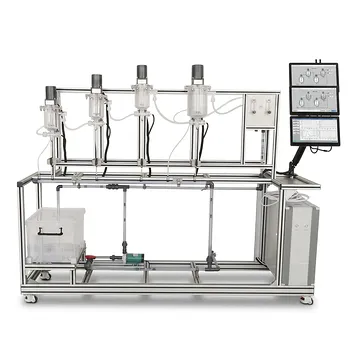
- Multi-Stage Stirred Tanks in Series Residence Time Distribution and Mixing Performance Determination Educational Pilot Plant
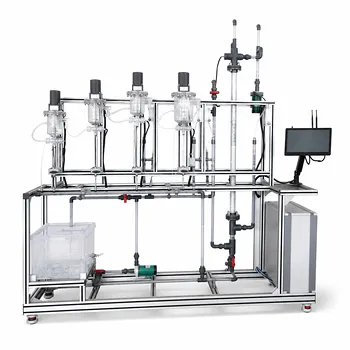
- Multi-Reactor Educational Pilot Plant for Reaction Engineering Unit Operations
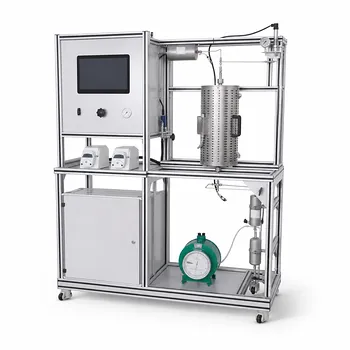
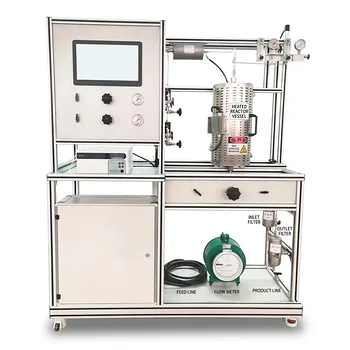
- Multi Functional Catalytic Reaction and Reactor Evaluation Educational Unit Operations Pilot Plant
- Ethylbenzene Dehydrogenation Educational Unit Operations Pilot Plant
- Fluidized Bed Gas Solid Catalytic Reaction Educational Pilot Plant
People Also Ask
- How does MRF model impeller rotation in CFD? Key Boundary Conditions Explained
- How can a CSTR pilot plant demonstrate reactor staging? Visualize volume savings.
- How does steady-state multiplicity affect the operation and safety of exothermic reactions within a CSTR pilot plant? - Guide
- What parameters to monitor transitioning from Batch to CSTR? Master Pilot Plant Setup
- Why is temperature regulation via a cooling jacket a critical feature in CSTR pilot plants used for laboratory training?