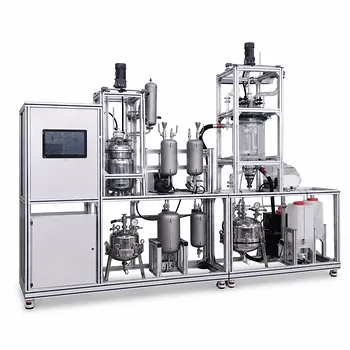
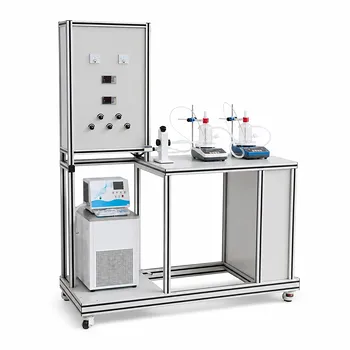
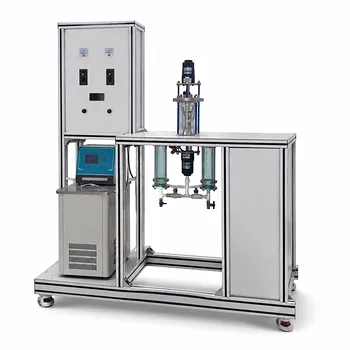
Separation efficiency is not created equal. For identical total solvent consumption, multi-stage counter-current extraction delivers the highest solute recovery—reaching 97.97% in a typical pilot-scale comparison—while a three-stage cross-current scheme achieves only 88.96%, and a single-stage operation falls to 76.47%. This stark gap drives the need for chemical engineering pilot plants to experimentally map the true performance of each mode, validate mass balances, and generate the transfer-unit data that underpins reliable process scale-up.
The definitive insight: Counter-current staging gives you near-complete extraction with the least fresh solvent, because it maintains the strongest driving force from feed inlet to raffinate outlet. Comparing all three modes in a pilot plant transforms extraction from a textbook calculation into a verifiable, scalable decision—teaching operators how to quantify stage efficiency, understand phase stability, and choose the configuration that balances cost, yield, and safety.
The Efficiency Hierarchy Across Extraction Modes
Liquid-liquid extraction performance is not solely a function of solvent chemistry; it is dramatically shaped by how the phases are contacted. The three fundamental contacting modes produce a clear ranking when total solvent volume is held constant.
Single-Stage: Simple, but Solvent-Hungry
A single-stage extraction mixes the entire feed with the entire solvent batch in one vessel. The solute partitions according to the equilibrium distribution coefficient, but the process stops after one contact.
Because the spent raffinate still holds a significant residual solute concentration, achieving high recovery demands a disproportionately large volume of fresh solvent. The primary reference quantifies this: under fixed solvent consumption, single-stage extraction reaches only 76.47% efficiency. This mode is easy to set up and ideal for teaching basic phase equilibrium, but it is economically unviable for deep removal targets.
Cross-Current: Incremental Gains with Staging
Cross-current extraction splits the total solvent volume into multiple portions and contacts the feed sequentially—each stage receives fresh solvent while the raffinate passes forward. This staged refreshment gives fresh driving force at each step, boosting overall recovery.
The improvement is tangible: a three-stage cross-current layout lifts efficiency to 88.96%. However, each new stage demands a separate fresh-solvent stream and a subsequent phase separation step. The law of diminishing returns sets in quickly, and solvent management complexity grows without delivering a step-change in yield.
Counter-Current: The Gold Standard
In counter-current operation, the feed and solvent enter from opposite ends of the contactor. The raffinate leaving the unit contacts the freshest solvent just before exit, while the solute-rich extract leaves at the feed inlet.
This flow profile sustains a high mass transfer driving force throughout the entire system. The result—under exactly the same total solvent usage—is a separation efficiency of 97.97%. The configuration not only maximizes yield but also drastically reduces solvent inventory, lowers downstream distillation costs, and aligns naturally with continuous, large-scale operation.
Why the Efficiency Gap Matters – The Thermodynamic and Economic Driving Force
The superior performance of counter-current flow isn’t just a laboratory curiosity; it is a direct consequence of mass transfer fundamentals that pilot plants are designed to elucidate.
The Mass Transfer Driving Force Advantage
Extraction rate is proportional to the concentration difference between the actual solute level in one phase and its equilibrium value. In single-stage and cross-current modes, this driving force decays as the phases approach equilibrium.
Counter-current staging prevents this decay. The solute-depleted raffinate always encounters fresh solvent, maintaining a large concentration gradient right up to the discharge point. This ensures the extract phase reaches the highest practical solute loading while the raffinate concentration is driven to its minimum.
Experimental Proof of Solvent Economy
The supplementary data highlights an extreme case: moving from multiple single-stage extractions to a three-stage counter-current column can slash solvent requirements by roughly 76% for the same separation target. That magnitude of savings has profound implications for solvent purchase, recovery, and waste disposal. Pilot plants make this gain tangible by allowing side‑by‑side runs where the only variable is flow configuration.
The Role of Pilot Plants: Bridging Theory and Real-World Choice
A chemical engineering unit operations pilot plant is not merely a demonstration tool—it is the proving ground where extraction fundamentals are pressured against real fluid dynamics, equipment constraints, and safety margins.
Verifying Mass Balances and Stage Efficiencies
Textbook stage calculations assume ideal equilibrium stages. Real vessels never reach that perfection. In a pilot plant, operators sample the actual extract and raffinate phases, close the component mass balance, and compute the true stage efficiency. The primary reference emphasizes the measurement of the number of transfer units (N_OR) and height of a transfer unit (H_OR)—parameters that cannot be predicted from theory alone but are essential for sizing columns.
From Ternary Diagrams to Operating Lines
Pilot exercises typically start with partially miscible ternary systems. Students construct the binodal curve on a triangular diagram, locate the feed and solvent points, determine the mixture point from the solvent-to-feed ratio, and find the operating point (Δ) to step off theoretical stages. They then run the physical unit and compare the calculated theoretical stages against the actual physical stages—an exercise that cements the concept of stage efficiency. For completely immiscible systems, simplified X‑Y diagrams and Kremser-type analytical equations provide the same verification pathway.
Proving Phase Stability and Operational Limits
The supplementary material stresses that operating near the unstable region of a ternary system can trigger unforeseen phase homogenization or separation collapse. A pilot plant enables deliberate exploration of this boundary. By manipulating temperature, pH, and flow rates, students learn how to keep the system safely within the two‑phase envelope—a skill that directly transfers to troubleshooting industrial extractors.
Understanding the Trade-offs
Efficiency comes with complexity. The pilot plant comparison must also illuminate the practical concerns of each mode.
- Equipment complexity: Counter-current columns demand precise interface-level control and can suffer from axial backmixing that erodes efficiency. Single-stage batch vessels are far simpler to build and clean.
- Solvent recovery: While counter-current minimizes fresh solvent feed, the extract is more concentrated and may require a higher energy input for downstream solvent regeneration.
- Phase separation challenges: In cross-current and counter-current systems, the liquid‑liquid disengagement must be rapid. Interfacial tension and density difference must remain within a moderate window to prevent emulsion‑formation or excessively slow settling, constraints that can limit solvent choices.
- Start‑up and transient behavior: Continuous counter‑current units require time to reach steady state, whereas a single‑stage batch run provides immediate results—a relevant factor when testing hazardous or expensive materials on a small scale.
Making the Right Choice for Your Pilot Plant Goal
The “best” mode depends entirely on what you are trying to learn or prove. Use the pilot plant to answer these goal-specific questions.
- If your primary focus is understanding extraction fundamentals and phase equilibria: Start with a simple single‑stage batch extraction. It isolates the partition coefficient and lets you practice mass balance closure without equipment dynamics clouding the data.
- If your primary focus is demonstrating the impact of staging on recovery and solvent economy: Run a comparative experiment—single‑stage versus three‑stage cross‑current versus counter‑current—with the same total solvent. The 21‑percentage‑point spread in efficiency will immediately cement the value of process intensification.
- If your primary focus is generating scale‑up data for a production column: Operate a continuously fed counter‑current unit to measure N_OR and H_OR under representative fluid properties. Use that data with your ternary phase diagram to size an industrial column and predict its performance envelope.
- If your primary focus is mapping operational robustness: Deliberately shift temperature or pH to near‑unstable limits in a counter‑current pilot unit and record which variables trigger phase disintegration. This knowledge builds the safe‑operating envelope for future processes.
In every case, the pilot plant transforms extraction from a theoretical abstraction into a mastery of real-phase behavior. The numbers—97.97% versus 76.47%—are not just efficiency percentages; they are proof that how you contact the phases controls whether you merely own a process or you truly control it.
Summary Table:
| Extraction Mode | Separation Efficiency | Key Advantages | Main Trade-offs |
|---|---|---|---|
| Single-Stage | 76.47% | Simple setup; ideal for teaching basic phase equilibrium. | High solvent consumption; lowest solute recovery. |
| Cross-Current | 88.96% | Higher recovery than single-stage; incremental driving force. | Complex solvent management; diminishing returns. |
| Counter-Current | 97.97% | Maximum recovery; saves up to 76% solvent; ideal for scale-up. | High equipment complexity; requires precise interface control. |
Bring Practical Extraction Science to Your Lab with LABPARK
Empower your students and researchers to transition from textbook calculations to real-world process optimization. Contact LABPARK today to discover how our systems can enhance your curriculum and research.
What We Offer:
- Comprehensive Range: Educational and Vocational Unit Operations Pilot Plants in chemical engineering, bioprocess & biotech, and environmental & water treatment.
- Tailored for Excellence: Purpose-built systems for universities, research institutes, and enterprises.
- Hands-on Learning: Equipment designed to accurately measure mass balances, transfer units ($N_{OR}$, $H_{OR}$), and phase stability.
Partner with us to elevate your engineering lab capabilities—request a quote today!
Related Products
- Educational Rotary Disc Liquid-Liquid Extraction Pilot Plant
- Comprehensive Liquid-Liquid Extraction Pilot Plant for Engineering Education
- Gallium and Indium Selective Extraction Educational Pilot Plant
- Ternary Liquid-Liquid Equilibrium Educational Pilot Plant
- Liquid-Liquid Mass Transfer Coefficient Determination Educational Pilot Plant
People Also Ask
- How do density and IFT affect liquid-liquid extraction pilot plants? Optimize Column Performance
- How to Estimate KD for Liquid-Liquid Extraction Pilot Plants Using Henry's Law when Lab Data is Limited
- How to Select a Liquid-Liquid Extraction Pilot Plant with Space Constraints: Key Factors
- In a liquid-liquid extraction pilot plant, how is a ternary-phase diagram utilized to determine solvent feed requirements?
- How to resolve emulsion in liquid-liquid extraction? 5 ways to ensure efficient phase separation