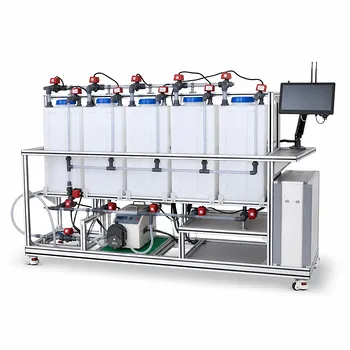
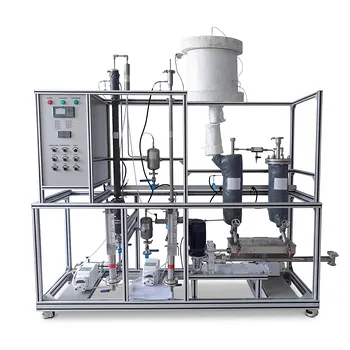
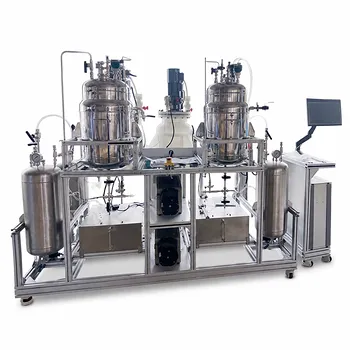
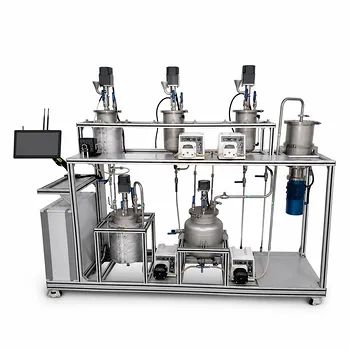
Design factors and flow safety margins are not mere afterthoughts—they directly determine whether an educational chemical engineering pilot plant will deliver safe, instructive, and cost-effective operation. In practice, a typical 10% margin is added to the average process flow rates calculated from material balances. This margin provides operational flexibility, prevents bottlenecks, and accommodates the flow fluctuations intrinsic to student-led experiments. However, to avoid cost overruns and equipment over-sizing, these margins must be meticulously documented, justified, and never allowed to compound unchecked across different subsystems.
A well-configured educational pilot plant balances the need for flexibility and safety with the imperative of cost control. The key is to apply a single, documented system-level margin—commonly 10% for proven processes—and resist the temptation to stack additional “safety factors” on every individual component. For unproven processes, a higher allowance (up to 15%) is required, but the same discipline against cumulative over-design applies.
Why Educational Pilot Plants Need Design Margins
The Inherent Variability of Student Operation
Unlike industrial production lines, educational pilot plants are operated by learners. Flow rates can fluctuate, valves may be left partially open, and experiments often deviate from the nominal recipe. A design margin built into pumps, piping, and sensors ensures these normal variations do not trip alarms, stall unit operations, or create unsafe conditions.
Preserving the Learning Experience
A system that chokes at the first small deviation is useless as a teaching tool. The 10% flow safety margin allows students to explore the operational envelope—for example, intentionally increasing feed rates to study reactor conversion limits—without immediately crashing the process. This flexibility makes the plant a genuine experimental platform rather than a fragile demonstration.
Safeguarding Against Hidden Pressure Drops
In pilot-scale piping, even small changes in tubing length, bends, or fouling can create unexpected pressure drops. A design factor on the flow rate translates into a modest increase in pipe diameter or pump head, absorbing these minor losses and keeping the system within its normal operating window.
The Danger of Cumulative Over-Design
The “Stacking” Problem
The most common pitfall in configuring an educational pilot plant is applying a 10% margin at each design step: 10% extra flow for the reactor sizing, another 10% for the heat exchanger, another 10% for the pump, and so on. The result is a cumulative over-design—a plant that is oversized, more expensive, and less representative of industrial scale. It teaches students the wrong economics.
The Documentation Cure
To prevent this, the primary reference insists that each margin must be clearly documented in the project calculation sheets and explained in the project documentation. Engineers must define a single system-level flow margin (e.g., 10% for a proven process) and then flow down that capacity requirement to all components without multiplying intermediate factors.
Component-Specific vs. System-Level Margins
Some safety factors are mechanical (e.g., corrosion allowance on vessel walls) and must remain independent. However, the process flow margin should be a system-wide parameter. When an equipment vendor adds its own internal factor, the total design flow can inflate silently. Open specification sheets and a clear master calculation model are the only defenses.
Applying Margins to Key Pilot Plant Components
Piping and Pumps
A 10% flow margin typically requires a pump and piping sized for 1.10 times the nominal flow rate. In the small-diameter pipework common in pilot plants (often ½" to 1"), this rarely forces a step change in pipe schedule or pump frame size, keeping costs in check while granting the needed surge capacity.
Sensors and Instrumentation
Flow meters, pressure transmitters, and temperature probes must be ranged so that the margin-bumped maximum flow falls within their optimal accuracy band. An orifice plate or vortex meter sized exactly at nominal flow will lose accuracy or even clip at higher rates. Selecting a slightly wider ranged instrument preserves data quality during student-induced excursions.
Control System I/O Capacity
Field-mounted sensors and actuators require a corresponding margin in the control system hardware. As the supplementary references note, the number of I/O modules should include a safety margin for future sensor additions. A good rule is to specify at least 10–15% spare channels beyond the initial count. This prevents a simple sensor expansion from requiring a new control cabinet or system redesign.
Reactors and Pressure Vessels
Educational pilot reactors often handle non-isothermal or pressurized reactions. The flow margin feeds into residence time calculations, impacting reactor volume. However, the mechanical design (wall thickness, head type, nozzle orientation) must follow pressure vessel codes based on worst-case operating pressure, not flow. These mechanical allowances are safety-critical and kept separate from the process flow margin.
The Role of Process Maturity in Design Allowances
Proven vs. Unproven Processes
Industry guidelines—cited in the supplementary materials—reveal a stark difference in design allowances based on process maturity. A fully proven process warrants only a 3% equipment design allowance, while a new, unproven process demands a 15% allowance. The typical 10% margin mentioned in the primary reference is a reasonable middle ground for educational pilot plants handling relatively well-characterized unit operations.
Academic Research and Vocational Training Context
When the pilot plant is used for novel student research or vocational training on emerging feedstocks, the process itself is unproven. Here, the design allowance must rise toward 15% to account for variability in reaction kinetics, heat transfer coefficients, and separation efficiency. This ensures the plant can accommodate poor yields or unexpected mass balances without safety compromises.
Documenting the Basis for the Margin
Every deviation from a baseline (e.g., choosing 15% over 10%) must be justified in the design basis memorandum. The justification should reference the uncertainty in scale-up data, the lack of steady-state validation, and the educational goal of broad operability. This transparency trains students in industrial-grade design thinking and audit preparedness.
Safety Implications of Design Margins
Chemical Compatibility and Containment
When handling flammable or toxic solvents, the pilot plant configuration must integrate safety systems that are sized for the margin-increased flow. For instance, an overhead condenser on a closed-loop glass reactor must handle the maximum expected vapor load—including the flow margin—to ensure solvent recovery and prevent atmospheric release. Relief valves and rupture discs are similarly sized for the worst credible case, not the nominal case.
Over-Design in Safety Gear: The Right Kind
A control system protecting a hazardous area (e.g., requiring ATEX compliance) needs intrinsic safety barriers and explosion-proof components selected for the maximum anticipated load. Here, a modest margin in field device count and power consumption is not waste—it is a critical layer of protection. The supplementary references highlight that these safety additions (redundant I/O, explosion-proof cabinets) must be integrated from the first draft of the pilot plant configuration.
Thermal Management
Reactive chemicals can generate heat. If the cooling utility flow is designed at the nominal process flow without margin, a small exotherm excursion—common in student experiments—could exceed the heat removal capacity. A flow margin on the utility side (cooling water, chilled brine) provides thermal buffering and prevents runaway temperature rises, especially in batch or semi-batch operations.
Understanding the Trade-offs
Flexibility vs. Cost
A larger margin unquestionably increases flexibility, but every 10% extra capacity raises equipment cost by roughly 8–15% and can inflate utility consumption by a similar proportion. For a budget-constrained teaching lab, a 10% margin may be the sweet spot; pushing to 20% often yields diminishing educational returns while significantly burdening the budget.
Educational Realism vs. Robustness
An over-designed plant is forgiving, but it masks the constraints that make industrial processes economically viable. Students who never see a bottleneck or a capacity limit may develop an unrealistic sense of process dynamics. The most effective educational plants intentionally incorporate some tight margins in non-safety-critical areas (e.g., a slightly undersized pump) so students can genuinely optimize the process.
Control System Complexity
Spare I/O channels future-proof the plant, but an over-specified control system with excessive redundancy and cabinet space wastes lab square footage and complicates maintenance. The margin should be guided by a realistic expansion plan—typically 15% spare I/O is sufficient, not 50%.
Making the Right Choice for Your Educational Goal
Depending on your primary objective, the configuration of design factors and flow margins will shift. Use the following guidelines to focus your pilot plant design:
-
If your primary focus is student safety and chemical compatibility: Apply a 10–15% flow margin to all energy-intensive unit operations, size relief systems for the worst-case margin-bumped condition, and incorporate spare I/O for additional safety sensors. Keep the margins clearly segregated from mechanical safety factors.
-
If your primary focus is budget optimization and industrial representativeness: Enforce a single, documented 10% system-level margin using a master calculation sheet. Avoid margin stacking across components. Select some non-hazardous subsystems where the margin is intentionally kept low to demonstrate real process constraints.
-
If your primary focus is research with unproven processes: Justify a 15% equipment design allowance in your documentation. Size reactors, separators, and utility systems to accommodate the broader variability. This prevents the plant from becoming a bottleneck to novel chemistry and preserves data integrity.
-
If your primary focus is vocational training on standard unit operations: Stick to industry norms—a 3% allowance for proven, well-characterized processes when training on equipment directly mimicking industrial conditions, and a 10% margin only when the curriculum requires frequent start-ups, shutdowns, and troubleshooting.
Empower your students and protect your investment by treating every design margin as a deliberate, documented decision—not a hidden fudge factor. The discipline you build into the configuration of the pilot plant becomes one of the most valuable lessons the plant itself can teach.
Summary Table:
| Process Type / Goal | Recommended Margin | Key Configuration Focus | Avoid Common Pitfalls |
|---|---|---|---|
| Proven Processes | 3% - 10% | Match industrial conditions, keep margins low | Cumulative over-design (margin stacking) |
| Unproven / Research | 10% - 15% | High flexibility for kinetics & heat variations | Insufficient utility cooling capacity |
| Control Systems | 10% - 15% spare I/O | Future-proof cabinet space for sensor additions | Excessive over-specification |
| Safety & Utilities | Sized for worst-case | Separate flow margin from mechanical factors | Undersizing cooling or relief systems |
Optimize Your Lab with Expertly Designed Pilot Plants
Configuring educational pilot plants requires balancing process flexibility, safety margins, and budget constraints. LABPARK provides state-of-the-art Educational and Vocational Unit Operations Pilot Plants in chemical engineering, bioprocess & biotech, and environmental & water treatment tailored for universities, research institutes, and enterprises.
Whether you are training future operators or conducting cutting-edge research, we help you engineer systems that avoid costly over-design while ensuring ultimate safety and educational value.
Ready to design your next pilot plant? Contact LABPARK today to collaborate with our engineering experts!
Related Products
- Multi-Reactor Educational Pilot Plant for Reaction Engineering Unit Operations
- Fixed Bed Gas Solid Catalytic Reaction Educational Pilot Plant
- Multi-Functional Special Distillation Educational Pilot Plant
- Fixed-Bed Chemical Reaction and Gas Dust Tar Removal Unit Operations Pilot Plant
- Carbon Dioxide Hydrogen Methanol Synthesis Educational Unit Operations Pilot Plant
People Also Ask
- How do educational unit operations pilot plants address safety and waste management when scaling up?
- How do educational unit operations pilot plants bridge theory and design? Bridge the Engineering Gap
- Why Compare Predicted and Experimental Excess Enthalpy? Key to Accurate Pilot Plant Scale-up
- How to study gasification in pilot plants? Compare exit gas composition & efficiency
- Why Use PTFE & Hastelloy in Chemical Pilot Plants? Prevent Corrosion & Ensure Safety