The key to teaching petroleum process design is transforming unmanageable complexity into a system you can calculate. In a chemical engineering pilot plant, the concept of pseudocomponents is the bridge that turns a mysterious barrel of crude oil into a predictable set of data. By slicing the complex petroleum mixture into discrete, manageable "cuts" based on boiling point, students can perform the rigorous heat and material balance calculations required to design and simulate equipment like distillation columns.
The fundamental challenge of petroleum processing is that crude oil isn't a neat list of chemicals—it's a continuous mixture of thousands. Pseudocomponents solve this by grouping molecules into a finite number of artificial, pure compounds, each with defined properties. This allows the thermodynamic equations taught in theory to be applied directly to a realistic, hands-on pilot plant operation.
The Fundamental Challenge: Modeling the Un-Modelable
Crude oil contains an astonishing number of individual hydrocarbons. It is practically impossible, even with modern computers, to identify and model every single molecule in a process simulation. Chemical engineering education must overcome this barrier to make petroleum process design teachable.
From Continuous Mixture to Discrete Components
The core strategy is to convert a continuous property—the boiling curve—into a series of discrete steps.
Students begin with a standard laboratory distillation test, such as an ASTM D86 or a True Boiling Point (TBP) analysis. This test generates a curve showing the temperature at which different volume percentages of the oil boil off. The pilot plant’s simulation software, which acts as the brain of the educational unit, uses this curve as its primary input.
Defining the Cuts with the "Pseudocomponent" Concept
The instructor or student then defines a temperature slicing interval, typically 10°F, 15°F, or 20°F.
Every material that boils off within that narrow range is mathematically grouped together. This group is no longer a complex mixture; it is now a single, hypothetical component called a pseudocomponent. The software then calculates this pseudocomponent’s necessary physical properties—its average boiling point, API gravity, and molecular weight—treating it as a known chemical for all subsequent calculations.
The Pilot Plant as a Hands-On Property Lab
Once defined, these pseudocomponents become the active "fluids" flowing through the modular unit operations in the pilot plant. This transforms abstract modeling into a tangible, interactive learning experience.
A Modular, Physical Digital Twin
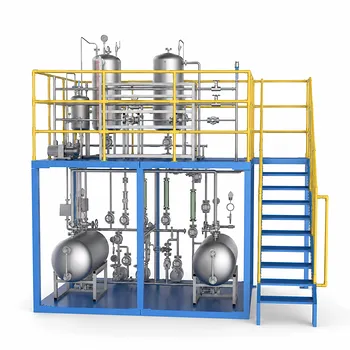
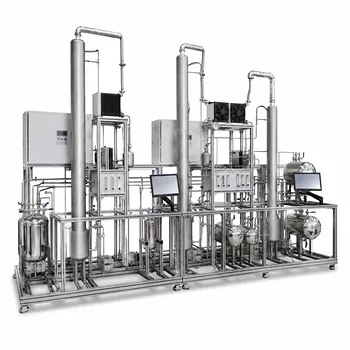
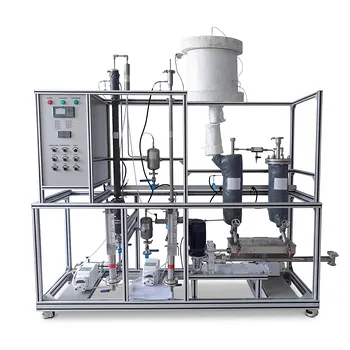
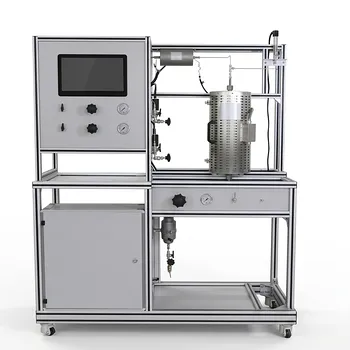
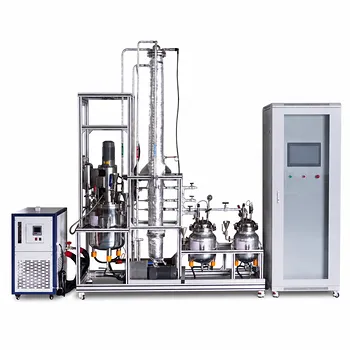
An educational pilot plant is typically a set of interconnected, transparent modules: a feed system, a heater, a distillation column, a condenser, and collection vessels.
When the model of a feed, now composed of its 20 or 30 pseudocomponents, is heated in the pilot plant's reboiler, the system doesn't just heat "oil"—it calculates how each specific pseudocomponent vaporizes. Students can then observe the physical separation happening in the glass column and directly compare the temperature profile they measured against the vapor-liquid equilibrium (VLE) their pseudocomponent-based model predicted.
Bridging Theory and Empirical Reality
This is the critical pedagogical link. A purely computer-based simulation can hide the assumptions and imperfections of a model.
Students run the physical pilot plant, collect real-time temperature, pressure, and flow rate data, and then perform the mass and energy balance calculations by hand or with software. They immediately see the discrepancies between their idealized thermodynamic model and the physical result. This forces them to account for real-world factors—like heat loss to the environment, column fouling, or non-ideal fluid dynamics—that pure simulations often overlook, teaching the crucial skill of empirical model validation.
Understanding the Trade-offs and Educational Pitfalls
The pseudocomponent method, while essential, is a simplification with clear limitations. Effective teaching requires making these trade-offs explicit to avoid creating a false sense of precision.
The Fidelity-Simplicity Balance
The choice of temperature slice width is a direct trade-off. Using very broad 50°F cuts creates a few pseudocomponents, making the model simple and calculations fast. However, this coarseness can lead to significant errors in predicting the separation of key components in a distillation column. Conversely, using ultra-fine 5°F cuts creates dozens of pseudocomponents, greatly increasing model fidelity and accuracy but at the cost of computational complexity and a more cumbersome learning process for a student trying to grasp the fundamentals. A 10°F or 20°F cut often represents the pragmatic educational sweet spot.
The Danger of Disconnected Physical Properties
Simply generating properties from a boiling curve is a form of educated correlation, not a direct measurement of fundamental thermodynamics.
The calculated molecular weight, critical properties, and interaction parameters for a pseudocomponent are estimates. Students can be misled into believing the model's output is "truth" rather than a highly useful approximation. The pilot plant's instructional value is maximized when instructors guide students to question the source of the property data and to conduct sensitivity analyses, observing how a small change in an estimated property propagates through their entire equipment design simulation.
Making the Right Choice for Your Learning or Training Goal
The application of pseudocomponents in a pilot plant can be tailored to serve different educational depths, from vocational training to advanced research.
- If your primary focus is vocational operations and troubleshooting: Emphasize the pilot plant's real-time response to changed operating parameters. Use a pre-built pseudocomponent model of a standard crude and let the focus be on how increasing reflux ratio physically changes product purity in the sight glasses. The model is a tool, not the subject.
- If your primary focus is process design and simulation fundamentals: Make building the pseudocomponent model the core of the exercise. Have students install different thermodynamic fluid packages and witness how this choice, coupled with their boiling point cuts, fundamentally alters the calculated column diameter and heat exchanger duty. The physical plant then becomes the final exam, validating or refuting their design.
- If your primary focus is advanced research and model validation: Use the pilot plant to gather high-precision empirical data to improve the pseudocomponent generation methods themselves. Critically compare the physical vapor-liquid equilibrium data from the pilot-scale column against multiple prediction methods, quantifying the error and analyzing its root cause in the physical property estimation of the pseudocomponents.
By forcing a disciplined definition of a messy problem, the pseudocomponent concept doesn't just teach petroleum processing—it teaches the essential engineering judgment to know when a model is useful and when it is misleading.
Summary Table:
| Training Focus | Role of Pseudocomponent Model | Key Learning Outcome |
|---|---|---|
| Vocational Operations | Pre-built model representing standard crude | Understand physical system response to parameter changes |
| Process Design | Student-built model with 10°F–20°F cut widths | Bridge thermodynamic equations with physical column design |
| Advanced Research | High-precision model compared against empirical data | Validate and refine physical property prediction methods |
Bring Real-World Simulation to Your Lab with LABPARK
Bridge the gap between thermodynamic theory and empirical reality. LABPARK provides state-of-the-art Educational and Vocational Unit Operations Pilot Plants in chemical engineering, bioprocess & biotech, and environmental & water treatment. Designed specifically for universities, research institutes, and enterprises, our modular equipment empowers students and researchers to master complex concepts through hands-on validation.
Ready to upgrade your engineering curriculum? Contact LABPARK today to find the perfect pilot plant solution for your institution!
Related Products
- Multi Pump Fluid Transport Process Piping Unit Operations Training Pilot Plant
- Crude Benzene Hydrogenation Educational Unit Operations Pilot Plant
- Green Anhydrous Ethanol Refining Practical Training Pilot Plant
- Methane Cracking Educational Unit Operations Pilot Plant
- Polymerization Granulation and Pellet Processing Educational Unit Operations Pilot Plant
People Also Ask
- Why distinguish Newtonian & non-Newtonian fluids in pilot plants? Prevent design errors.
- Why is the chemical plant startup schedule crucial? De-risk scale-up with pilot plants.
- When to transition from PID to adaptive control in pilot plants? Key process indicators.
- Why Use PTFE & Hastelloy in Chemical Pilot Plants? Prevent Corrosion & Ensure Safety
- How do deviations in estimating latent heat impact pilot plant thermal systems? Avoid hardware mis-sizing.