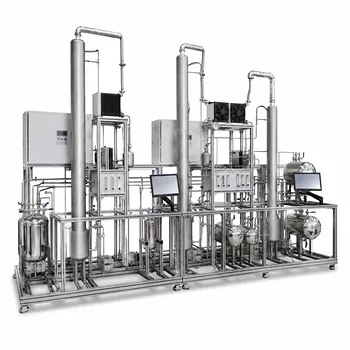
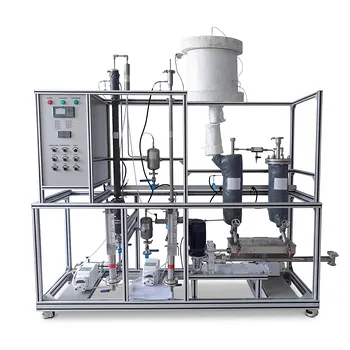
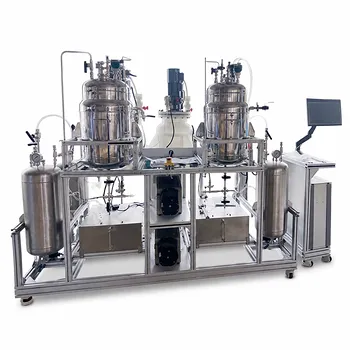
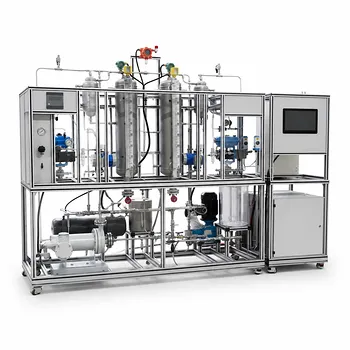
The real power of pilot-scale testing isn't just confirming your chemistry—it’s uncovering the operational and economic realities that decide whether an enzymatic process can truly replace a traditional one at industrial scale. Unit operations pilot plants enable researchers to evaluate and optimize enzymatic processes head‑to‑head with chemical synthesis by running them under authentic production conditions. They deliver the critical, long‑duration data on catalyst lifetime, reaction selectivity, energy consumption, fouling, and recyclability that laboratory flasks and computer simulations simply cannot provide.
Pilot plants transform biocatalysis from a promising lab experiment into an economically defensible industrial choice. They expose the hidden cost drivers—enzyme stability under continuous flow, byproduct accumulation in recycle streams, and purification efficiency—that ultimately determine whether an enzyme can outcompete conventional chemistry in the real world.
Moving Beyond the Lab: Why Bench Data Isn’t Enough
Initial process evaluations often paint an incomplete picture. Unit operations pilot plants address these blind spots by forcing the process to run continuously and realistically.
The Limitation of Early‑Stage Experiments
Lab‑scale reactions typically use pure starting materials, run for short periods, and focus on initial catalyst activity alone. They rarely account for impurity buildup in recycled streams or the gradual deactivation that happens far beyond the first few hours.
During scale‑up, these oversights can become catastrophic. For example, side products that slowly poison an enzyme may never appear in a 24‑hour flask trial but will accumulate to process‑killing levels after days of continuous operation.
The Blind Spots of Computer Simulations
Mathematical models are cost‑effective but fundamentally theoretical. Real‑world phenomena like fluid maldistribution, heat loss through vessel walls, and fouling of heat‑exchange surfaces introduce discrepancies that pure modeling can oversimplify.
Pilot plants physically validate those models. By collecting empirical mass and energy balances, heat transfer coefficients, and kinetic data under controlled yet realistic conditions, researchers can calibrate their simulations and identify where the virtual world diverges from the physical one.
The Pilot Plant Advantage: Direct Comparison Under Real Conditions
Unit operations pilot plants become the ultimate validation platform when you need to compare enzymatic and traditional chemical routes. They let you stress‑test both strategies side‑by‑side.
Side‑by‑Side Assessment of Catalyst Life and Stability
A pilot plant can run closed‑loop, continuous campaigns over days or weeks. This directly reveals the long‑term deactivation profile of an enzyme, such as gradual activity loss or structural breakdown, and contrasts it with the deactivation mechanisms of traditional catalysts (e.g., coking, sintering).
Crucially, the data captures how immobilization methods, enzyme recovery, and regeneration hold up over time. You can measure the true number of productive turnovers and calculate the effective cost per kilogram of product—an unreachable figure from batch flask data.
Precise Control Over Reaction Parameters
Bioreactor systems in pilot plants offer tight, automated control of pH, temperature, and dissolved oxygen. Operating enzymes at their optimal, mild conditions (often 30‑50 °C) can be maintained precisely to maximize selectivity and minimize side reactions.
Researchers can systematically explore mass transfer limitations, substrate inhibition, and yield optimization at a scale where hydrodynamic effects are representative. This directly contrasts with chemical synthesis, where high temperatures and harsh conditions may accelerate reaction rates but blow up purification costs later.
Measuring True Process Efficiency and Environmental Footprint
The pilot plant generates complete mass and energy balances, not theoretical estimates. You can quantify exactly how much waste is avoided because the enzyme’s high selectivity sidesteps byproduct‑heavy workups and multiple purification steps.
This also makes the environmental argument tangible. Data on reduced organic solvent consumption, lower energy for heating/cooling (thanks to mild conditions), and safer chemistries with biodegradable catalysts provides a solid foundation for life‑cycle assessment and regulatory justification.
Unveiling Operational Realities: From Stability to Scheduling
Beyond the reaction itself, pilot plants expose the engineering and logistics that determine the entire process’s viability.
Reactor Fouling and Enzyme Recovery
Continuous operation reveals whether enzymes or their supports cause reactor fouling, pressure drop buildup, or downstream filter blinding. It also tests the practical efficiency of enzyme recovery techniques—like membrane separation or magnetic immobilization—that directly influence raw material costs.
A process that looks clean and perfect in a beaker may rapidly gum up a heat exchanger or a Nutsche filter when run for a week. The pilot plant forces that conversation early.
Identifying Bottlenecks and Cycle Time Optimization
When multiple unit operations—reactors, filters, dryers—are linked in a realistic sequence, researchers can track occupancy and idle times to pinpoint the scheduling bottleneck. This bottleneck dictates the entire plant’s throughput.
Hands‑on experience at pilot scale demonstrates how adding an auxiliary reactor or a buffer tank can shift that constraint, reduce overall cycle time, and optimize capital utilization. It’s a practical lesson in process intensification that no spreadsheet can deliver.
Risk Assessment and Process Validation
Scaling up requires quantifying risk. Pilot plants allow you to deliberately introduce process upsets—temperature spikes, pH drifts, feed composition variability—and observe how the enzymatic system responds. This validates multivariate models and identifies potential failure modes.
The resulting empirical data supports a realistic risk assessment, building confidence for a transition to full‑scale commercial manufacturing without catastrophic surprises.
Understanding the Trade‑offs
Enzymatic processes are powerful, but a pilot plant will expose exactly where the challenges lie. No technology is a silver bullet.
- Mild conditions can hide economic trade‑offs. Enzymes often require larger reactor volumes to compensate for slower kinetics compared to high‑temperature chemical reactions. The capital expenditure (CAPEX) for bigger vessels may offset energy savings—a balance the pilot plant data can quantify.
- Impurities you never saw at lab scale become real threats. Recycle streams may concentrate inhibitors that do not exist in pure starting materials. Pilot campaigns can uncover sudden, unexpected enzyme inhibition or product degradation that kills the process economics.
- Operational complexity increases. Integrating continuous enzyme recovery, immobilization maintenance, or sterile operation adds cost and failure points. If the selectivity advantage does not significantly reduce downstream purification steps, the process may be less attractive than it initially seemed.
- Pilot testing itself is resource‑intensive. Not every enzymatic candidate merits a full pilot campaign. Robust, validated scale‑up models may suffice for well‑known enzyme systems; the pilot should be reserved for processes where the long‑term, interactive effects are unknown.
Making the Right Choice for Your Goal
When you use a unit operations pilot plant to pit an enzymatic route against traditional chemical synthesis, align your study with the core question you need to answer.
- If your primary focus is proving economic viability: Use pilot‑scale data to build accurate CAPEX and OPEX models that capture the true costs of enzyme replacement, recovery, and energy savings. Compare this against the traditional catalytic process’s full lifecycle costs.
- If your primary focus is process safety and sustainability: Leverage the pilot to document the reduction in hazardous waste, lower operating temperatures, and elimination of toxic reagents. These metrics become your strongest case for regulatory approval and ESG commitments.
- If your primary focus is de‑risking scale‑up: Run continuous, closed‑loop campaigns to expose long‑term catalyst stability, impurity buildup, and fouling. The pilot’s failure modes—caught early—will save countless resources versus discovering them at full scale.
Ultimately, the unit operations pilot plant is the objective arbiter that reveals whether an enzymatic process is genuinely ready to replace traditional chemistry—not just on the benchtop, but in the demanding, uninterrupted rhythm of real‑world production.
Summary Table:
| Evaluation Parameter | Enzymatic Processes (Pilot Scale) | Traditional Chemical Synthesis (Pilot Scale) |
|---|---|---|
| Operating Conditions | Mild temperatures (30‑50 °C), precise pH & DO control | Often harsh conditions (high temperature/pressure) |
| Catalyst Stability | Subject to enzyme deactivation, fouling, & recovery limits | Subject to coking, sintering, or chemical poisoning |
| Selectivity & Waste | High selectivity; minimizes byproduct-heavy workups | Lower selectivity; requires complex solvent purification |
| Reactor Sizing | Often requires larger reactor volumes due to slower kinetics | Typically smaller reactor volumes due to faster kinetics |
| Scale-up Risks | Enzyme denaturation, shear stress, and recycle stream buildup | Heat runaways, corrosion, and hazardous waste handling |
Ready to transition your biocatalysis or chemical processes from the laboratory to industrial reality?
LABPARK provides premium Educational and Vocational Unit Operations Pilot Plants in chemical engineering, bioprocess & biotech, and environmental & water treatment. Specifically designed for universities, research institutes, and enterprises, our pilot systems empower researchers to capture crucial long-duration operational data, evaluate catalyst stability, and accurately model process economics.
Stop relying on flask-scale assumptions—contact LABPARK today to design a pilot plant solution tailored to your research goals!
Related Products
- Ethyl Acetate Synthesis Unit Operations Pilot Plant for Practical Training
- Ethylbenzene Dehydrogenation Educational Unit Operations Pilot Plant
- Electrolyte Distillation Purification and Formulation Educational Pilot Plant
- Natural Product Extraction Unit Operations Training Pilot Plant
- Polymerization Granulation and Pellet Processing Educational Unit Operations Pilot Plant
People Also Ask
- How do pilot plants demonstrate esterification? Visualizing Chemical Engineering Equilibrium
- When to transition from PID to adaptive control in pilot plants? Key process indicators.
- Why is the chemical plant startup schedule crucial? De-risk scale-up with pilot plants.
- Why Use PTFE & Hastelloy in Chemical Pilot Plants? Prevent Corrosion & Ensure Safety
- How to study gasification in pilot plants? Compare exit gas composition & efficiency