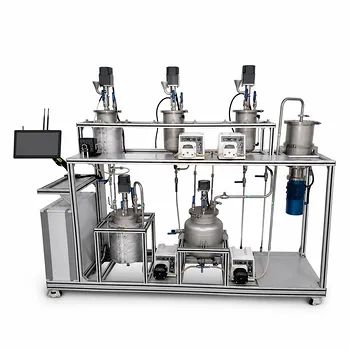
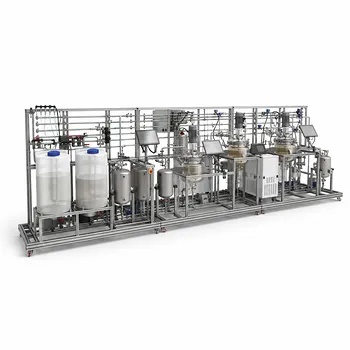
Mass balance equations transform bioprocess pilot plants from simple hardware into powerful, quantitative learning laboratories. Educators use them to teach the dynamic interplay of biomass (X), substrate (S), and product (P) formation. Researchers, in turn, leverage pilot-plant data with these balances to estimate critical kinetic parameters—such as the true biomass energetic yield and maintenance coefficient—and to design feeding strategies that optimize product formation without exceeding mixing or oxygen transfer limits.
The real value lies in using real-time pilot plant data to validate and refine mass balance models, turning abstract equations into tangible process understanding. By confronting students and researchers with complexities like recycle loops and oxygen transfer constraints, mass balances become the definitive bridge between theory and industrial reality.
Why Pilot Plants Are Irreplaceable for Teaching Mass Balances
Pilot plants offer a controlled, physical environment where theoretical equations meet the messiness of real data. This interplay is essential for deep learning.
The Gap Between Simulated and Physical Systems
Software simulations rely on idealized assumptions—perfect mixing, constant yields, and lumped parameters. A pilot plant reveals daily realities: sensor drift, imperfect mixing, and unexpected metabolic shifts.
Only by writing and running a mass balance can a student see how an assumption like “no maintenance requirement” breaks down at low growth rates. The physical system forces them to question and refine their models.
Cementing Concepts Through Experimental Data
Educators can assign experiments where students measure substrate consumption and biomass production over time. By fitting these measurements to the fundamental mass balances, students calculate specific growth rate (μ) and true biomass energetic yield (η_max) themselves.
The act of physically sampling, analyzing, and then solving the equations transforms cryptic Greek letters into concrete, measurable phenomena. This hands-on cycle builds lasting engineering intuition.
The Essential Mass Balance Equations for Biomass and Product Yield
Understanding the core equations is the first step. The real power comes from using them to interpret pilot plant behavior under different operating modes.
The Foundation: Batch, Continuous, and Fed‑Batch Dynamics
The general balance for any component (e.g., biomass X) is Accumulation = Flow In – Flow Out + Formation – Consumption. The beauty lies in how the dilution rate (D) simplifies the equation for different modes.
- Batch mode (D = 0): Volume remains constant, and accumulation equals net reaction rate. This isolates the intrinsic kinetics, perfect for teaching how μ and substrate affinity govern the growth curve.
- Continuous mode (D = F/V, constant): Steady state is reached when D equals μ. This allows precise control of a single growth rate, making it simple to demonstrate the linear relationship between substrate uptake and growth described by the Pirt equation.
- Fed‑batch mode (D = F/V(t)): Volume increases, making the balance a differential equation with a time‑varying term. Educators use this to teach optimized feeding—controlling μ to switch from biomass accumulation to product formation without oxygen limitation.
Extracting Hidden Parameters from Routine Measurements
A pilot plant’s analytical data (off‑gas analysis, glucose concentration, cell dry weight) feeds directly into these balances. A researcher can rearrange the mass balance for substrate to estimate the maintenance coefficient (m_s) and the true maximum yield.
For example, a plot of the specific substrate uptake rate versus μ yields a straight line—slope gives 1/η_max, intercept gives m_s. This simple, data‑driven approach demystifies how these fundamental biological parameters are quantified, directly from an operating pilot plant.
Moving Beyond the Textbook: Confronting Recycle Loops and Model Validation
True educational and research value emerges when mass balances tackle industrial realities—recycle streams and the need for model validation against empirical evidence.
The Complexity of Recycle Loops
Many bioprocesses (e.g., cell retention or solvent recovery) incorporate a recycle loop that returns unreacted material to the bioreactor. The composition of the recycle stream depends on downstream unit operations, creating a circular dependency in the mass balance.
Unlike simple textbook problems, the flowsheet cannot be solved sequentially. Educators use this as a prime opportunity to teach advanced calculation techniques like the “tearing” (iteration) method or solving a set of simultaneous equations. Students physically sample the recycle stream, measure its composition, and then compare their iterative mathematical solutions with real data—turning a computational headache into a powerful lesson in process simulation validation.
Bridging Design and Reality for Researchers
A pilot plant’s greatest value to a researcher is as a truth serum for theoretical models. Initial mass and energy balance designs are built on assumed yield coefficients and heat‑transfer coefficients.
By operating the plant and collecting real‑time empirical data (flow rates, concentrations, temperature profiles), researchers can compute actual performance and compare it directly to their design balances. This allows them to refine their kinetic parameters, adjust for non‑idealities, and build a validated process model that de‑risks scale‑up to industrial production.
Understanding the Trade‑offs and Pitfalls
No tool is perfect. Applying mass balances in a pilot plant requires acknowledging their limitations to avoid misleading conclusions.
- Lumped Parameters Are an Approximation. Using a single μ and constant maintenance coefficient assumes homogeneity. In reality, population heterogeneity and metabolic shift can cause predictions to drift, especially during transient phases.
- Measurement Quality Dictates Model Quality. The balances are only as good as the data fed into them. Small errors in off‑gas analysis or biomass dry‑weight determination can propagate, yielding unrealistic maintenance coefficients or negative yield values. Rigorous sampling protocols are non‑negotiable.
- Mixing and Oxygen Transfer Constraints. A mass balance might suggest a feeding rate that maximizes product yield, but if that rate exceeds the plant’s oxygen transfer capability (kLa), dissolved oxygen crashes. The balance must be coupled with a physical constraints check to be safely actionable.
Making the Right Choice for Your Goal
Leverage pilot-plant mass balances strategically, based on your primary objective.
- If your primary focus is teaching fundamental kinetics: Use a simple batch reactor without recycle loops. Have students measure the growth curve and use the integral form of the mass balance to calculate μ and yield, avoiding the complexity of flow terms.
- If your primary focus is process design and model validation: Introduce a fed‑batch or continuous setup with a recycle loop. Challenge students or researchers to solve the balance using the tearing method and validate their model by comparing calculated recycle compositions against physical samples.
- If your primary focus is maximizing product yield: Use the fed‑batch mass balance to design a dynamic feeding profile. Use the equation to predict the exact point to shift from growth to production, then experimentally validate that the predicted profile remains within the plant’s oxygen transfer limit.
By forcing theory to reconcile with physical data, mass balance equations in a pilot plant do more than model growth—they build the judgment required to operate, scale, and optimize real-world bioprocesses.
Summary Table:
| Operating Mode | Mass Balance Focus | Key Parameters & Applications |
|---|---|---|
| Batch (D = 0) | Accumulation equals net reaction rate | Isolates intrinsic kinetics; determines specific growth rate (μ) and substrate affinity |
| Continuous (D = μ) | Steady-state operation | Establishes linear relationship for substrate uptake; estimates maintenance coefficient ($m_s$) |
| Fed-Batch (D = F/V(t)) | Time-varying volume dynamics | Designs dynamic feeding profiles; shifts cells from growth to product formation phase |
| Recycle Loops | Circular dependency flows | Teaches advanced iteration methods (tearing) and validates process simulation models |
Bridge the Gap Between Theory and Industrial Reality with LABPARK
Applying mass balance equations is most effective when students and researchers can validate their models with real physical data. LABPARK provides premium Educational and Vocational Unit Operations Pilot Plants in chemical engineering, bioprocess & biotech, and environmental & water treatment designed for universities, research institutes, and enterprises.
Our pilot plants empower your lab to:
- Engage Students Hands-On: Turn abstract kinetic equations and recycle loop calculations into concrete, measurable phenomena.
- De-Risk Scale-Up: Allow researchers to refine kinetic parameters, adjust for non-idealities, and validate process models against real-time empirical data.
- Train with Confidence: Prepare the next generation of engineers using industrial-grade components and control systems.
Ready to elevate your department's practical training and research capabilities? Contact LABPARK today to find the perfect pilot plant solution for your institution.
Related Products
- Bio-fermentation Ethanol Production Practical Training Unit Operations Pilot Plant
- Natural Product Extraction Unit Operations Training Pilot Plant
- Continuous Batch Extractive Distillation Educational Pilot Plant
- Electrolyte Distillation Purification and Formulation Educational Pilot Plant
- High-Gravity Emulsification and Mass Transfer Educational Pilot Plant
People Also Ask
- Why Use PTFE & Hastelloy in Chemical Pilot Plants? Prevent Corrosion & Ensure Safety
- Why Compare Predicted and Experimental Excess Enthalpy? Key to Accurate Pilot Plant Scale-up
- Why is the chemical plant startup schedule crucial? De-risk scale-up with pilot plants.
- When to transition from PID to adaptive control in pilot plants? Key process indicators.
- Why must batch and fed-batch fermentation pilot plants be designed to accommodate changing rheological conditions?