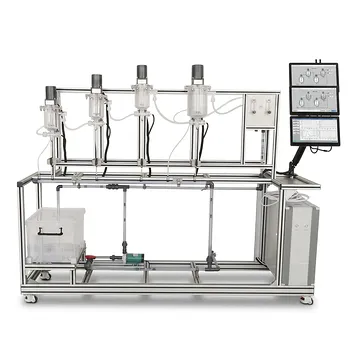
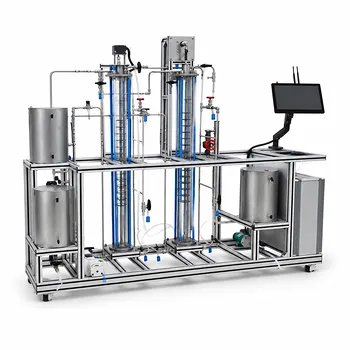
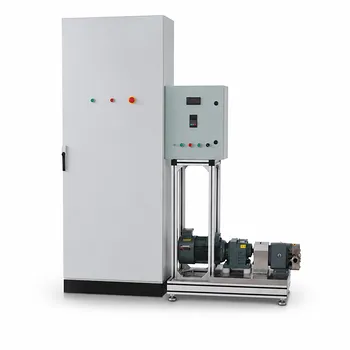
The most direct way to understand the tension between mass transfer and phase disengagement is to see it happen in real time. Educational mixer-settler pilot plants let students systematically vary stirring power and immediately witness the consequences: moderate agitation creates a fine, stable dispersion that drives extraction efficiency, while the slightest over-mixing triggers stubborn emulsions and a flooded settling chamber. By pairing these visual observations with quantitative measurements—residence times, phase volumes, and stage efficiencies—students bridge the gap between idealized design equations and the real-world compromise every extraction process demands.
The core lesson of a mixer-settler pilot plant is that extraction is never a single-variable problem. The same stirring energy that enhances interfacial area also risks forming droplets too small to coalesce. Mastering this balance teaches not just extraction, but the fundamental engineering skill of managing conflicting objectives under physical constraints.
Why the Balance Between Mixing and Separation Exists
The Role of Interfacial Area in Mass Transfer
Liquid-liquid extraction depends on the transfer of a solute from one immiscible phase to another. The rate of this transfer is directly proportional to the interfacial area between the two phases. Without sufficient mixing, the phases stratify, and only a tiny contact area is available, making the process impractically slow.
Moderate agitation, typically characterized by a power per unit volume ($P/V$) around $1\text{ kW/m}^3$, breaks one phase into small droplets dispersed in the other. This dramatically increases the total surface area across which solute can diffuse. In a pilot plant, students can observe this transition from a sluggish, layered pool to a vibrant, milky dispersion, seeing the physical meaning of a larger mass transfer coefficient.
How Droplet Size Dictates Settling
The same physics that creates that dispersion also governs its end. Settling velocities are described by Stokes’ law, which shows tiny droplets settle far slower than large ones. When stirring power is pushed beyond the optimal range, droplet sizes collapse. This excessive breakage can lead to emulsification—a metastable state where droplets are so fine that gravity-driven separation grinds to a halt.
In the settling chamber of a mixer-settler, this failure is instantly visible. Instead of a clean interface, a rag layer forms, organic carries over into the aqueous outlet, and the system cannot achieve steady-state. The pilot plant turns an abstract textbook warning into a compelling, bottle-necked reality.
How a Mixer-Settler Pilot Plant Makes the Invisible Visible
Visualizing the Dispersion and Coalescence Zones
Transparent mixer-settler units are powerful learning tools. Students can directly observe the droplet size distribution inside the mixing chamber and then trace how droplets coalesce along the length of the settling chamber. This direct visualization helps them qualitatively correlate stirring power with dispersion stability—a connection that is hidden inside industrial metal vessels but laid bare at pilot scale.
By adjusting the agitator speed, they see the immediate shift in turbidity and the changing depth of the coalescence band. This gives an intuitive, physical feel for the fact that low interfacial tension systems (where separation is naturally slow) require an even more careful energy input, as the driving force for coalescence is already weak.
Tracking the Rag Layer as a Process Limit
One of the most instructive experiments involves intentionally inducing an emulsion. Students increase stirring intensity in small increments and measure the thickness of the rag layer—a persistent band of mixed, non-separating droplets at the liquid-liquid interface. As the rag layer grows, they can quantify the loss of effective settling volume and calculate the point at which the settler becomes hydraulically overloaded.
This teaches a vital scale-up lesson: industrial processes often operate much closer to emulsification limits than one might assume, and a misjudged change in agitation in a larger vessel can lead to catastrophic phase carryover. The pilot plant becomes a safe sandbox to learn this expensive mistake before it happens in production.
Quantifying the Balance: From Visuals to Design Equations
Connecting Mixing Time to Mixer Volume
The pilot plant allows students to move from qualitative to quantitative. They experimentally determine the required residence time in the mixing chamber ($t_m$) for a desired stage efficiency at a given $P/V$. By knowing the continuous phase flow rate, they then calculate the necessary mixer volume ($V_m$). This bridges the gap between the empirical—finding the mixing speed that avoids a rag layer—and the design equation $V_m = Q \cdot t_m$.
This exercise reveals the direct cost implication: for a slower mass transfer system, the mixer must be larger, and the energy input must be sustained over a longer period. Students see that the balance is not just an operational tweak but a fundamental capital and operational cost driver.
Calculating Settler Volume from Observed Settling Rates
In the settling chamber, the goal is to reduce the dispersion to a clean phase separation within the available residence time ($t_s$). Students measure the settling rate of the dispersion at different agitating powers and use this data to determine the cross-sectional area (and thus volume, $V_s$) needed for the settler.
When they plot $t_s$ against stirring power, a classic bathtub curve emerges: too little mixing leaves large, fast-settling droplets but poor extraction; optimal mixing produces fine droplets that still settle within the design target; excessive mixing creates emulsions with effectively infinite settling time. This graphical representation solidifies the concept of a process optimum and makes the penalty for deviation explicit.
Understanding the Trade-offs and Limitations
The Energy-Efficiency Dilemma
Higher stirring power increases the interfacial area and mass transfer coefficient, potentially reducing the required mixer volume. However, the energy input scales with the power number and speed cubed, meaning a small increase in extraction efficiency can come at a huge electricity cost. In the pilot plant, students can measure the direct electrical load on the agitator motor and compare it against incremental improvements in stage efficiency, confronting the energy-efficiency trade-off head-on.
The Impact of System Physical Properties
The optimal $P/V$ is not universal; it is highly system-dependent. A system with a large density difference and high interfacial tension (like water and toluene) can tolerate much higher energy input before emulsification than a system with near-matched densities and low tension. The pilot plant allows students to test this by swapping solvent systems, showing that a setting that works perfectly for one pair of fluids can immediately cause flooding in another. This teaches that rigid design heuristics fail without understanding the underlying fluid physics.
Axial Mixing and Backmixing
Even within a single mixer, not all fluid elements experience the same residence time. Axial mixing (or backmixing) in the mixing chamber reduces the effective driving force for mass transfer. Students can perform tracer studies on the pilot plant to quantify the residence time distribution and see how deviations from plug-flow behavior erode their theoretically calculated stage efficiency. This reveals that the “balance” is more nuanced: it’s not just about average droplet size, but about the uniformity of the mixing environment itself.
Making the Right Choice for Your Educational Goal
The way you leverage a mixer-settler pilot plant depends on the core concept you want to instill in your students or team.
- If your primary focus is teaching fundamental mass transfer theory: Use the pilot plant to measure the mass transfer coefficient directly. Vary stirring power and show how the coefficient rises and then plateaus as the interfacial area increase competes with increased axial mixing and emulsification.
- If your primary focus is process design and scale-up: Center the lab on quantifying $V_m$ and $V_s$ from residence time measurements. Have students create a design curve that plots both reactor and settler volumes as a function of $P/V$, forcing them to identify the economic optimum.
- If your primary focus is troubleshooting and operational robustness: Deliberately trigger flooding and emulsion formation. Let students measure the rag layer growth rate and practice the operational changes—reducing agitation, adding demulsifier, adjusting interface level—needed to recover a destabilized unit.
- If your primary focus is process intensification: Challenge students to find the absolute lowest energy input that still meets a stage efficiency specification. This flips the objective from “maximum extraction” to “fit-for-purpose performance,” a critical industrial mindset.
A mixer-settler pilot plant is more than a demonstration tool; it is a physical calculator that forces you to confront the non-negotiable trade-off at the heart of all solvent extraction: the very energy that brings phases together must be dissipated, predictably and completely, before they can part.
Summary Table:
| Parameter | Low Stirring Power | High Stirring Power | Optimal Balance |
|---|---|---|---|
| Interfacial Area | Low (stratified phases) | Extremely high (fine droplets) | Moderate (fine dispersion) |
| Mass Transfer Rate | Slow / Impractical | Fast but hard to separate | Efficient & stable |
| Settling Chamber | Rapid separation | Emulsification & flooding | Clean phase separation |
| Key Risk | Poor stage efficiency | Rag layer & carryover | High energy cost (if unoptimized) |
Bring Hands-On Extraction Chemistry to Life with LABPARK
Looking to equip your laboratory with high-performance teaching tools? LABPARK provides premium Educational and Vocational Unit Operations Pilot Plants in chemical engineering, bioprocess & biotech, and environmental & water treatment. Designed specifically for universities, research institutes, and enterprises, our transparent mixer-settler pilot plants help students visualize complex fluid dynamics, master scale-up equations, and bridge the gap between theory and industrial reality.
Ready to upgrade your lab's training capabilities? Contact LABPARK today to request a quote and explore our customized educational pilot plant solutions!
Related Products
- Multi-Stage Stirred Tanks in Series Residence Time Distribution and Mixing Performance Determination Educational Pilot Plant
- Ethyl Acetate Synthesis Unit Operations Pilot Plant for Practical Training
- Natural Product Extraction Unit Operations Training Pilot Plant
- Multi-Functional Drying Educational Unit Operations Pilot Plant
- Multi Pump Fluid Transport Process Piping Unit Operations Training Pilot Plant
People Also Ask
- How does MRF model impeller rotation in CFD? Key Boundary Conditions Explained
- How can a CSTR pilot plant demonstrate reactor staging? Visualize volume savings.
- What parameters to monitor transitioning from Batch to CSTR? Master Pilot Plant Setup
- How does steady-state multiplicity affect the operation and safety of exothermic reactions within a CSTR pilot plant? - Guide
- Why is temperature regulation via a cooling jacket a critical feature in CSTR pilot plants used for laboratory training?