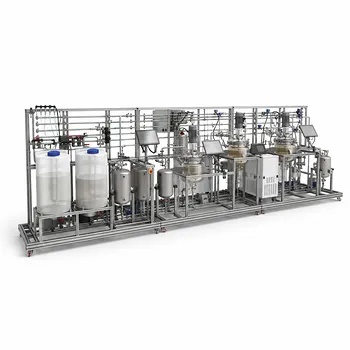
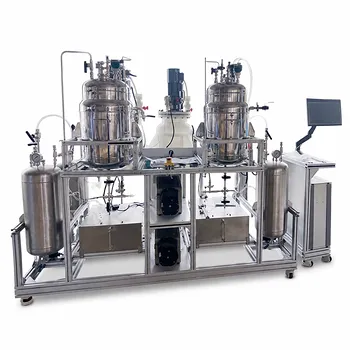
Scaling up a bioprocess is not a simple matter of making a larger vessel. Educational bioprocess pilot plants teach students the principles of bioreactor scale‑up by letting them experimentally verify how key parameters—power‑to‑volume ratio, oxygen transfer rate, and impeller tip speed—change as reactor size increases. By operating pilot‑scale fermenters, students directly observe how geometric similarity and gas sparging designs influence the mass transfer coefficient (k_La) and mixing times, building a hands‑on bridge between laboratory shaker flasks and industrial production vessels.
The core value of an educational pilot plant is that it transforms abstract scaling equations into a tangible, measurable experience. Students learn that successful scale‑up requires balancing multiple interdependent factors—from oxygen delivery and heat removal to shear sensitivity and sterilization efficacy—in a controlled, risk‑tolerant environment.
Experiencing the Realities of Scale‑Up
Manipulating Power, Oxygen, and Shear
At lab scale, mixing and aeration feel effortless. At pilot scale, the same power‑to‑volume ratio can demand dramatically different impeller speeds and tip velocities. Students use pilot‑scale fermenters to maintain a target P/V ratio while directly measuring the oxygen transfer rate (OTR) and dissolved oxygen levels. If impeller tip speed rises too high, they witness shear‑induced cell damage in real time, learning the non‑negotiable balance between bulk mixing power and local shear forces.
Confronting Declining Heat Transfer
As fermenter volume increases, the surface‑area‑to‑volume ratio drops, and passive heat dissipation fails. Pilot plants force students to engage with active cooling—cooling jackets, internal coils, or external heat exchangers—and to correlate heat generation with metabolic activity. They see how a small lab‑scale over‑temperature becomes a runaway thermal event at pilot scale if cooling capacity is not correctly designed, a lesson no textbook can replicate.
Geometric Similarity and Mixing Time
Geometric similarity (matching impeller diameter‑to‑tank ratios, liquid height‑to‑diameter ratios) provides a starting point, but pilot‑scale operation quickly reveals its limits. Students measure mixing time with tracer tests and find that even geometrically similar vessels need adjusted agitation rates because fluid dynamics do not scale linearly. The pilot plant becomes a laboratory for understanding the gap between idealized similarity and real‑world mixing.
Three Paths for Gas Flow Rate Scaling
Scaling aeration from bench to pilot requires deliberate choice. Students evaluate three principles side‑by‑side:
- Equal VVM (volume air per volume liquid per minute) keeps the gas‑to‑liquid ratio constant but can under‑deliver oxygen at height due to pressure effects.
- Equal superficial gas velocity (W_s) maintains bubble rise velocity, preserving flow patterns, but may not supply enough total oxygen if biomass density increases.
- Equal (k_La)‑based scaling focuses on the oxygen transfer rate itself, forcing students to account for increased hydrostatic pressure and bubble coalescence in taller vessels.
Running these regimes experimentally—and correlating them with online oxygen sensors—ingrains the trade‑offs that govern industrial aeration design.
Sterilization: A Thermal Degradation Lesson
Media sterilization at pilot scale often uses continuous thermal processing (e.g., holding at 120 °C or 140 °C). Students can manipulate holding time and temperature while measuring the degradation kinetics of heat‑sensitive nutrients like vitamins B₁ and C. The pilot plant thus teaches optimization: how to maximize cell viability while minimizing nutrient loss, a direct application of reaction engineering that bench‑top autoclaves rarely reveal.
Integrating Downstream and Continuous Operations
Pilot plants are not just reactors; they integrate downstream unit operations—solid‑liquid separation, extraction, and solvent recovery—into a single flow. Students transition a batch biocatalytic conversion (e.g., using immobilized enzymes) to a continuous process, observing how residence time distribution and feed‑back mixing affect product quality and yield. This exposure to equipment integration and process safety mirrors the complexity of a commercial plant.
Process Safety and Fluid Dynamics in a Scaled‑Down Setting
Even in a kilo‑lab or pilot plant (yielding 100 g to 10 kg of product), students face real heat and mass transfer limitations and fluid dynamic anomalies that glassware hides. Real‑time data acquisition systems let them monitor pressure, temperature, and space velocity, reinforcing how a reactor’s geometry and flow regime dictate reaction kinetics and safe operating windows.
Recognizing the Limitations of Pilot‑Scale Training
While pilot plants are powerful educators, they can also mislead if their constraints are not understood.
- Geometric similarity is a guideline, not a guarantee. Maintaining identical aspect ratios does not ensure identical mixing; students must learn to measure and not assume.
- Heat transfer scales differently than mixing. Focusing solely on oxygen transfer while neglecting the cooling duty can create a false sense of success—pilot‑scale fermenters often require dedicated cooling strategies that small glass reactors completely bypass.
- VVM scaling can hide oxygen limitations. At pilot scale, tall liquid columns mean bubbles experience greater hydrostatic pressure and longer residence times, altering (k_La) in ways that constant VVM does not predict. Students who only use VVM may overlook under‑oxygenated zones.
- Sterilization time‑temperature profiles are scale‑dependent. A nutrient‑destruction model calibrated at lab scale may over‑ or under‑predict losses in a larger sterilizer, because thermal penetration and residence time distributions change with geometry.
Awareness of these pitfalls is itself a key learning outcome, preventing blind extrapolation and encouraging a design‑of‑experiments mindset.
Tailoring the Pilot Plant to Your Learning Objectives
The educational pilot plant is not a single lesson; it is a configurable platform. How you use it depends on what you want students to master.
- If your primary focus is mastering fundamental scale‑up parameters: Systematically vary agitation speed and aeration rate while measuring (k_La) and mixing time. Use these data to confirm the safe limits of P/V and impeller tip speed, building a personal, intuitive feel for oxygen‑transfer constraints.
- If your primary focus is process integration and industrial safety: Choose a pilot plant that couples the bioreactor with downstream unit operations (filtration, extraction). Let students manage the heat, sterility, and mass transfer across multiple connected steps, learning to anticipate bottlenecks and failure modes.
- If your primary focus is cost and sustainability: Experiment with switching from batch to continuous operation and vary sterilization hold times to minimize nutrient degradation while maintaining sterility. Quantify raw material waste and energy use as direct performance indicators.
- If your primary focus is bridging biocatalysis from bench to industry: Replicate a single biocatalytic transformation—from enzyme or biocatalyst feed through to automated solid‑liquid separation and extraction—so students experience firsthand how mass transfer limitations and substrate inhibition shift with scale.
Regardless of your specific goal, the hands‑on feedback from a well‑designed educational pilot plant is irreplaceable for building the intuition that separates theoretical knowledge from industrial expertise.
Summary Table:
| Scale-Up Parameter | Lab vs. Pilot Challenge | Key Educational Focus |
|---|---|---|
| Oxygen Transfer (OTR) | Mixing becomes harder; bubbles coalesce | Balancing P/V ratios and impeller shear sensitivity |
| Heat Transfer | Surface-to-volume ratio drops significantly | Operating active cooling systems and thermal control loops |
| Sterilization | Long heating times degrade media | Optimizing holding times to balance sterility and nutrient preservation |
| Mixing Dynamics | Fluid dynamics scale non-linearly | Running tracer tests to measure and analyze real mixing times |
Bring Industrial-Scale Bioprocessing to Your Institution
Ready to elevate your curriculum or research with hands-on scale-up training? LABPARK provides state-of-the-art Educational and Vocational Unit Operations Pilot Plants in chemical engineering, bioprocess & biotech, and environmental & water treatment for universities, research institutes, and enterprises.
Help your students and researchers bridge the gap between laboratory-scale experimentation and real-world industrial production. Contact LABPARK today to request a quote or customize your pilot plant solutions!
Related Products
- Bio-fermentation Ethanol Production Practical Training Unit Operations Pilot Plant
- Natural Product Extraction Unit Operations Training Pilot Plant
- Electrolyte Distillation Purification and Formulation Educational Pilot Plant
- High-Gravity Emulsification and Mass Transfer Educational Pilot Plant
- Continuous Batch Extractive Distillation Educational Pilot Plant
People Also Ask
- Why Use PTFE & Hastelloy in Chemical Pilot Plants? Prevent Corrosion & Ensure Safety
- Why Compare Predicted and Experimental Excess Enthalpy? Key to Accurate Pilot Plant Scale-up
- Why is the chemical plant startup schedule crucial? De-risk scale-up with pilot plants.
- When to transition from PID to adaptive control in pilot plants? Key process indicators.
- Why must batch and fed-batch fermentation pilot plants be designed to accommodate changing rheological conditions?