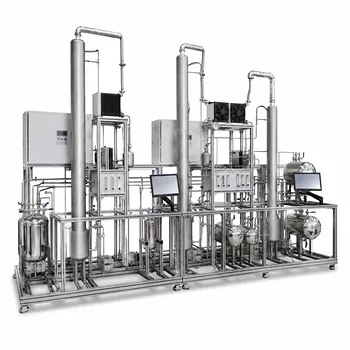
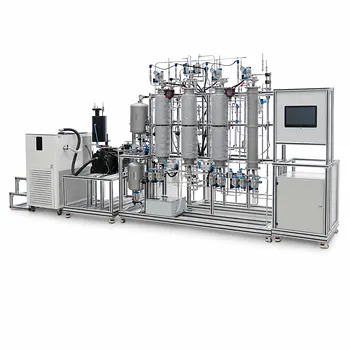
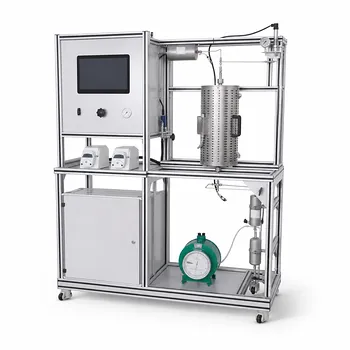
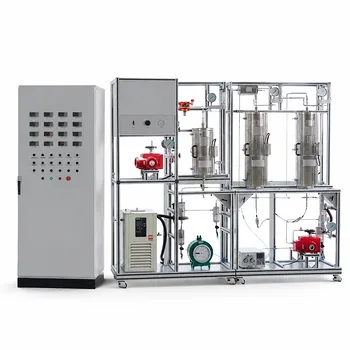
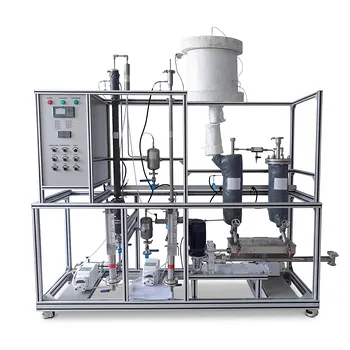
Here’s the blunt truth about teaching impossible separations: chemical engineering unit operations pilot plants make the invisible struggle of ethene/ethane fractionation tangible. By operating a scaled-down distillation column, students and researchers can physically observe tray action, manipulate reflux ratios, measure pressure drops, and calculate stage efficiencies—turning the abstract thermodynamic nightmare of a 100-tray, sub-zero industrial tower into a hands-on, data-rich experiment that prioritizes deep understanding while eliminating catastrophic process risks.
The core value of a pilot plant is not to mimic a full-scale cryogenic cracker, but to isolate the fundamental engineering constraints—tray hydraulics, energy demand, and equilibrium limitations—that make close-boiling separations like ethene/ethane so brutally difficult. It bridges the gap between a clean simulation and the messy reality of a real column.
The Immense Challenge of Close-Boiling Separations
Why Ethene/Ethane Fractionation Is So Difficult
Ethene and ethane are separated by a difference of only 15 degrees in their normal boiling points. This tiny thermodynamic margin forces industrial columns to operate at cryogenic temperatures, often requiring internal conditions below -100°C and pressures that push the limits of material design.
The process demands 80 to 150 actual distillation trays—a column that could be 50 to 90 meters tall—and an enormous reflux ratio to achieve polymer-grade purity. The energy consumption is staggering, and any small disturbance in pressure or composition ripples through the entire system, making control exceptionally challenging.
The Data Deficit in a Classroom
A standard lecture can present the McCabe-Thiele diagram or an Aspen simulation showing 100 stages, but that does not convey the physical reality. Students never feel the column weeping, see the foam building on a tray, or experience the sluggish response of a composition loop. The deep need is to replace the intangible abstraction with a physical intuition for the equipment itself.
The Unique Role of Pilot-Scale Distillation Columns
From Chalkboard Equations to Observable Phenomena
A pilot distillation unit—typically containing 5 to 20 trays in a transparent glass column or a section of industrial-grade stainless steel—puts the physical behavior of the separation on full display. Students can watch how liquid flows down through downcomers, how vapor bubbles through sieve trays, and what happens when the column is operated too close to the flooding point.
This direct observation cements concepts like column hydraulics, downcomer backup, and entrainment that remain abstract in a textbook. It transforms the “why 150 trays?” question from a number into a visceral understanding of stage-by-stage composition change.
Measuring the Critical Parameters
The pilot plant becomes a physical laboratory for the very variables that dictate ethene/ethane separation cost and feasibility. Real-time sensors capture temperature profiles along the column, allowing students to pinpoint the steepest composition gradient and understand the concept of a “pinch.” They can deliberately alter the reflux ratio and immediately see how product purity responds, feeling the law of diminishing returns when each extra unit of purity demands an exponential increase in energy.
By measuring pressure drop per tray and comparing it with theoretical correlations, researchers can calculate tray efficiency directly. This hands-on measurement is critical because it reveals that real trays never achieve a perfect equilibrium stage—a gap that defines the difference between a simulated 100-stage column and a real 150-stage necessity.
Bridging Simulation and Reality
Modern pilot plants integrate process control systems that log data at every step. Engineers can feed these real operating numbers back into their process simulators, tune the Murphree efficiency parameters, and see why a column behaves differently from an idealized model. This feedback loop teaches the single most important lesson for difficult separations: a thermodynamic equilibrium model is only as good as the hydraulic reality it ignores.
Scaling Insights from Other Pilot Plant Operations
Learning from Liquid-Liquid Extraction: Emulsification and Axial Mixing
Difficult separations often share a common enemy: backmixing. In a liquid-liquid extraction pilot plant, the small density difference and low interfacial tension can cause slow phase separation and emulsification. Students visually observe how axial mixing degrades separation efficiency—the same destructive effect that weeping and entrainment have in a distillation column.
This cross-training is invaluable. A researcher who has measured droplet coalescence in an extraction column is far better prepared to diagnose a sudden drop in tray efficiency in a distillation unit. They understand that mass transfer equipment always fights against mixing in the wrong direction.
Azeotropic Distillation and Modular Configurations
The primary reference highlights single-column studies, but supplementary systems teach the next level of complexity. A modular pilot plant that connects multiple distillation columns in series, integrated with decanters for liquid-liquid phase separation, mirrors the process logic of an industrial ethene/ethane fractionation train.
By running an ethanol-water azeotropic distillation with an entrainer, students and researchers learn how to manage coupled mass and energy balances across a sequence of columns, how a small pressure shift or entrainer ratio can break azeotropes, and how to design controls that stabilize an interconnected system. These same principles govern the operation of a demethanizer, deethanizer, and C2 splitter in an olefins plant.
Understanding the Trade-offs and Limitations of Pilot Plants
The Scalability Gap
Pilot-scale columns are small in diameter, often just 50 to 150 millimeters. This changes the fluid dynamics significantly. Wall effects become dominant, and correlations for tray efficiency or pressure drop developed on a pilot column cannot be directly scaled to a 4-meter-diameter industrial tower.
A critical learning objective for students is to understand that the point efficiency measured in a small glass column is not the same as the overall column efficiency at industrial scale. The pilot plant teaches the principle, but the absolute numbers require interpretation through scale-up factors or theoretical models—an essential lesson in engineering judgment.
Safety and Cost vs. Fidelity
True cryogenic operation at -100°C introduces significant safety hazards and material constraints. Most educational pilot plants cannot run a genuine ethene/ethane mixture at cryogenic temperatures in a glass column; the materials and insulation would be prohibitively expensive and dangerous.
The standard pedagogical approach is to use model systems—close-boiling mixtures like n-hexane/n-heptane or methanol/water—that can demonstrate the same thermodynamic difficulty (high reflux ratios, many stages, sensitivity to pressure) while operating safely at ambient or mild conditions. The trade-off is a loss of chemical specificity, but the gain is an unbroken focus on the universal engineering principles behind any difficult distillation.
How to Leverage Pilot Plants for Mastering Complex Distillation
To extract the maximum benefit from a pilot plant for ethene/ethane-like separations, align your experimental plan with your primary objective.
- If your primary focus is understanding thermodynamic limitations: Operate the pilot column at varying reflux ratios and plot the actual separation performance against the theoretical minimum energy demand, so you physically experience the exponential relationship between purity and cost.
- If your primary focus is mastering equipment design: Replace standard trays with different designs (sieve, valve, high-capacity) and deliberately push the column toward flooding and weeping conditions to map the hydraulic operating window and its effect on tray efficiency.
- If your primary focus is bridging simulation and reality: Run the pilot plant under steady-state conditions, collect rigorous temperature and composition profiles, then use the data to calibrate tray efficiencies in a process simulator—explicitly quantifying the gap between ideal equilibrium stages and actual hardware.
The true power of a chemical engineering pilot plant lies not in replicating a massive cryogenic splitter, but in giving you the physical intuition and validated data to anticipate why difficult separations demand extreme solutions—and that is a lesson no textbook can deliver.
Summary Table:
| Parameter / Feature | Classroom Lecture & Simulation | Pilot-Scale Distillation Column |
|---|---|---|
| Hydraulic Observation | Theoretical equations (McCabe-Thiele, Aspen) | Direct view of tray action, weeping, and flooding |
| Data Collection | Idealized equilibrium calculations | Real-time temperature profiles, pressure drops, and efficiency |
| Safety & Cost | Low cost, zero physical risk | Safe operation using model mixtures (e.g., hexane/heptane) |
| Process Control | Instantaneous simulated adjustments | Real-world control loop dynamics and sluggish response times |
| Learning Outcome | Abstract concept retention | Practical engineering intuition and model validation |
Bring Complex Engineering Concepts to Life with LABPARK
Bridge the gap between thermodynamic theory and physical reality in your laboratories. LABPARK provides state-of-the-art Educational and Vocational Unit Operations Pilot Plants in chemical engineering, bioprocess & biotech, and environmental & water treatment.
Designed specifically for universities, research institutes, and enterprises, our pilot systems empower students and researchers to master difficult separation processes through safe, hands-on, and data-rich experimentation.
Ready to elevate your chemical engineering curriculum or research capabilities? Contact LABPARK today to discuss your custom pilot plant requirements!
Related Products
- Ethyl Acetate Synthesis Unit Operations Pilot Plant for Practical Training
- Bio-fermentation Ethanol Production Practical Training Unit Operations Pilot Plant
- Multi-Modal Distillation Unit Operations Training Pilot Plant
- Green Anhydrous Ethanol Refining Practical Training Pilot Plant
- Green Anhydrous Ethanol Purification Extractive Distillation Unit Operations Training Pilot Plant
People Also Ask
- How do pilot plants demonstrate esterification? Visualizing Chemical Engineering Equilibrium
- When to transition from PID to adaptive control in pilot plants? Key process indicators.
- Why is the chemical plant startup schedule crucial? De-risk scale-up with pilot plants.
- Why Use PTFE & Hastelloy in Chemical Pilot Plants? Prevent Corrosion & Ensure Safety
- Why Compare Predicted and Experimental Excess Enthalpy? Key to Accurate Pilot Plant Scale-up