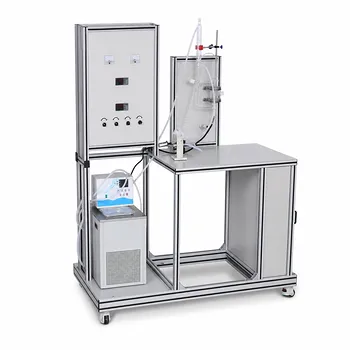
Pilot plants demonstrate the key thermal differences by directly exposing students to the two sequential reactor stages in VCM production. The first is a highly exothermic chlorination where heat is violently released, demanding immediate cooling. The second is a stubbornly endothermic cracking furnace where intense heat must be constantly supplied just to make the reaction proceed. By operating these twin reactors side-by-side, the physical act of managing opposite heat flows turns abstract thermodynamic theory into undeniable practical knowledge.
The VCM synthesis route via ethylene is the ultimate pedagogical tool for thermal engineering because it physically connects a heat-producing step with a heat-consuming one. The pilot plant reveals that "exothermic" means fighting to remove energy to prevent a runaway explosion, while "endothermic" means fighting to pump energy in to prevent the reaction from freezing. Mastering this contrast through process integration is the heart of industrial chemical engineering.
The Twin Reactors: Two Opposing Thermal Challenges
The VCM process is not a single reaction; it is a sequence that forces operators to confront the extremes of chemical thermodynamics in adjacent unit operations. The pilot plant makes these extremes tangible.
Visualizing the Exothermic Release: The Chlorinator
In the first stage, ethylene and chlorine gas combine. This bond formation is fundamentally energy-releasing.
You don't just read about the temperature rising; you watch the cooling system struggle. Thermal runaway is a real-time threat here, not just a textbook footnote. To prevent a safety hazard, the pilot plant’s control system must aggressively circulate coolant through the reactor jacket to strip the excess heat away.
The lesson is immediate: mastering an exothermic reaction means mastering heat removal rates.
Visualizing the Endothermic Demand: The Cracking Furnace
The liquid dichloroethane (EDC) then flows into a second, vastly different reactor. To break the strong chemical bonds and form vinyl chloride, the pilot plant must hit temperatures near 500°C.
Unlike the first stage, there is no self-heating. The moment heat input stops, the reaction effectively stops. Students witness the direct correlation between energy input and conversion rate, learning that controlling an endothermic process is fundamentally about the precision of heat delivery to prevent cold spots and incomplete cracking.
Beyond Observation: Quantifying Heat in Real Time
The visual contrast is only the surface need. The deep need is to quantify these thermal behaviors. The pilot plant’s instrumentation suite transforms qualitative observation into hard engineering data.
Calculating Energy Balances and Heat Transfer Coefficients
By logging the flow rate and temperature delta of the cooling medium in the chlorinator, you can directly calculate the exothermic heat duty. Simultaneously, measuring the power input to the cracking furnace allows you to calculate the endothermic energy demand.
This closing of the energy balance loop is critical. You can then calculate the practical heat transfer coefficient ($U$) of the equipment, a value that theory provides in ideal terms but reality always degrades due to fouling and non-ideal flow. This bridges the gap between a textbook equation and a real functioning unit.
Discovering the Optimum Temperature Trajectory
A more advanced demonstration involves manipulating the cracking reactor’s heater profile. While high heat drives the endothermic reaction forward, secondary coking reactions also accelerate.
By experimentally adjusting the temperature gradient along the reactor tube and measuring the product stream, you can discover the optimum temperature trajectory ($T_{opt}$) for a given conversion. This shows that "more heat" is not always better, even for an endothermic reaction, teaching a non-intuitive but crucial principle of yield optimization.
Understanding the Pitfalls of Theory vs. Reality
A pilot plant’s greatest value is in humbling theoretical models. It demonstrates why industrial design relies on empirical data, not just assumed ideal equilibrium.
The Trap of Equilibrium Assumptions
A simulation might predict a clean 60% conversion in the cracker. The physical pilot plant will often produce less. You will witness firsthand how catalyst deactivation, non-ideal flow patterns, and localized cool spots create a product distribution that deviates from the theoretical yield. This demands that you fit a real reaction rate constant ($k$) to actual data, not just a textbook value, to make a model useful for scale-up.
The Risk of Ignoring Heat Integration
A critical mistake is studying the two reactors in isolation. The main body of the VCM pilot plant connects them. The scorching hot, cracked gas exiting the furnace must be quenched, and this recovered heat can be conceptually integrated back to preheat the EDC feed or run a reboiler.
Ignoring this connection is the classic academic pitfall. The pilot plant forces you to see them as a single thermal system. The energy you fight to remove in step one can, in principle, offset the energy you pay to add in step two.
Making the Right Choice for Your Learning Goal
How you configure and operate the VCM pilot plant depends entirely on whether your focus is on safety, kinetics, or process economics.
- If your primary focus is safe operation: Focus your study on the exothermic chlorinator’s cooling failure scenarios to map the path to thermal runaway and design a properly sized relief system.
- If your primary focus is reaction kinetics: Run the endothermic cracker at multiple steady-state temperatures to generate real-world kinetic data and compare it against the predictions of the Arrhenius equation.
- If your primary focus is process intensification: Use the interconnected unit operations to study pinch analysis and heat integration, quantifying how effectively you can minimize external energy duty for the entire VCM production train.
The VCM pilot plant is not just a piece of equipment; it is a physical argument that heat management is the very definition of a safe, selective, and economical chemical process.
Summary Table:
| Feature | Exothermic Chlorination | Endothermic Cracking |
|---|---|---|
| Thermal Behavior | Releases heat violently | Demands constant heat (~500°C) |
| Control Goal | Aggressive cooling (prevent runaway) | Precise heat input (prevent cold spots) |
| Key Calculation | Cooling jacket heat duty ($U$) | Electrical energy input & kinetics ($k$) |
Bring Industrial Thermodynamics to Life in Your Lab
Bridge the gap between theoretical calculations and hands-on chemical engineering. LABPARK designs and manufactures premium Educational and Vocational Unit Operations Pilot Plants specializing in chemical engineering, bioprocess & biotech, and environmental & water treatment.
We empower universities, research institutes, and enterprises to train future engineers with real-world, instrumented process control systems. Let us help you select the ideal setup for your lab.
Get a Customized Quote from LABPARK
Related Products
- Water Electrolysis Hydrogen Production and Storage Educational Pilot Plant
- Polymerization Granulation and Pellet Processing Educational Unit Operations Pilot Plant
- Fluidized Bed Gas Solid Catalytic Reaction Educational Pilot Plant
- General Purpose Cosmetics Production Unit Operations Training Pilot Plant
- Continuous Batch Extractive Distillation Educational Pilot Plant
People Also Ask
- How do chemical engineering pilot plants demonstrate electrolysis? Bridge Theory & Industrial Scale
- In educational chemical engineering pilot plants, why use absorption and adsorption before reforming?
- How do chemical engineering unit operations pilot plants demonstrate catalytic high-purity hydrogen production from methane?
- SMR, POX, or ATR? Trade-offs in Hydrogen Production Educational Pilot Plants
- What are the core parameters of water electrolysis efficiency? Master them with pilot plants.